Easter One Sunday
†
On Easter Sunday, we discussed the reasons why the Holy Scriptures are trustworthy and reliable. Such dependability is necessary, not only for the Bible to make the claims that it does, but, also, reliability is necessary if we are going to believe the Bible’s claims. We made the case that JESUS’ resurrection from the dead, after three days in Joseph of Arimathea’s tomb, was because of the trustworthiness of JESUS, those who recorded His history, and because of the veracity of the eyewitnesses to the events; many of which gave their lives for the testimony of what they saw, heard, and touched concerning the Word of Life. And of the whole of the written record, I am much encouraged and delighted, that the Anglican Divines, who organized the Proper Readings for Easter Week and the first Sunday after Easter, desire to keep our attention in the awe and power of the moment – which was the first Easter Day. This focus on JESUS’ appearance to His disciples and apostles immediately after His Resurrection aide us in our understanding of how JESUS revealed Himself, what the response was of His followers to Him, and why JESUS did what He did. Now, we would do well, making every effort, to try to put ourselves in the shoes of JESUS’ followers, trying to process things on that Day for the first time, just as they did.
If you recall, very early in the morning on the first day of the week, Mary Magdalene, Joanna, Mary the mother of James the less and Joses, and other women who followed JESUS from Galilee, went to the tomb to anoint the Body with spices and fragrant oils out of honor, love, and respect. Upon arriving at the place where they knew the body had been laid two days earlier, two angels were there, sitting atop the stone, now removed from the tomb’s entrance. They invited the women into the Holy Sepulcher to see where the body of JESUS once lay. Then one of the angels told the women, “Do not be afraid, for I know that you seek JESUS who was crucified. He is not here; for He is risen, as He said” (Matthew 28.5-6). Then the angels instructed the women with the following words: “And go quickly and tell His disciples that He is risen from the dead, and indeed He is going before you into Galilee; there you will see Him. Behold, I have told you” (Matthew 28:7).
At this news, the women turned to obey the angel’s directions and proceeded to Galilee to some heretofore known rendezvous point, while Mary Magdalene, filled with fear and joy, left the group to go to the place where Peter and John were residing. Meanwhile, Saint Matthew tells us that on the way to Galilee, JESUS met the group of women, saying, “‘All hail and rejoice!’ — So, they came and held Him by the feet and worshipped Him” (Matthew 28.9). JESUS then sent them on their way to Galilee, as the angel had instructed.
Meanwhile, Mary made haste to see Peter and John. Finding them, she said, “They have taken away the LORD out of the tomb, and we do not know where they have laid Him” (John 20.2). This, then leads to the humorous but specific detail that John records, in the which, John outran Peter to the tomb. After arriving, they find things just as Mary said. Yet, John had one reaction to the scene and Peter, another. John saw and believed, but Peter, was confused. For the Bible records, “They did not know yet the Scripture, that He must rise again from the dead” (John 20.9). So they went back to their homes, perplexed.
Having made the trek to the tomb twice already, Mary Magdalene stays behind after the two apostles depart. She then looked again within the tomb to see it empty, and then “She turned around and saw JESUS standing there and did not know that it was JESUS. JESUS said to her, ‘Woman, why are you weeping? Whom are you seeking?’ She, supposing Him to be the gardener, said to Him, ‘Sir, if You have carried Him away, tell me where You have laid Him, and I will take Him away.’ JESUS then said to her, ‘Mary!’ [Recognizing His voice], she turned and said to Him, ‘Rabboni!’” (John 20.14-16).
The exciting events of the Day of Resurrection do not stop there. JESUS would then reveal Himself again after walking and talking with two of His disciples on a road out of Jerusalem to a city called Emmaus. After a lengthy discussion about the events of the prior week and the anticipation that JESUS of Nazareth was Israel’s Messiah come to re-establish David’s Kingdom on earth, the traveling party, not recognizing JESUS, takes lunch together. After giving thanks and breaking the bread, the disciples’ eyes, therebefore closed, were opened, and they saw that they had been walking and speaking with the Risen LORD. At that moment, He disappeared before their eyes. Full of excitement, these two disciples, one being called Cleopas, ran back to where the Eleven were residing, and they relayed their story to them. Just as excited, the Eleven inform these two bursting disciples with their own report that JESUS, that same day, had also shown Himself to Peter.
This is the empirical evidence that the apostles, and those that were with them, understood, when we meet them again in today’s Gospel Lesson from Saint John chapter 20. — How were they processing the information, and what did they plan to do with it? — The women would have told them that they held and touched JESUS, and that though He was somehow different, deserving and accepting worship, He was also very much the same. They could cling to Him and hold His feet, and they recognized His voice plainly. Yet, on the contrary, the disciples that met Him on the road to Emmaus would have said JESUS was very different – unrecognizable in fact, in face and voice, that is, until He broke the bread of their Eucharistic Meal, then bodily vanishing. The group now had Moses’ requisite number of eyewitnesses required by the Law (indeed, times four) to verify a matter, but what did the resurrection of JESUS mean? Though seeing Him, talking with Him, and some even touching Him, “still they seem not yet to have understood His Resurrection; to have regarded it rather as an Ascension to Heaven, from which place He then made Himself manifest back on earth in historical time to His followers, rather than as the reappearance of His real Corporeity … What the apostles seemed not to consider was the real import of the appearances of Christ as the women seemed to have grasped, readily. [For the women, JESUS had returned to be with them, and stay with them, evidenced by their taking hold of Him, bodily] … For the apostles, JESUS’ appearance seemed to have been considered as what we might call a spectral appearance. But then, all at once, JESUS stood among them in the place where they had all the doors shut, and He says, ‘Peace be unto you.'”1
At that time, they thought they were now gazing upon a spirit’s appearance. Of Saint Luke’s record of the same event, he writes that when JESUS appeared in their midst, the apostles and others, “were terrified and affrighted, and supposed that they had seen a spirit – [an disembodied essence of the LORD] — JESUS knowing this, said, “Peace be unto you! And when He had said so, He showed them His [corporeal] hands and His side. Then were the disciples glad when they saw the LORD” (John 20.19-20).
JESUS also asked for some fish, that He might share in a meal of thanksgiving, not only to show that He was corporeal and not a spirit, but also to satisfy another concern they had; the one which the women had already resolved. Their resounding internal question was whether they could continue to have fellowship with the LORD, or whether the bond of their fellowship would be broken by His new glorified state. The Eucharistic Meal they shared together shortly dispelled that fear, even though they would have much to learn about their participation in the sacramental Presence of the Christ in the New Testament Paschal Feast, just as all Christian since, have struggled to comprehend.
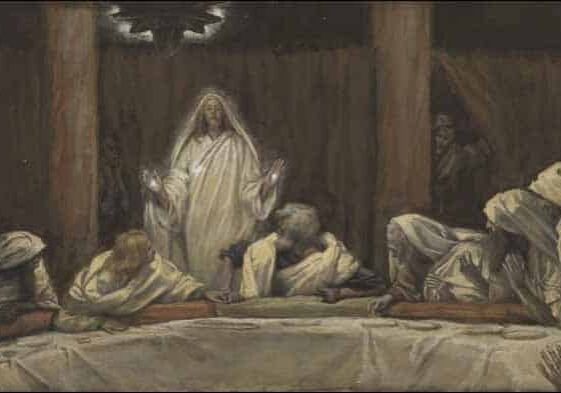
Then, as He had done on the night before He was betrayed, JESUS stood to teach and instruct His followers. Again, He says, “Peace be unto you” (John 20.21). Comments from Matthew Henry underscore the significance of this statement to the troubled and sheltering-in-place disciples. Henry comments that, “This ‘Peace’ was not a word of course, though commonly used so at the meeting of friends and family, but rather, a solemn and uncommon benediction, conferring upon the apostles the blessed fruits and effects of JESUS’ death and resurrection. The phrase was common, but the sense was now divinely peculiar. By Christ’s saying, ‘Peace be unto you,’ with His resurrection glory, it becomes: ‘All good throughout all time and space be to you; all peace always, by all means.’ Christ had left them His peace for their legacy at an earlier time, when again they did not understand Him. As mentioned in John chapter 14:27, JESUS said: “Peace I leave with you; my peace I give unto you; yet not as the world giveth.”
JESUS was not only wishing peace to the apostles in the Upper Room; He was giving it to them. — How could He do this? — Well, the Jewish understanding was that by the death of the testator, the testament was become in-force, and JESUS, through whom all things were create (cf. Col. 3.16), was now risen from the dead, to prove the will of His testament, and to be himself the Executor of it. “Accordingly, He here makes prompt payment of the legacy of the peace He promised to His apostles with these words: ‘Peace be unto you.’ His speaking peace makes divine and transcendental peace that passes all understanding, dividing through space, matter and time, so that those who were once enemies of Christ, would now become His friends again, receiving His divine consolation that the world cannot given – even becoming members of His own family. Christ’s peace spoken and received by the Believer, allow the two parties to become one again. Christ’s peace is not peace with the world, but peace in Christ. [Note, Christians live in two places at once: in the world and in Christ. If we solely live in the world, we have not peace as the world has no consolation to give. Yet if we live in Christ, our consolation is in Him.] … Christ’s words of peace are the significant tokens of the abundant assurance of His Testament of Legacy which He gives to all His people – failing not to be new every morning – new every meeting of the Remnant of Israel.”2
JESUS’ appearance in the Upper Room on the first Day of Resurrection was not only to re-establish fellowship with His followers through His peace and consolation, and to impress upon their faith that He was indeed corporeally resurrected from the dead. It was also to reconstitute and recommission the Twelve to His company. Surely, the apostles were not thinking through the larger strategy of JESUS’ bodily resurrection and appearance, especially as it related to His earthly call to each of them to: “Follow Me!” — We will examine Christ’s strategy and the apostles’ response to it in the readings set apart for us in the Sundays ahead in Eastertide. Yet for now, understand that during the forty-days JESUS spent with His apostles before His Ascension into Heaven, He begins to train them to not only rely upon the empirical evidence that is presented to them through their senses and reason, but also to trust JESUS when He is absent from them, trusting instead in the Gift of the Holy Spirit that He would leave behind. — In so doing, JESUS would fulfill another area of His Testament of Legacy, when He promised: “I will not leave you as orphans; I will come to you” (John 14.18).
Finally, JESUS needed His apostles to retake the authority He had once given them when they were in His company, when He had sent them out two by two. This was necessary, because Christ needed a human Commissionerate, to go in His Name as His missionaries throughout the world, to share His resurrection peace. This time, though, they were going to be commissioned into the name of Him Whose Name was above every name, for He had overcome sin on the Cross and recaptured the Keys of Death when He overcame the Grave. To accomplish this, JESUS breathes His Spirit onto the reconciled Eleven, saying: “As the Father has sent me, I also send you … Receive the Holy Spirit” (John 20.21-22).
Christ’s recommissioning will be better understood by His apostles in the forty-days before Christ JESUS’ Ascension, but what we should point out is that the LORD will not want them to go forth with sword or simitar, making converts by force or economic compulsion. Rather, He calls His apostles to act as He acted, for He sends them as He Himself was sent. And how was JESUS sent? — He tells us: “Most assuredly, I say to you, the Son can do nothing of Himself, but what He sees the Father do; for whatever He does, the Son does in like manner … I can of Myself do nothing. As I hear, I judge; and My judgment is righteous, because I do not seek My own will but the will of the Father who sent Me” (John 5.22,30). — JESUS empowered His apostles with His Holy Spirit, regenerating them with His Life, so that they might “destroy arguments and every lofty opinion raised against the knowledge of GOD, and take every thought captive to obey Christ” (2 Corinthians 10.5 – ESV). Though they did not know or understand it yet, JESUS was preparing them to be able to preach the Gospel to all nations, but especially to their brother and sister Jews. Once they understood these things, they would accomplish JESUS’ Resurrection Commission of reconciliation as read in the Book of the Acts of the Holy Spirit.
Further, in John chapter 20, JESUS empowered His apostles with the gift and discernment to apply His binding and loosing – remitting and retaining sins. Not for their own glory, mind you, but instead, to pronounce GOD’s absolution and forgiveness unto His elect, just as JESUS had done in His earthly ministry in the Name of His Father. They were being the gift of absolution as the Church, not individuals, to give it as Christ had given, or retain it as He had retained.
JESUS’ first encounter with His apostles all together, after His resurrection, was a monumental occasion. Monumental events were the reason they had come together to this point in the first place. JESUS had been arrested without provocation; He had been tried and accused without witnesses; He had been convicted and executed without cause. Yet, one thing that was certain, was that His friends had abandoned Him and His mission for fear and lack of love. Unfortunately, people follow personalities and brands, not ideas. — On the night He was betrayed, JESUS’ brand seemed to plummet, and His friends abandoned Him for the empirical evidence that was in front of them. The Temple guards had come out to arrest Him; the Sanhedrin sought without remorse a way to accuse Him; and Rome was willing to sweep JESUS under the rug of history, though burdened by guilt for doing so. — Again, people follow personalities and brands, not ideas. — JESUS’ idea was clear and clearly stated: “A new commandment I give unto you, that you love one another; as I have loved you, that ye also love one another” (John 13.34). But, of course now, He was the First Fruits of the Resurrection, the Glorified Second Person of the Holy Trinity that could support His ideas in an entirely new Way – His brand had not died – no, it was just being launched.
On the evening of His Resurrection, JESUS came to show His friends His hands and His sides, and though glorified, they would be able to continue to fellowship with and hold Him as they had always done, but in a much more participatory way. They would learn as we are learning that He would now be in them and they in Him. — Yet for now, it was important to GOD to reconstitute His assembly – His society – by speaking onto them His peace – that they would be reconciled to Himself, each other, and the mission of reconciliation He was sending them to fulfill.
Brothers and sisters, JESUS’ peace is not just a word of course, though commonly used as such when we meet together. His peace is true peace when spoken to us in His Name, wherein He confers the blessed fruits and effects of His reconciling death and resurrection upon us. Now that we have the witness and reality of JESUS’ resurrection from the dead by the sure witness of the empirical evidence of the Bible, we need no longer to trust in the peace of the world, but in GOD’s consoling peace in Christ; for He will not leave us as orphans. Therefore, we are to reconstitute and be recommissioned together unto His mission each week, around His Holy Table, by partaking of His Holy Food, which is His Body and Blood. And then we are to go out, as ‘sent ones’, with His mission of reconciliation to the world. And as we will learn in the days ahead from His Holy Scripture, it will not be by our power or by our might that we are successful. Nay, it will be by His Spirit, sayeth the LORD. Until then hear the words of Christ on the night that He reconstituted and recommissioned them that betrayed and abandoned Him when they thought His brand was dead and His ideas passé: “Peace be unto you: as my Father hath sent me, even so I send you” (John 20.21). Amen.
—
1 Edersheim, Rev. A., Life and Times of the Messiah JESUS, (Peabody: Hendrickson Publishers, 1993), 18135-18142.
2 Henry, Matthew. BlueLetterBible.org. “Commentary on John 20.” Accessed 8 April 2026. https://www.blueletterbible.org/Comm/mhc/Jhn/Jhn_020.cfm?a=1017019.

Join Us for Biblical Worship, Study, & Fellowship
Sundays:
Morning Prayer 9:45 am
Coffee & Catechesis 10:30 am
Holy Communion 12:00 pm
Thursdays:
Holy Communion 6:00 pm
Recent Sermons
Easter Sunday
Worship with Us
Join us for Biblical worship, study, and fellowship. We currently meet in the sanctuary of Christ the King Lutheran Church in Waxahachie.
Catechesis for Adults and Children 5+
Sundays at 9:00 am
The Order of Holy Communion
Sundays at 10:30 am
Fellowship Opportunities
See our calendar for other weekly and special events.