Fifth Sunday in Epiphany
† The Gospel of Matthew is called by many biblical commentators, the Summa of JESUS’ parables. It is not because we only find JESUS’ parables in St. Matthew, but because most of the LORD’s parables are found there. In the thirteenth chapter of St. Matthew’s gospel, parables are presented relating to JESUS’ description of what the Kingdom of GOD is like. And it is in this chapter that we find today’s Gospel Lesson.
At the outset, it is important to understand that JESUS tells His disciples the purpose of His parables in this chapter. There He explains that His parables are meant to provoke curiosity in those wanting to learn more about His movement generally, and the Kingdom of GOD, specifically. The meaning of the parables is given or granted, as the LORD says, to those who press in and knock, seek, and ask how to make sense of His teachings. To His disciples, the LORD says, “It has been given to you to know the mysteries of the Kingdom of Heaven, but to the [common man or woman] it has not been given” (13,11). – You see, a parable is like a pecan or a walnut. The fruit of the meaning of the nut is there for the enjoying, but it can only be enjoyed by the diligent. To the lazy or incurious, it cannot be cracked. For Wisdom cries out, sayeth King Solomon, and “All the words of [her] mouth are righteousness; they are plain to him who understands [through observation and discernment], and right to those who find knowledge, [partaking in a diligent search]” (Proverbs 8,8a & 9). In other words, if you want at the nut of a pecan, then you must get cracking – it will not pop-out and land in your hand by simple observation.
Even though diligent in their efforts to crack the meaning of the LORD’s parables, the Apostles did not always understand their significance. – Yet, they were persistent, attending unto Christ, forsaking all they had to follow Him, and pressing Him to understand His common, but enigmatic doctrine. Yet, for the casual goers with hearts unconcerned with the fruit of the nut of divine truth, who came to hear JESUS on irregular occasions, or out of some simple fascination, seeking cultural, political, or religious entertainment, these are described by one commentator in the following manner: “But the carnal hearers that rested in bare hearing, and would not be at pains to look further, nor to ask the meaning of the parables [from the LORD], these would be never the wiser, and so would justly suffer for their remissions.”1
Thus, JESUS attributes Isaiah’s famous summary to these casual ‘hear-ers’ and ‘see-ers’ of His metaphorical stories about the Kingdom of His Father: “And in them the prophecy of Isaiah is fulfilled, which says: ‘Hearing you will hear, and shall not understand, and seeing you will see and not perceive; For the hearts of this people have grown dull. Their ears are hard of hearing, and their eyes they have closed, lest they should see with their eyes and hear with their ears, lest they should understand with their hearts and turn, so that I should heal them’” (13,14-15; cf. Is. 6,9-10).
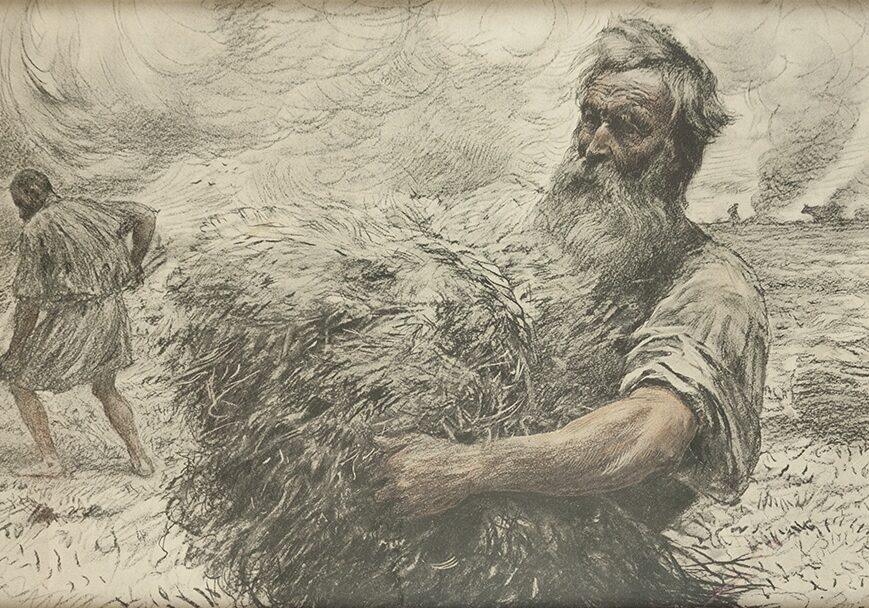
Today’s Gospel Lesson concerns the parable of the wheat and tares, as it is known, and it begins innocently enough. We are told that “The Kingdom of Heaven is like a man who sowed good seed in his field.” — Now, when JESUS speaks about ‘the Kingdom of Heaven,’ He describes how GOD the Father executes His just economy of gracious mercy and judgment for all people while they live on this earth. The divine economy of GOD considerately evaluates every person’s posture towards the Kingdom and the reality of GOD’s Lordship over it. For, as the book of Hebrews states, “it is appointed for men to die once, but after this the judgment” (Hebrews 9,27). This divine judgment is uniquely balanced by GOD’s just outlook towards each human soul, and how they respond to His rule, (or the lack thereof), in their lives, while they live, move, and have their being in His Kingdom.
You see, GOD has the prerogative of judgment and or mercy, because He is the Creator and Redeemer of all mankind, and is by nature, absolute Truth, Beauty, and Goodness. Further, because of the work of salvation of His Representative and Mediator, His beloved Son JESUS, GOD the Father has retaken possession of what was lost in the Garden of Eden by our first parents when they sinned against Him and His perfect created order. As the Book of Revelation tells us, with Christ’s victory over Satan and sin on the Cross, “The kingdoms of this world have become the kingdoms of our LORD and of His Christ, and He shall reign forever and ever! Amen” (Revelation 7,17). – Thus, in this parable under review, (and all parables that JESUS tells about the Kingdom of GOD), JESUS explains the eternal prospects of distinction between those who answer GOD’s call to kneel before Him as King of the Kingdom, and those who do not.
Today’s parable describes how the Landowner (JESUS) sowed some good seed in His field. The seed is the Gospel message of hope, which detailshow all people from every tribe, nation, and tongue, are invited to enter the Kingdom of GOD as His children. – Now, having sown good seed into His field, which is the world, while the Landowner’s tenants were asleep, the enemy of GOD, the devil, came into His field, sowed bad seed and went on his way. He did this knowing that his seed would spring up alongside the good seed as weeds or tares, causing havoc and corruption. JESUS says, “He who sows the good seed is the Son of Man. The field is the world, the good seeds are the sons of the Kingdom, but the tares are the sons of the wicked one. The enemy who sowed them is the devil” (St. Matthew 13,37b-39a).
JESUS wisely uses a parable to communicate this spiritual reality of the Kingdom of GOD, for its truth mimics what happens in the world around us. The Gospel is being preached daily, and many receive it and grow into faithful Christians, like healthy wheat, ripe on the stalk. — On the other hand, another force is at work in the world against the Gospel, and that effort is driven by the evil one, “that old serpent, called the Devil, and Satan, which deceiveth the whole world” (Revelation 12,9). He aims to raise up children of his own, in the Son of Man’s field; children that are not always apparent or distinguishable. – It is interesting that JESUS makes this known, for it is not until certain aspects of the enemy’s seed bud forth, that the sons and daughters of disobedience can be discerned. – Metaphorically, JESUS says it is not until “the blade was sprung up, and brought forth fruit, that the tares appeared [alongside the wheat]” (St. Matthew 13,16). And at this, the Landowner’s laborers are surprised and say: “Sir, did you not sow good seed in your field? How then does it have tares?” (13,27). To this the Landowner responded that it was the work of His enemy. – You see, tares are also called Bearded Darnel, which resemble wheat…to a point. They resemble the good crop of wheat of the Landowner, until the plant puts forth the blade and head with its kernels. At that point, the two plants are very distinguishable – the one full of Kingdom life, and the other full of Kingdom corruption and death. – St. John, writing in his first epistle, reports how these plants, (viz. these different types of people), can be distinguished in the world. He says, “In this the children of God and the children of the devil are manifest: Whoever does not practice righteousness is not of God, nor is he who does not love his brother” (1 John 3,10).
But here is where this parable grows complex, demanding that we, like the Disciples, press in diligently, listening, hearing, and seeing, so that we can come to the morale of this teaching. – The parable grows complex when the Landowner’s laborers suggest uprooting the Bearded Darnel and ridding the field of this corruption. The Landowner says, “No, lest while you gather up the tares you also uproot the wheat with them. Let both grow together until the harvest” (13, 29-30a).
The challenge of interpretation comes when we must assign theological meaning to the word, ‘world’, in this parable. JESUS tells His Disciples that the field of sowing and growing is the world. In Greek, the word for world is kosmos; the same root word for our English word of the same sound and meaning. The cosmos is the universe of ordered creation with the earth as the center of human, cosmological history. – So, with the children of the devil, who do not practice righteousness, and the children of GOD in Christ who do, both living side-by-side in human history, what would be the harm of pulling up the children of the devil now, versus waiting to rid the world of corruption? – Well, the challenge is twofold.
The first reason is that judgment of the wicked is not GOD’s preferential behavior. — As Anglicans hear the priest say in the Morning and Evening Prayer Office: “Almighty GOD, the Father of our LORD JESUS Christ, who desireth not the death of a sinner, but rather that he may turn from his wickedness and live…”2 – The Holy Scriptures are quite clear, GOD is not “an entity above you that would punish you if you do things wrong, and send you into a mental state of shame, guilt, and self-loathing.”3 – That is a lie! GOD is different – He is Father, and He desires a relationship through JESUS Christ, the GOD-Man, with all people. Our Father, desires none to perish, but all to come to everlasting life in Him.
Therefore, GOD stays the hand of those who would root up the children that the devil has sown, because they, like we, can experience the life-transforming power of new creation in relationship with Him, through obedience to His Word and Sacraments. As King David says, “Blessed are those whose lawless deeds are forgiven, and whose sins are covered; Blessed is the man to whom the LORD shall not impute sin” (Romans 4,7-8).
Secondly, the Landowner does not uproot the Bearded Darnel before the wheat because the uprooting, which will happen, is seasonal! The Landowner tells his laborers that the best time to uproot the tares is alongside the wheat, at the harvest. JESUS defines the harvest as “the end of the age” (13,39b). The time to gather the sons of disobedience is while the sons of obedience are being gathered as well…at the Day of the LORD – the time of judgment of this world by GOD and His Christ – ‘the end of the age.’ – The parable about the wheat and tares is about the Parousia, which is the second coming of Christ on the Day of Judgment. And on that day, according to this parable of JESUS, the Bearded Darnel, the sons of the devil, will be rooted out, bundled together and burned, while the wheat, the sons and daughters of GOD, will be gathered into His barn.
It is said that JESUS spoke about no other topic more frequently than the Day of Judgment. Several of those instances are right here in this chapter: Matthew 13. — JESUS did this out of love. He communicated this truth about the world’s end and the judgment of mankind on the Last Day, in the desire that all who hear Him, and are burdened, tired, frustrated, disappointed, bored, neglected, and lost, will come to Him who promises rest and purpose for their souls, before the end. – Out of divine love, JESUS describes the Day of the Harvest to us in images that we can understand, and that are not watered down; to do otherwise would be unloving. For even in the face of this stark reality, which seems terrifying and daunting, the LORD JESUS says, “These things I have spoken unto you, that in me ye might have peace. In the world ye shall have tribulation: but be of good cheer; I have overcome the world” (St. John 16,33).
For those Bearded Darnel, their destiny is set, and they should fear, though I am afraid many do not. – Perhaps there is still time for us, by our lives and doctrine, to save some of them. – I hope we can. I hope we will try, with GOD’s help. For it is of a truth, that “the grace of GOD’s forgiveness affords pardon for offenses past, change of life in the present, and strength for obedience and service in the future.”4 – In fact, this is our calling and mission before the Day of Harvest. As the Church of GOD, elect and glorious, the hymn writer has told us: “GOD has called us out of darkness, into His most marvelous light; brought His truth of life within us – turned our blindness into sight. We must then let our light so shine around us, that GOD’s name is glorified, so all find fresh hope and purpose, in Christ JESUS Crucified.”5
After thirty years of ministry, I hate to say that most tares will not be mollified, even with the blessed hope of GOD’s Gospel – their roots are too deep in the world. – And yet, I believe this is the hope for the Church today meant by this parable of JESUS about the Kingdom of GOD. If you are wheat in the LORD, do not be discouraged by the deep roots of the tares that surround you. All will be well! We need only to keep growing in response to The Gardner’s fine pruning and fertilizing of us by His Word and Sacrament. JESUS says, “To those who overcome, I will grant them to sit with Me on My throne, as I also overcame and sat down with My Father on His Throne” (Revelation 3,21). – To be wheat in the Kingdom of GOD, is to be a beneficiary of an inheritance – the inheritance of hope of the Most-Blessed.
And that hope is this – ‘to be gathered into the Landowner’s barn’ at the end of the age. – The privilege is not for sons of disobedience, but for sons and daughters of obedience, full of faith, and meekness. — Meekness, as the Bible defines it, “is a highly esteemed quality, reflecting the character of Christ Himself. It is associated with a deep trust in GOD and a commitment to His ways, even in the face of adversity.”6 And to the meek, JESUS promised the inheritance of the earth on the Last Day. (cf. Matt. 5,5).
In the parable of the wheat and tares, JESUS has given His Disciples something significant to hope for, and that is the certainty of justice, truth, and the promised inheritance of His meek saints. The righteous in Christ, the meek, the sons and daughters of obedience, we shall inherit the new heavens and the new earth, sitting as kings and queens, with the King of kings, on His Throne. On the Day of Harvest, brothers and sisters, we shall be gathered into the Landowner’s barn. And in a world fraught with daily tension about wars and rumors of wars — this should speak great peace into our lives. For, “it is a righteous thing with GOD to repay with tribulation those who trouble you, and to give you who are troubled rest with us when the LORD JESUS is revealed from Heaven with His mighty angels, in flaming fire, taking vengeance on those who do not know GOD, and on those who do not obey the Gospel of our LORD JESUS Christ. These shall be punished with everlasting destruction from the presence of the LORD and from the glory of His power, when He comes, in that Day, to be glorified in His saints and to be admired among all those who believe, because our testimony among you was believed” (2 Thessalonians 1,3-10).
‘The Kingdom of Heaven is like a man who sowed good seed in his field … He who has ears to hear, let him hear! – In the Name of GOD the Father, GOD the Son, and GOD the Holy Ghost. Amen.
1 Henry, Matthew. BlueLetterBible.org. “fn. On Matthew 13,11”. Accessed 4 February 2025. https://www.blueletterbible.org/Comm/mhc/Mat/Mat_013.cfm?a=942011
2 1918 Book of Common Prayer, pg. 7
3 “Ayaan Hirisi Ali on the Threat to the West.” Secrets of Statecraft with Andrew Roberts, Hoover Institution, www.hoover.org. Accessed 7 February 2025.
4 Sheppard Jr., Massey Hamilton, The Oxford American Prayer Book Commentary, (New York : Oxford, 1950), 25.
5 The Book of Common Praise, “Church of GOD, elect and glorious”, (Newport Beach: Anglican House Media Ministry Inc., 2017), 493.
6 BibleHub.com. “Strong’s Lexicon definition for meek (πραΰς)”. Accessed 8 February 2025. https://biblehub.com/greek/4239.htm

Join Us for Biblical Worship, Study, & Fellowship
Sundays:
Coffee and Fellowship 8:30 am
Catechesis for all ages 9:00 am
Holy Communion 10:30 am
Recent Sermons

Trinity Twenty Sunday
Worship with Us
Join us for Biblical worship, study, and fellowship. We currently meet in the sanctuary of Christ the King Lutheran Church in Waxahachie.
Catechesis for Adults and Children 5+
Sundays at 9:00 am
The Order of Holy Communion
Sundays at 10:30 am
Fellowship Opportunities
See our calendar for other weekly and special events.