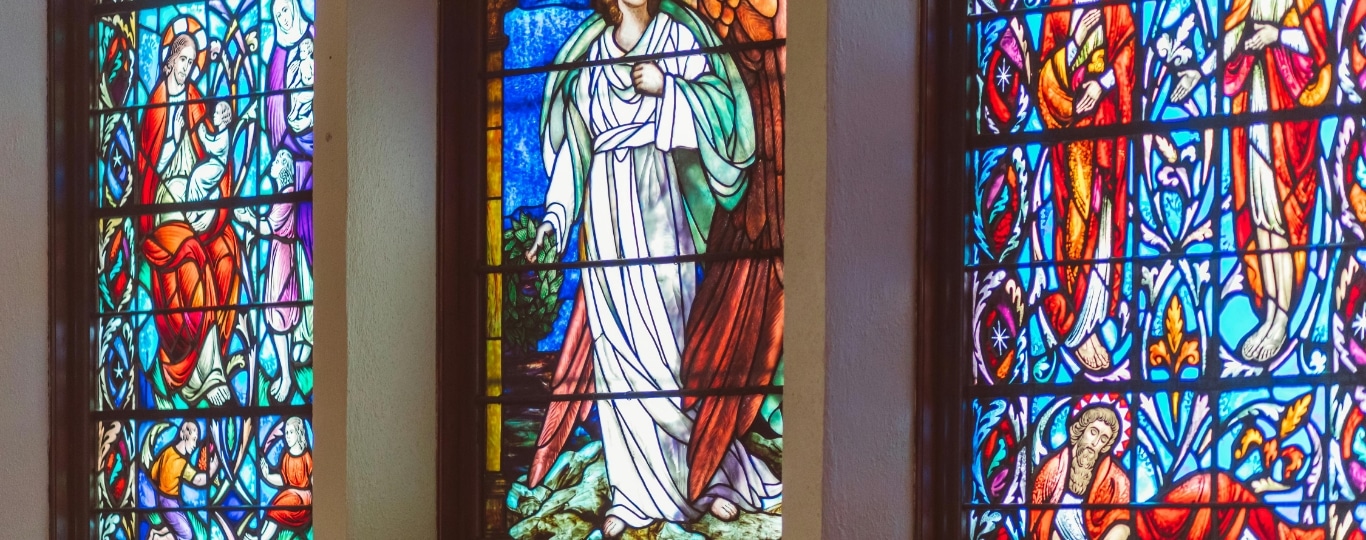
Fourth Sunday in Advent
†
It seems to me that for the whole of this Advent-tide, we have had the Blessed John the Baptist, either indirectly in the shadows impressing upon us, or directly, speaking into our ears, the hope of this Season. And that hope is this: ‘Repent ye and prepare, for Christ has come, and He will come again.’ We are told in the Scriptures on Advent One that John, sent in the spirit, character, and energy of Elijah, will “turn the hearts of the fathers to the children, and the hearts of the children to their fathers” (Malachi 4.6), that they may be ready when the Messiah comes. Besides John’s words, there were many signs of the coming Messianic Age. One of those miracles was the birth of John, himself, to the aged Elizabeth, who was beyond childbearing years. Upon his birth, John’s father, a priest of Israel named Zacharias, prophesied about this miracle baby, saying he would be the forerunner to the Christ. He said: “And you, child, will be called the prophet of the Highest; for you will go before the face of the LORD to prepare His ways, to give knowledge of salvation to His people by the remission of their sins…” (St. Luke 1.76-77). — And once the Messiah did arrive, another man of GOD, Simeon, took up another prophecy concerning this Child, JESUS. Simeon said: “For my eyes have seen Your salvation which You have prepared before the face of all peoples, a light to bring revelation to the Gentiles, and the glory of Your people Israel” (St. Luke 2.30-32). — John the forerunner to the Christ, and JESUS the Christ born into the world. We have been considering all these things this Advent-tide and wondering when Christ will come again. — Thus, on this Sunday before Christmas, I think it would be appropriate to consider again why Christ had to come in the first place, and why the Church, with such hopeful expectation, prepares anxiously for His return.
Before we recall why He came, let us recount how the Messiah came, as the Holy Scriptures say: ‘among us.’ — How? — Well, He came through the Virgin Mary by the overshadowing, preternatural power of GOD. GOD’s power rested on Mary in the Person of the Holy Spirit, the Bible says. And by His overshadowing power, the Spirit caused the blessed Virgin to bear a Child, whom she called (as instructed), JESUS, the Son of the Highest. JESUS, born of GOD and of man – the GOD-Man, if you will. For, it was necessary that the Messiah should come as both Divine and Mortal, not only to fulfill the most ancient prophesies foretold about Him, but also to sanctify the human condition in all that JESUS would experience in His earthly life. — As Divine, the Seed of the Woman would crush the curse embraced by our first parents, Adam and Eve. As GOD foreordained, the Seed of the woman would stomp the head of the prince of death, “that ancient serpent called the devil, or Satan, who leads the whole world astray” (Revelation 12.9). By taking on flesh, the Son of GOD, who is the Word, the Second Person of the Holy Trinity, could also adopt the role and title reserved for Him when He was still in the loins of David: the Christ and King of Israel. JESUS, the Son of GOD and the Son of Man, He is the one whom GOD described to David as, “Your seed after you, who will come from your body. I will establish his kingdom, and He shall build a house for My name, and I will establish the throne of his kingdom forever. I will be his Father, and he shall be My son … And your house and your kingdom, [in Him], shall be established forever before you. Your throne shall be established forever” (2 Samuel 7.12-14a & 16).
“We are taught in the Scriptures that our LORD and Savior, JESUS Christ, possessed two natures: of His manhood, perfect man, and of His Godhead, perfect GOD. It is written (in the Bible) that The Word became flesh and dwelt among us (John 1.14). And dwelling among us and being sent of GOD in the similitude of sinful flesh, JESUS fulfilled those things which the law could not (Rom. 8.3). Christ, being in the form of GOD, took on Him the form of a servant and was made like unto man, being found in shape as man (Phil. 2.6-8). The Apostle Paul testifies that GOD was showed in the flesh, justified in the Spirit, seen of angels, preached to the Gentiles, believed on in the world, and received up in glory (1 Tim. 3.16) … These be plain places in Holy Scripture for proof and declaration of both natures, divine and human, united and knit in one Christ.”1 — It is glorious and comforting to know how JESUS came – among us; that as the GOD-Man, JESUS “sat by our hearths, walked through our corn fields, was seen in markets and labor houses, attended our weddings, mourned at our funerals, and did works of wonder at both. ‘Among us’ – is it not wonderful how much two little words may convey?”2 GOD in Christ was one of us, yet without sin, a most important truth, for this point addresses why He came down from Heaven to dwell ‘among us’.
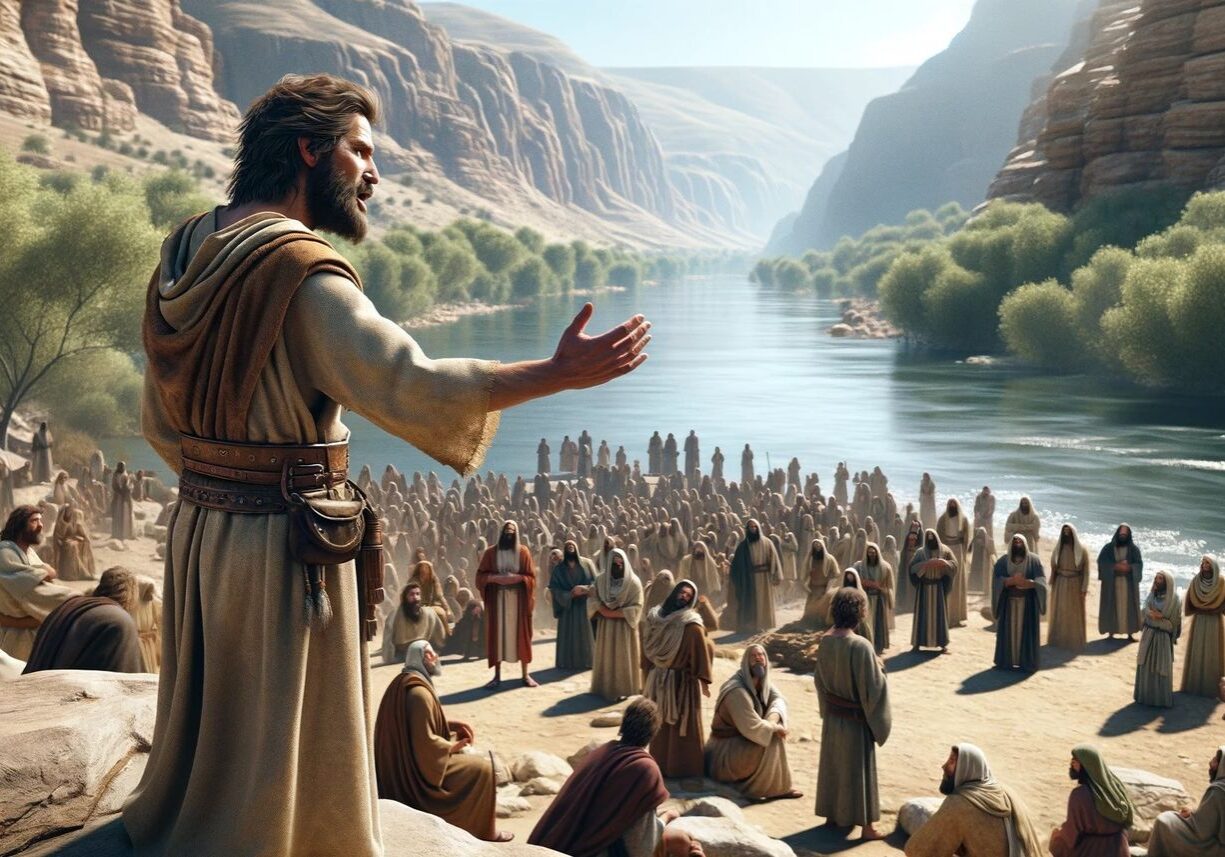
Since JESUS came as the Son of GOD and the Son of Man, St. John the Baptist was able to say of JESUS, “there standeth one among you … he it is, who coming after me, is preferred before me, whose shoes’ latchet I am not unworthy to unloose” (St. John 1.27). A group of Pharisees had come out to John, on the other side of the Jordan, to find out why he was baptizing Jews. You see, baptism in those days was reserved for Gentile converts to Judaism. Gentiles were seen as unclean because of the habits they kept the food they ate, and the gods they worshipped. If they were going to become part of the family of Abraham, Isaac, and Jacob, they needed to have a bath. This washing was a spiritual cleansing, shadowed by the washing of water, of the filth of impurity, both physical and spiritual. This was good and necessary if these Gentiles were going to be born again into Israel. And yet, here was John, baptizing Hebrews, the ‘chosen race’ of Abraham. He did so, he said, in preparation, as Zachariah had earlier prophesied, to prepare the people for the visitation of the Dayspring from on High, who would bring salvation to His people through the remission/forgiveness of their sins. The righteousness that comes by the Law of Moses that the Jews had been attempting to fulfill for 1,500 years was not working. The Law was righteous, but no man could keep it perfectly. Thus, it would take the GOD-Man to fulfill the Law, so that those who would be born into His family might be free from blame or punishment for sin before GOD. John’s baptism was a preparation of the Jewish people for the reception of Christ; a pre-washing, if you will, of intentionality to follow the Coming-One, the Messiah. The Messiah, JESUS, it was He who would take away the sins of the world by washing people’s souls with His Spirit. John said, “I baptize you with water. But one who is more powerful than I will come… He will baptize you with the Holy Spirit and fire” (St. Luke 3.16). The Messiah’s/Christ’s baptism is by the Spirit, and that baptism leads to new life for those who are born of the will of GOD, who believe in Him, and who receive His grace freely. Christ JESUS’ baptism of fire is reserved for the judgment of those born of the will of men, who reject JESUS, and who would prefer to pay for their own sins.
That the Word came down from Heaven and took on human flesh, being born of the Seed of GOD the Father through the womb of the mortal and most blessed Virgin, and to baptize with the Spirit and with Fire as John the Baptist proclaimed, begins to tell the story of Christ’s coming, but not in its totality. You see, JESUS also lived a life above reproach and without sin. He did so, not only that He might be referred to as ‘good teacher’ and ‘Rabbi,’ but also that He might offer His life as payment as a ransom for mankind’s universal sin against GOD’s law and truth. But friends, the Good News of JESUS Christ, His Gospel, would only still be partly told if we were to conclude our exposition here. — Though it is a great truth, and a most blessed message for all who would hear it, and in hearing it, believe it. Yet, lest we cheapen the measure of grace that we have been given by the mercy of GOD, then we cannot neglect discussing what Christ laid His perfect, divine life down to accomplish. — Yes, we have already said that He did it to remit or forgive the sins of all men willing to put their trust and faith in Him, but it would be criminal not to mention the cost JESUS paid to achieve this victory over death and sin for us.
As it concerns His divinity, JESUS laid it down at the foot of the Cross to please the will of the Father. JESUS “did not consider it robbery to be equal with God, but made Himself of no reputation, taking the form of a bondservant, and coming in the likeness of men. And being found in appearance as a man, He humbled Himself and became obedient to the point of death, even the death of the cross” (Philippians 2.6-8). “It pleased JESUS to deliver Himself of all His goodly honor, which He was equally endowed with, along with His Father in Heaven, and to come down into this vale of misery, to be made a mortal man, and to be in a state of a most low servant, serving us for our spiritual wealth and eternal profit. Us, I say, who were His sworn enemies, who had renounced His Holy Law and Commandments, and followed the lusts and sinful pleasures of our corrupt, fallen, and selfish nature. [And as the Holy Scriptures say, ‘while we were yet sinners, Christ died for us.’] Christ put Himself between us and GOD’s deserved wrath of our sin, and rent that obligation, wherein we were in danger of owing GOD, and paid the debt of our sin for us, [nailing it to His Cross, once and for all.] For without the payment of His own flesh and blood, GOD the Father could never have been at one with us. Neither was it possible to be loosed from the debt of our sins by our own ability.”3 It pleased Him, JESUS, therefore, to be the answer to our prayer: “O wretched man that I am! Who will deliver me from this body of death?” (Romans 7.24). It was Christ JESUS who did this at His first advent, when He came down from Heaven to earth, “preaching peace to those who were afar off (the Gentiles) and to those who were near (the Jews). For through Him, we both have access by one Spirit to the Father” (Ephesians 2.17-18). Estranged children, once, we, now, by faith in His Passion and Resurrection, have His victory over sin and death, being given a seat at His table as newly adopted sons and daughters of GOD.
This is how and why JESUS came. And now, with these things in consideration, which of us could possibly “consider the grievous debt of sin, which could none otherwise be paid, but by the death of this GOD-MAN, and will not, now, hate sin with all his or her heart? If GOD hated sin so much that He would allow neither man nor angel for our redemption, but only the death of His only Begotten and well-beloved Son … how could any man love sin and hate GOD? No man can say that he loves GOD and His Christ, truly, and have their great enemy, which is sin, as a familiar friend and commonplace confidant. [Brothers and sisters,] so much do we love GOD and Christ JESUS, as we hate sin.”4 This is the outcome of the how and why of Christ JESUS’ first advent, or at least it should be, which brings us to why the Church looks so expectantly and hopefully for JESUS’ promised return, a second time.
We now look with great expectancy, setting aside a whole month to prepare our hearts, minds, and even our lives, for the hope promised to us – that JESUS will come again in His glory. — Why? Well, the answer is revealed in the Collect for the Fourth Sunday in Advent: “We are sore let and hindered in running the race that is set before us.”5 — Though JESUS Christ took on our flesh and defeated sin and death, becoming like us, so that He might make us like Himself, sons and daughters of GOD, in this life, we must still wrestle with the corrupt weight of our flesh. Though He stomped the serpent’s head and dispelled the eternal darkness of the world’s spiritual winter, being the Dayspring from on high, we must still endure the many temptations that the devil and those systems of this world, which hate GOD, direct against us. In this life, we must persevere in the Faith, learning obedience as JESUS Himself did. We must learn to retreat from the passions of our own desires, all the while hating sin and seeking instead to follow GOD’s will and purposes. But we are not perfect, yet. In this life, we, the people of Abraham’s faith, still stumble, trip, and fall.
As our Collect rightly points out, because of our insatiable desire to return to our sins and wickedness, we require the bountiful grace and mercy of GOD to speedily help and deliver us, up until the Day our Savior returns. — Our pilgrimage on this earth is not without physical, mental, emotional, and spiritual strife. Yet, we struggle, not as a people alone, nor without the armor of success. The Triune GOD has not left us as orphans in this world to toil in our fears, but He hears us and will aid us when we call. As the Psalmist has written, we must “cry unto God with our voice; * even unto God must we cry with our voice. For He shall hearken unto us” (Psalm 77.1). GOD will, as the first Sunday in Advent’s Collect says, “give us grace that we may cast away the works of darkness, and put upon us the armor of light.”6 You see, dear church, Christianity is a partnership of faith with GOD! Once one has been grafted into the Vine and become a member of Christ’s Body, he or she must struggle and strain against sin for the prize. Our embattlement is not, though, against flesh and blood, but against principalities, against powers, against the rulers of the darkness of this age, against spiritual hosts of wickedness in the heavenly places” (Ephesians 6.12). And having warred against these, faithfully, and in Christ’s Name, under His banner and flag, we will receive our heavenly inheritance, which Christ will give us when He returns. And so, we pray and we long for that Return. — This is the message of hope and expectation of Advent.
Until then, dearest St. Mark’s, as Aesop has wisely noticed in his fables, there is no possibility of being extricated from the quagmire of besetting sin in this life, save by our combined efforts, co-operating with the Divine Grace in the Name and power of the GOD-MAN. For “Our Hercules does not lift any wagon out of the rut, unless the waggoneer himself applies his shoulder to the wheel, and whips the horses.”7 Let us then, with faith in the how and why that JESUS the Christ came among us, and with the great hope and expectation of His imminent return, “let us lay aside every weight, and the sin which so easily ensnares us, and let us run with endurance the race that is set before us, looking unto Jesus, the author and finisher of our faith, who for the joy that was set before Him endured the cross, despising the shame, and sitting down at the right hand of the throne of God” (Hebrews 12.1b-2).
This Fourth Sunday in Advent – this last Sunday before the day of remembrance of our LORD’s first coming among us, let us consider again and believe how and why our LORD and Savior came. Let us remember that He came meekly and mildly, in the form of the Servant of GOD. Let us cling to the hope that it is GOD in Christ who is our Hercules, and it is He who will help to extricate us from the quagmire of besetting sin and life’s disappointments. And finally, let us, the Church, look hopefully, heavenward, for JESUS’ return. For in His return, that which He started at His first Advent, He will come to complete at His second. — Until then, we wait, and we hope. “For somehow or other, the weight of our besetting condition must be laid aside if we are ever to claim the victor’s wreath. Yes, indeed! somehow or other.”8 — ‘O LORD, raise up, we pray thee, thy power, and come among us … quickly, LORD. Come! Amen.
—
1 Anglican Divines, The Anglican Book of Homilies, (London: The Prayer Book and Homily Society, 1852), 376-377.
2 Goulburn, D.D., D.C.L, Edward Meyrick, Volume 1 of The Collects of the Day: An Exposition Critical and Devotional of the Collects Appointed at the Communion, (London: Longmans, Green, and Co., 1897), 84.
3 Anglican Divines, 383.
4 Anglican Divines, 384.
5 1928 Book of Common Prayer, 95.
6 1928 BCP, 90.
7-8. Goulburn, 85.
Join Us for Biblical Worship, Study, & Fellowship
Sundays:
Coffee and Fellowship 8:30 am
Catechesis for all ages 9:00 am
Holy Communion 10:30 am
Recent Sermons
Sixteenth Sunday after Trinity
Worship with Us
Join us for Biblical worship, study, and fellowship. We currently meet in the sanctuary of Christ the King Lutheran Church in Waxahachie.
Catechesis for Adults and Children 5+
Sundays at 9:00 am
The Order of Holy Communion
Sundays at 10:30 am
Fellowship Opportunities
See our calendar for other weekly and special events.