Maundy Thursday
†
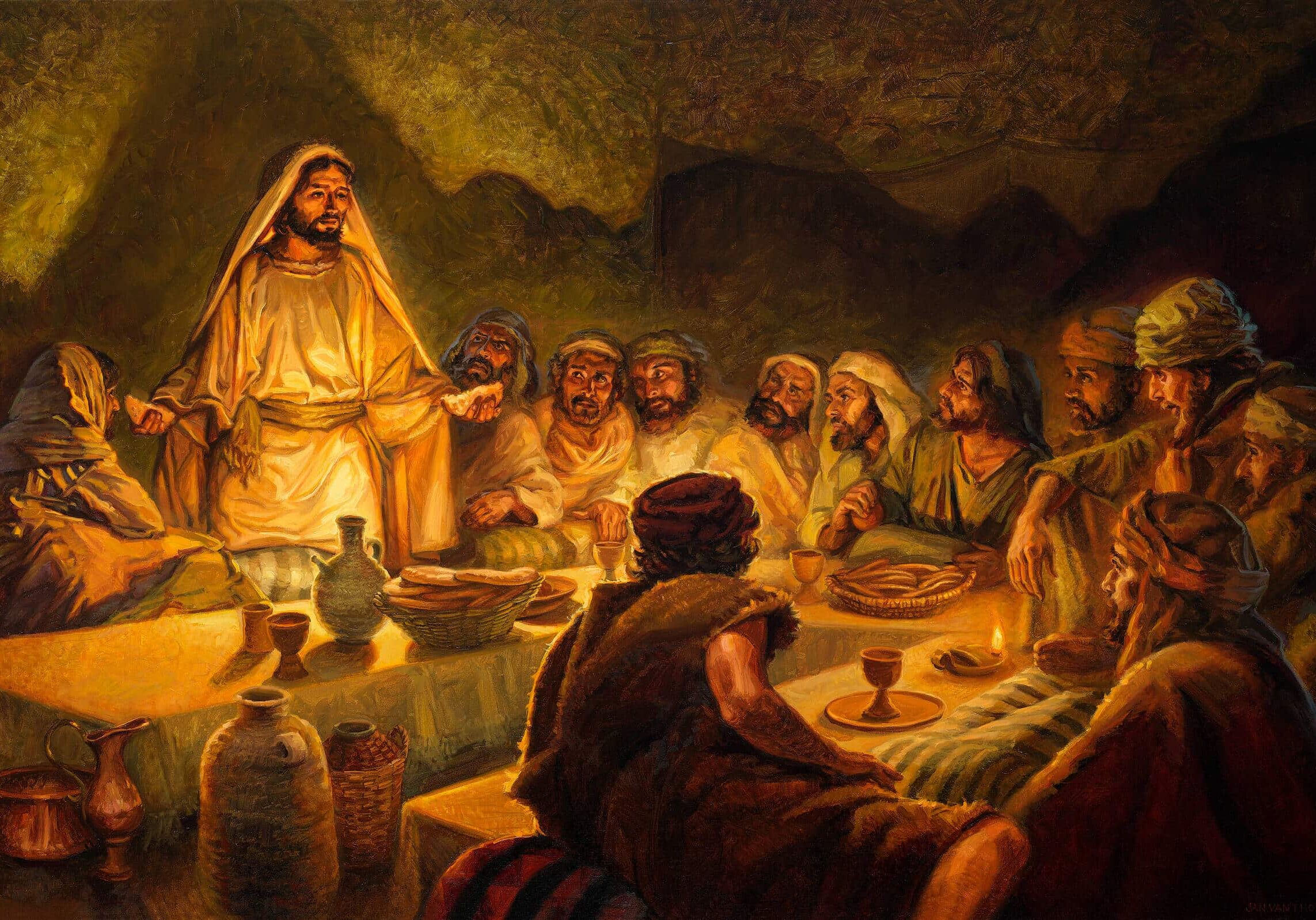
In our Epistle Lesson for this evening, St. Paul explains to the church in Corinth the purpose of the blessed Holy Eucharist, which Christ JESUS instituted the night before He was crucified. He did this because some of the members of that church had lost their understanding of the meaning of the Paschal Feast and their role in it. Paul says, “For as often as ye eat this bread and drink this cup, ye do shew the LORD’s death till He come” (1 Corinthians 11:26). That is, the Corinthians, as all Christians do, when they gather as a body of believers to take the Bread and drink of the Cup, they announce Christ’s complete and satisfactory atonement and sacrifice for humanity’s sin in a mysterious, but effectual manner, until He comes again. By participating in the LORD’s Supper, the people of GOD, the Church, makes this confession with authority and conviction throughout time immemorial. We are confidently proclaiming that through JESUS’ shed Blood, wherein lies His Life, we pass from death into His eternal life – our souls made free from any bondage of guilt because of our sinful rebellion against GOD. When eating JESUS’ Body and drinking His Blood by faith, we are able to participate in the innumerable benefits procured and pledged unto us by JESUS – the main of which is life eternal.
That should then raise the question in our minds: What does this life eternal look like?
When we walk through any architectural space, natural or constructed, we are surrounded by shadows, are we not? It is when we are overwhelmed by large shadows, that we look up to see what could possibly be casting them over us. In the Old Testament, there exists a feast that should cause us to look to what cast it, for it is one of those very large, historical shadows over Israel, that should cause us pause for the mystery it holds – a towering shadow of the good things to come, which we now realize in Christ’s Holy Eucharist. — And though shadows are important and reveal truths in Holy Scripture, let us not forget that a shadow is the form of the Thing, but not the Thing itself. Its size and shape are but an expression of the true Thing, because the true Thing – the real, tangible, and consequential Thin- is interposed between us and the source of Light that illuminates and reveals the true Thing.
In this case, the shadow of import from the Old Covenant was a covenant meal instituted by GOD through Moses, which the Jews called the Meal of the Victim – the Meal of GOD’s Pretermission/Exemption – the LORD’s Passover. — Like the Holy Eucharist that JESUS instituted, the Passover was a meal that also pertained to the people’s participation in a distinct food, whose character and essence proclaimed a death that would save and bring life to it participants, if they ate it by faith. Those in Israel who gathered and proclaimed the death of the victim that served as the source of the Passover meal, as GOD commanded, were promised an escape from GOD’s judgment of death, which He prescribed for His enemies. And instead of His retribution, the partakers would receive GOD’s pledge of sustained life instead.
This Meal of the Victim was instituted on the night in Egypt when Pharaoh refused (for the tenth time), GOD’s request to let His people go from his tyrannous overlordship. Pharaoh was warned by GOD that if he did not let Israel go free from their captivity, after nine previous, significant and destructive plagues of warning, then a tenth, and even more fierce plague would come. And Moses, GOD’s mediator, said of that plague, that “all the firstborn in the land of Egypt shall die, from the firstborn of Pharaoh who sits on his throne, even to the firstborn of the female servant who is behind the hand mill, and all the firstborn of the animals” (Exodus 11.5). Yet, to show how GOD would be marvelous in His works, a difference would be shown between rebellious Egypt and faithful Israel. To show that difference, GOD permitted a lamb to be sacrificed in the Hebrew households on the night of His judgment, as an atonement of substitution and a pledge of sustained life.
Those faithful Hebrew families, believing GOD’s Word, were to strike the heart of their home (the side posts and lintel of their doors), with the blood of the victim of the Passover Meal, and then they were to eat the lamb that was slain. In so doing, the people would be mysteriously participating in the unblemished victim’s death, while also being nourished by the nutrients in its flesh for their journey out of captivity and into freedom. — This is a perfect shadow of the sacramental reality realized in the Holy Meal of Christ’s Body and Blood – atonement and nourishment. — And in the Holy Eucharist, those members of the Family of GOD who gather around the Table and partake of the Meal of Pretermission/Exemption in Christ’s Blood, like Israel, can walk out of sin’s bondage unto new life, mysteriously redeemed and spiritual refreshed for their journey into a free walk in Christ.
The life eternal promised to us by Christ in the tokens of His Body and Blood, first, communicate His atoning deliverance from the fury of GOD’s judgment against His enemies – those who sin and rebel against GOD. — In the New Covenant, the atoning sacrifice of GOD’s Heavenly Lamb was made on our behalf outside the walls of Jerusalem, so that by His substitutionary and sinless death, we are made free to walk out of the bondage of sin and death, and unto the freedom of life eternal. — With JESUS’ life-giving Blood struck onto the lintels and doorposts of our hearts at Baptism by the Holy Ghost, we celebrate in the New Covenant the remission of sins sealed in Christ’s Blood on Calvary. Of this hope and of this covenant, Christ said: “Drink ye all of this; for this is my Blood of the New Testament, which is shed for you, and for many, for the remission of sins. Do this, as oft as ye drink it, in remembrance of me.”1
Another aspect of the life eternal that we receive from Christ in the tokens of the Realized Passover Meal of Christ flesh and blood, is the call to proclaim/publish GOD’s redeeming work through the death of His Son. As St. Paul says, “For as often as ye eat this bread and drink this cup, ye do shew the LORD’s death till He come” (1 Corinthians 11:26). — Now, perhaps your view of eternal life has more to do with ‘enjoying life’ versus helping others to ‘enjoy it’. Perhaps your vision of life eternal is like sailing in a sleek sloop or a well apportioned corvette on smooth seas, not necessarily beating to windward, tacking back and forth, so as to help another gain their port and destination without discomfort. Yet, this is exactly what Christ’s Body is called to do – to joyfully sacrifice our own pleasures and ambitions to proclaim peace, love, and redemption to the world. This is what the Church is called to do now, which is when eternal life begins – it is already, and not yet. On this point, Paul says the same thing in another place in his significant epistolary of correspondence to the church in Corinth. There, he says, “And all things are of GOD, who hath reconciled us to Himself by [the shed blood of] JESUS, and hath given us the ministry of reconciliation” (2 Corinthians 5.18). — Life eternal is being given the ministry of reconciliation and being committed to the word on behalf of others by proclaiming that GOD has reconciled the world to Himself through Christ JESUS. (cf. 2 Cor. 5.19)
Good people of GOD, the Holy Eucharist turns every participant of the Meal of the Victim into a proclaimer of the Good News of the Gospel. By recapitulating the Holy Eucharist every week, we proclaim the marvelous power and grace of GOD until Christ comes. As one commentator has explained, “Each Holy Communion Service is a living sermon. Regular observance of the consecrated Meal of Christ, ensures that the Redemption of Christ’s Cross remains central, and that every congregation fulfills its proclaiming mandate.”2
Now consider the implications of the strategy of this pledge, which is a true blessing of the tokens given us in the Eucharistic Meal. By proclaiming Christ’s death through the Holy Eucharist until He comes again, our children and our children’s children will be catechized in the meaning of Christ’s death and in the Gospel of Hope, for generations. That is, by our eating of Christ’s Body and by drinking of His Lifeblood from the Cup, we are faithfully evangelizing the world, especially when joined by our community’s children and their children’s children. Again, it is the Old Covenant shadow of the Passover that overwhelms us concerning this theological truth.
Like the faithful in Israel, when we participate in the realized Passover of Christ JESUS’ Holy Communion, we declare our emancipation from sin unto every generation. Just like Paul’s admonition of the Christians in Corinth to reverently, faithfully, and regularly proclaim Christ’s death until He comes again, so did GOD command the Israelites to do in the Passover Meal. — After their liberation in Egypt, so that the work of GOD’s liberating Grace and the means that procured it would not be forgotten by future generations, GOD commanded Israel to remember the Passover Meal annually, with this caveat. — He said, “And it shall come to pass, when ye be come to the land which the LORD will give you, according as He has promised, that ye shall keep this service [of the Passover Meal]. And it shall come to pass, when your children (and the sojourners in the land), shall say unto you, ‘What mean ye by this service?’ That which ye shall say is, ‘It is the sacrifice of the LORD’s Passover, who passed over the households of the children of Israel in Egypt, when He smote the Egyptians, and delivered our houses – [viz., our families]” (Exodus 12.25-27). — As one Anglican Divine has written, “As of old time, GOD decreed His wondrous benefits of the deliverance of His people to be kept in memory of eating of the Passover, with His rites and ceremonies (Exod. 12.14,&c); so our loving Savior hath ordained and established the remembrance of His great deliverance expressed in His Passion in the institution of His heavenly supper, whereby, every one of us must be guests and not gazers; eaters and not lookers; proclaimers not concealers; feeding ourselves and not hiring others to feed for us.”3
The Holy Eucharist, says our Collect on this Maundy Thursday, is a gift made of holy and sacramental mysteries, given to the Church as a pledge of Christ’s life eternal. This meal is participatory; it not only recalls information – that is the what and how of our redemption – but it also recalls the why. — And at first glance, the why of our redemption is not always apparent; for this reason, some misunderstand the meaning and their role in the Meal of the True Victim, vis-a-vis, the Corinthians. — The why of the LORD’s Meal of Remembrance is not only about the truthful information that it communicates; i.e., GOD’s love expressed in Christ’s blood sacrifice. It also communicates a strategy. The strategy of GOD’s desire to enlist all faithful believers into the ministry of His reconciliation, wherein we declare His gracious salvation to the whole world each time we assemble together and partake of it.
Redemption in the Old Testament (and in the New), requires participation. In the Old Passover, “Each household had to take a lamb, prepare it, mark their doors with the blood, and eat the Passover Meal.”4 In the New and Realized Passover, the people must take bread and wine, prepare the LORD’s Table, confess Christ’s Life as the source of everlasting life found in those tokens, and then eat the sacramental Meal broken and shed in Christ’s Body and Blood. These are the tokens pledged for us of life eternal. They are both a remembrance of our redemption by shed Blood of the pure sacrifice of JESUS for our sins, and a proclamation of the same to each generation that proceeds us when we partake of it, reverently, faithfully, and regularly.
As we come forth and hold JESUS’ Body gently in our hands and taste His Blood on our lips, we are confessing that Christ is risen from the dead for the dead, and that He will come again to lead us into His glory. JESUS Christ’s crucifixion and the meal He instituted as a recapitulation of that sacrifice and the New Covenant His Blood ushered in, was that substantial edifice that cast such a looming and long shadow over Israel’s history. Until its institution by the LORD, the Passover of Egypt, “was a figure for the time then present … [but] it could not make them that participated in the service perfect, as pertaining to the conscience … [Yet now, in the Holy Eucharist of the True Passover Lamb], how much more shall the Blood of Christ, who through the Eternal Spirit offering Himself to GOD without spot, purge your consciences from dead works to serve the living GOD? And for this cause, JESUS is the mediator of the New Covenant, that by means of His death, for the redemption of the transgressions that were under the first covenant, we, which are called, might receive the promises of His eternal inheritance” (Hebrews 9.9,14-15).
Beloved, the time is now. Christ has made all things new. Let us eat and drink of His Holy Eucharist with Him in His Kingdom, which is both now and not yet. For I have received of the LORD that which also I delivered unto you. That the LORD JESUS, the same night in which He was betrayed took bread and He took wine – His Body and His Blood. This do ye, as oft as ye eat and drink of it in remembrance of Him, showing His death until He come. — Beloved, soon, all will be made ready. When it is, come – come and taste freedom and proclaim captivity overcome, forever, with me. In the Name of Him, who in these holy mysteries giveth us a pledge of life eternal, even JESUS the True Passover Lamb. Amen.
—
1 1928 Book of Common Prayer, 80.
2 BibleHub.org. “Thayer’s Greek Lexicon reference on kataggello from 1 Cor. 11.26.” Accessed 30-March 2026. https://biblehub.com/interlinear/1_corinthians/11-26.htm
3 Various Anglican Divines, The Anglican Book of Homilies, (London: The Prayer Book and Homily Society, 1852), 413.
4 Passover & Easter: To Remember is to Participate. CMJ-Israel.org. Published and Accessed 31 March 2026. Article emailed direct to personal e-dress.

Join Us for Biblical Worship, Study, & Fellowship
Sundays:
Morning Prayer 9:45 am
Coffee & Catechesis 10:30 am
Holy Communion 12:00 pm
Thursdays:
Holy Communion 6:00 pm
Recent Sermons
Palm Sunday
Worship with Us
Join us for Biblical worship, study, and fellowship. We currently meet in the sanctuary of Christ the King Lutheran Church in Waxahachie.
Catechesis for Adults and Children 5+
Sundays at 9:00 am
The Order of Holy Communion
Sundays at 10:30 am
Fellowship Opportunities
See our calendar for other weekly and special events.