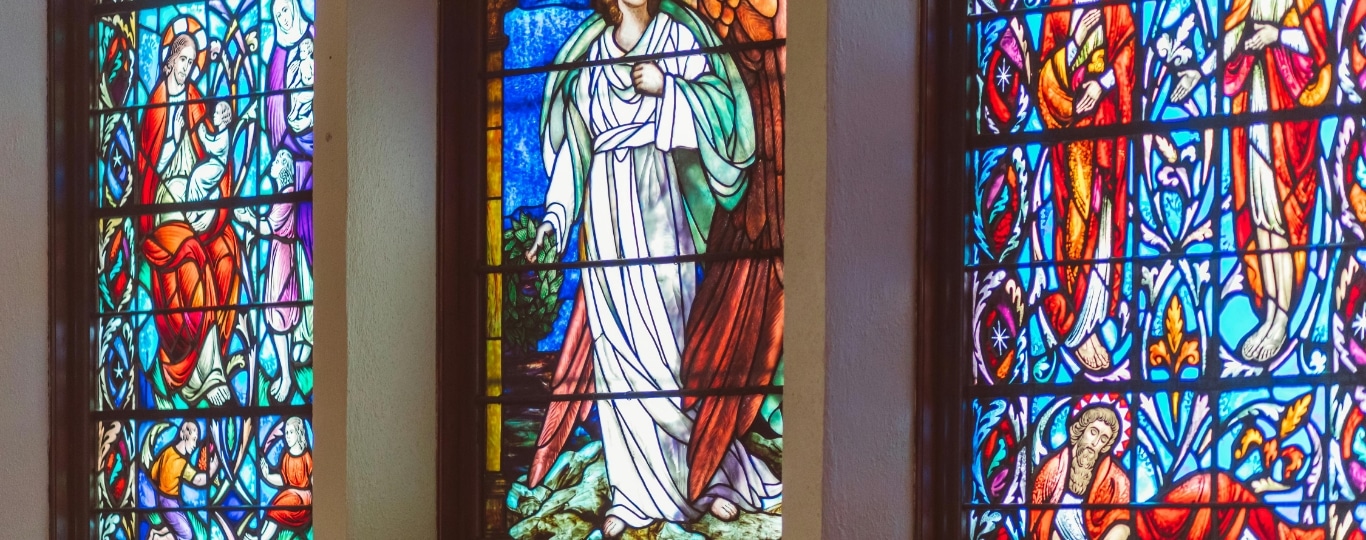
Presentation of Christ in the Temple Sunday

†
The Feast of Christ’s Presentation in the Temple has seen a robust history as a day of special observance from the earliest times of Christian faithfulness. This feast emerged “in the late fourth century in the Church in Jerusalem.”1 Its history is made notable, not only because of the names by which this feast has been known (i.e., The Purification of the Blessed Mother Mary & Candlemas), but also by the theme by which it finds its meaning. The Eastern Church calls this feast ‘Hypapante’, meaning ‘The Meeting’ – specifically, the meeting between our LORD and Simeon in the Temple scene we just read from our Gospel Lesson. “The Meeting”, this is the purposed theme of today’s Collect prayer – the result of which our Collect says, we are able to present ourselves unto GOD with clean and pure hearts.
The arrival of the Christ Child at the Temple forty days after His birth was no accident. Mary and Joseph brought Him there dutifully, as faithful members of the Abrahamic Covenant and practitioners of the Mosaic Law. The Old Testament required this visit, stating that any woman of the covenant, having given birth to a son, would need to participate in the rite of purity from blood for forty days. After those days, she and her husband were to bring a lamb to the Temple. And if their economic circumstances did not allow for the cost of a lamb, then two turtle doves or pigeons could be brought for the appropriate sacrifice unto the LORD. And in doing so, “the priest shall make atonement for her, and she will be clean” (Leviticus 12.8).
Mary’s purification was only one part of the important visit to the Temple by the Holy Family that day. Their visit forty days after JESUS’ birth in Jerusalem held another important meaning in obedience to the Law. — Moses required that the firstborn of a woman, male or female, was to be set-apart as a dedication of distinction unto GOD – particularly the boys. The young boys, who bore the sign of the Abrahamic Covenant in their flesh, became GOD’s special possession to be raised in the knowledge and admonition of the LORD. In this way, the statutes of holiness in the covenant could be perpetuated throughout Israel’s generations. The first-born sons of Israel were sacred because GOD had spared the first-born males of Israel in Egypt through the sacrifice of the paschal lamb. From that time forward, all the first-born males were to be dedicated to GOD and redeemed with a special financial sacrifice of five shekels. — Some of the boys would be dedicated to Temple service, as we saw with the story of Elkanah, Hannah, and Samuel, and some would be dedicated and live normal, but faith-filled lives in service and obedience to YHWH GOD as tradesmen, shopkeepers, shepherds, and the like. Others, like Samson and John the Baptist, would live lives of special transcendental significance, affecting GOD’s relationship to the nation of Israel.
This was no small affair as it pertained to the Messiah, GOD’s Christ, the son of Mary and Joseph. For not only was JESUS the Holy Family’s first child, bearing the sign of the Abrahamic Covenant in His flesh, but He would also become the Standard Bearer of the New Covenant of Grace, redeeming the nation of Israel and the whole world with the price of His sacred Blood. By JESUS’ life, He would purify all people by faith as well as satisfy all the demands of Moses in laws, rules, and ritualistic requirements by His obedience. For, we read about His redemptive act in Galatians: “But when the fullness of the time had come, God sent forth His Son, born of a woman, born under the law, to redeem those who were under the law, that we might receive the adoption as sons” (Galatians 4.4-5). — Unlike other little Hebrew boys, JESUS’ dedication in the Temple that day was to the highest purpose given unto mankind – to be the Savior and Redeemer of the world, through whom all people could re-enter Holy Communion with GOD Almighty and inherit His Holy Spirit. And though Joseph and Mary did not have the financial means to bring the ideal sacrifice for Mary’s purification, the Lamb of GOD would be offered up as a dedication to the LORD that day in the Temple, as a dedication of the purest offering, not only for Mary’s purity, but also for that of the whole world.
This is a point of stumbling for many who have no trouble accepting that the Christ, being the Second Person of the Holy Trinity, was “Heir of all things, through whom also [the Father] made the worlds; who being the brightness of [the Father’s] glory and the express image of His person – upholding all things by the word of His power,” as the author of Hebrews describes Him. (Hebrews 1.2-3). Yet to His meanness and lowliness of person, condescending His glory and taking upon Himself the likeness of our flesh so that He became subject to Moses, some struggle, doubt, and trip upon this theological truth, like one over a cornerstone. The idea that GOD would become incarnate, likened unto one of His creatures, then bleed, suffer, and die, such a theological reality crushes them under the weight of their disdainful incredulity. — Yet, this is what the Christ did – He took on the body prepared for Him by His Father in Heaven, purposefully obeyed Moses, and fulfilled all the righteous requirements of the Law. So that such doubters might arise out of the dust of their apprehension and believe unto a clear conscience, these things were necessary, says St. Paul, so that JESUS the Christ could “reconcile all things to Himself … whether things on earth or things in heaven; making peace [with GOD the Father] through the blood of His cross” (Colossians 1.20).
The Christology of the Incarnation, as we are presented with it in the Temple scene – the Hypapante – the meeting between JESUS and Simeon, was cast to be a stone of stumbling before all men. — Many looked (and are still looking), for the consolation of GOD, but they are not fond of finding it in the face of JESUS the Christ. Why? Because, JESUS “put his neck under the yoke of the Law, and though its institutions were beggarly elements and mere rudiments of this world, as the apostle calls them, Christ submitted to it, that he might with the better grace cancel it, and set it aside for us.”2 — GOD’s ways are mysterious, but they are not beyond our grasp. Thus, Simeon says: “Behold, this Child is destined for the fall and rising of many in Israel, and for a sign which will be spoken against” (Luke 2.34). Even Mary was not to be free from such a painful stumbling, as she would be presented with its unimaginable final outworkings on Calvary, on the Hill of the Skull, right in front of her eyes.
Yet, Simeon did not speak against GOD’s plan, nor did he stumble because of the Christ’s Incarnation. According to Jewish commentators, it is believed that Simeon was a man unique in Jerusalem, and someone whom the people, especially the elders and priests, would have esteemed and celebrated. We can read how “Some learned men, who have been conversant with the Jewish writers of history, find that there was at this time, one Simeon, a man of great note in Jerusalem, the son of Hillel, and the first to whom the Jews gave the title of Rabban (Master/Teacher); the highest title that they gave to their doctors, to wit, it was never given but to seven of them … Simeon succeeded his father Hillel as president of the rabbinic college which his father founded, and was a member of the great Sanhedrin. The Jews say that he was endued with a prophetical spirit, and that he was turned out of his place because he witnessed against the common opinion of the Jews concerning the temporal, [political] kingdom of the Messiah. [This would explain Simeon’s attendance in the Temple, and not in the Praetorium, awaiting the Messiah’s appearance and spiritual consolation.)”3
GOD had promised Simeon that he would not die until he had seen the Christ. What great faith this man must have had for the LORD to have done this. Yet how did Simeon know to come to the Temple the day the Babe Christ was there? — There are two things that the Scriptures tell us to answer this question. St. Luke writes that “the Holy Spirit was upon him,” and “he came by the Spirit into the temple”. (cf. Lk. 2.25,27) — Simeon was a great man of GOD, not some Temple-squatter and insignificant hobo awaiting a spiritual handout in Jerusalem. He was a man of the Faith of Abraham, also believed to be a priest, and he would have been well informed of the recent news of the Christ from the men of the East following their star. In fact, he might have been one of the Jewish scholars who advised Herod as to Bethlehem’s honor as being the city where the Christ was to be born. — Simeon would have also understood the meaning of Daniel’s prophecies, which forecasted the coming of the Messiah in the time that Simeon was living. (cf. Dan. 9.20-27) Along with the devotee, Ana, who was also in the Temple that day, “these were the true representatives of those pious Israelites who waited patiently for God’s redemption of His people foretold by the prophets and expected it in their day. Further, their spiritual intuition, heightened by years of assiduous exercises of prayer and devotion, was revealed in their understanding of the true character of God’s salvation as an inward grace (available to Jew and Gentile alike), rather than a re-establishment of a temporal political kingdom in Israel. Thus, Simeon foresaw the ‘stumbling-stone’ – the ‘sign’ of true Messiahship in Mary’s child, [but was not stumbled by it himself]”.4 — Thus, this seer of GOD confessed: “LORD, now let Your servant depart in peace, according to Your word; For my eyes have seen Your salvation, which You have prepared before the face of all peoples, a light to bring revelation to the Gentiles, and the glory of Your people Israel” (St. Luke 2.29-32).
As though the Babe was a stranger, Simeon took the Christ Child and presented Him before the LORD. Yet JESUS was no stranger – He had only recently come from Heaven. — Yet, like the babe Samuel, JESUS was presented to the LORD to serve Him all His life, but not in the Temple as Rachel promised of Samuel. JESUS was dedicated to minister to GOD the Father in the true Temple not made with hands – even His own Body. — JESUS ministry is Light and Life, and by His light, as Simeon proclaimed by the Holy Ghost, the Gentiles would come to the True Israel in search of Life. (cf. Is. 60) JESUS would later echo this same truth when He said: “I am the light of the world: he that followeth me shall not walk in darkness but shall have the light of life” (John 8.12). For in JESUS, as Simeon testifies, is “life, and His life is the light of men … [JESUS is] the true Light which gives light to every man coming into the world” (John 1.4,9), for “all people are revealed for who they are in their hearts [when confronted by JESUS]”.5 Thus, faithful and true Simeon could proclaim to GOD, ‘my eyes have seen your Salvation, which you have prepared before all peoples.’
And now, here we are dear, friends! GOD’s salvation, since Christmas Day, has been presented to us to reveal the nature of what is in our hearts by the light that emanates from the face of JESUS the Christ. We have been led here today, as Simeon was, by the Holy Ghost, to see the Christ in Word, Sacrament, and ‘in the assembly of the faithful’ – to stand by faith or to stumble over doubt. — We have come to the Temple not made with hands, and none are here because of the persuasive speech of enticing words or man’s wisdom. Rather, we have been stirred up to come and see the goodness of the LORD – to taste the sweetness of His Light and Life, if we would have it. For, those who would see and partake of Christ must go to His Temple. In JESUS’ presentation by Simeon in the Temple forty days after His birth, the true Sacrifice of purification for the whole world was offered unto GOD – the Victim that would purify all unclean hearts and redeem and regenerate all people being newly born through Holy Baptism in the Spirit.
s after His birth, Simeon not only dedicated a Hebrew child according to Moses, but he also dedicated a New Temple – the Temple of the Body of Christ. — “Destroy this temple, and in three days I will raise it up” (John 2.19). — If we are to commune with GOD and offer praises to Him, we must come to the Temple of Christ. And contrary to a temple of stone, mortar, and gold, we do not enter Christ’s Temple through doors of steel or wood, but rather, through faith. Faith that JESUS is GOD’s salvation prepared before the face of all people, and faith as Malachi confessed, that He is “the LORD, whom you seek” (cf. Mal. 3.1). The Temple in Jerusalem is no more, and if GOD’s people are going to offer Him sacrifices of praise and thanksgiving with pure and clean hearts, they must enter into His presence through the Door of His Son.
s after His birth, according to the Law, in the Temple in Jerusalem, the Temple that JESUS loved, something called the Hypapante occurred. The Light of the world was there officially declared and dedicated, being made available by GOD to all people who would no longer walk in darkness. And as a good and faithful priest, Simeon, highly respected and revered, showed the people what a true watchman he was by leading the way for them – for us all. He drew the Babe as close as He could to his heart and embraced Him and said that his life was forfeit – GOD could now let him depart in peace, for he had found new life through faith in the spiritual salvation made available by Christ alone. — Now, all that remains is for us to follow Simeon’s lead. If we would yet receive this Light as he did, we need only embrace JESUS equally close to our hearts with a lively faith, accepting the offer of the Gospel with love and resignation.
‘I am the light of the world: he that followeth me shall not walk in darkness, but he shall have the light of life.’ — Brothers and sisters, the LORD, whom you seek, has come to His Temple with Light and Life – He is here, among us. We will find Him in the breaking of the Bread and the pouring out of the Cup. — And when all is made ready, dear friends – come and find the One in Whom you delight, and taste and know that the LORD is Light and He is Life. Come by a lively faith – come and eat and drink – come without price. Amen.
—
1 Sheppard, Massey H., The Oxford American Prayer Book Commentary, (New York: Oxford Press, 1950), 232.
2-3 Henry, Matthew. BlueLetterBible.org. “Commentary on Luke 2.” Accessed 26 January 2026. https://www.blueletterbible.org/Comm/mhc/Luk/Luk_002.cfm?a=975001.
4 Sheppard, 233.
5 Carson, D.A., France, R.T. et al., New Bible Commentary, (Downers Grove: Intervarsity Press, 1994), 985.
Join Us for Biblical Worship, Study, & Fellowship
Sundays:
Coffee and Fellowship 8:30 am
Catechesis for all ages 9:00 am
Holy Communion 10:30 am
Recent Sermons
Twelfth Sunday after Trinity

Worship with Us
Join us for Biblical worship, study, and fellowship. We currently meet in the sanctuary of Christ the King Lutheran Church in Waxahachie.
Catechesis for Adults and Children 5+
Sundays at 9:00 am
The Order of Holy Communion
Sundays at 10:30 am
Fellowship Opportunities
See our calendar for other weekly and special events.