Quinquagesima Sunday
†
In today’s Gospel lesson from St. Luke 18, JESUS speaks plainly to His disciples, but they did not understand His shadowy conjectures. It was just last week that we read the parable of the Sower and the Seed, and how the disciples could not understand why Jesus spoke to the people in parables, because, in so doing, they said, the people would not be able to understand Him. In fact, the disciples were having trouble understanding the LORD themselves, so JESUS told them to listen more acutely with their hearts. — And yet, here in the final circuit of their travels before going to Jerusalem the final time, JESUS, not wanting to cause His disciples distress for what was about to happen, said to them: “Behold, we go up to Jerusalem, and all things that are written by the prophets concerning the Son of man shall be accomplished. For he shall be delivered unto the Gentiles, and shall be mocked, and spitefully entreated, and spitted on. And they shall scourge him and put him to death: and the third day he shall rise again” (Luke 18.31-33). And hearing these things, exactly because they were listening with their hearts and not their ears and eyes, the Bible says: “the disciples understood none of these things; the saying was hidden from them, and they did not know the things that were spoken [by the LORD]” (Luke. 18.34).
It was not that JESUS was saying something they could not understand as a concept, but their minds were just not able, nor willing to see this narrative as a reality. Understanding what the LORD means when He tells us something requires persistent curiosity and belief that we can understand JESUS, if He will but make His truth known to us, in good time, and when we are ready to accept it. This is the model: “Understanding is both commanded and bestowed by GOD. Holy Scripture holds these in tension: the call to seek wisdom and the necessity of GOD’s divine illumination to understand His wisdom.”1 Love of GOD and His truth lead us to spiritual contemplation, particularly, when we cannot see the light of the matter. The disciples were also forced into contemplation, for though they loved the LORD and believed He was GOD’s Messiah, the truth of JESUS’ words ‘were hidden from them’ – that is, their meaning was cloaked. “God sometimes withholds truth to display His sovereignty and cultivate humility. ‘You have hidden these things from the wise and learned and revealed them to little children’ (Matthew 11:25). When we cannot understand His words, we should not be discouraged, but contemplate them, with spiritual endurance.
The LORD sometimes veils His Kingdom mysteries until the appointed moment (cf. Col. 1:26), ensuring that spiritual understanding rests on grace, not human aptitude.”2 – The disciples were leaning too much upon their hopeful confidences towards GOD’s will, rather than through humility, trusting upon His grace. Thus, Luke carefully portrays a contrast in this passage that we would be wise to consider. It is between those who see JESUS through the wisdom of their own eyes, and those who reveal persistent curiosity and humility through belief that He is the Light of the world, shining exactly when and how He deems proper, opening the eyes of the blind to the wisdom of His Truth. For, “The Light that cometh from her, never goeth out” (Wisdom of Solomon 7.10).
First, based upon their several comments, it would be correct to say that the disciples were operating under a biased framework that prevented them from understanding JESUS’ statement about His impending persecution and crucifixion. This presupposition of theirs, GOD in His providence, used to humble the band of Christ-followers until they were ready to understand it. Take, for example, the comments made by James and John to JESUS – a direct reflection of the disciples’ bias. “Grant us that we may sit, one on Your right hand and the other on Your left, in glory.” To this, JESUS responded, “You do not know what you ask” (Mark 10.37-38). Indeed, they did not. The presupposition of the disciples, which was characteristic of many in Israel, was that the Messiah of GOD would come to equalize the inequities that the nation was experiencing under Roman occupation. The people, because of the leading of their spiritual shepherds, were, as told in the prophets, “Lost sheep. Their shepherds had led them astray. They had turned them away on the mountains. [Away from the truth of the Scriptures].” (Jeremiah 50.6).
JESUS at this point in His ministry had turned His face towards Jerusalem and with steadfast courage, marched forward, and His disciples “were amazed” (Mark 10.32). “JESUS went before them, as the captain of their salvation … Christ’s courage and constancy in going on with his undertaking for our salvation, was the wonder of His disciples.”3 So, who could blame them for misreading our LORD’s comments? How else were they to interpret JESUS’ intimations of being made perfect through His sufferings? Yet misinterpretation was not the only culprit in the disciples’ case – so was worldliness. — “Worldly honour is a glittering thing! It is a thing by which the eyes of Christ’s own disciples have many a time been bedazzled … Many have been led into a snare by false notions of Christ’s Kingdom, as if it were of this world, and like the kingdoms of earthly potentates. James and John must have concluded that, if Christ rises again, he must be a king, and if he be a king, his apostles must be peers, and one of these would willingly be the Primus par regni – the first peer of the realm, and the other next him, like Joseph in Pharaoh’s court, or Daniel in Darius’s palace.”4 And with this mindset, the disciples all, did not understand JESUS words, for it was hidden from them until a time wherein they would be humbled, loving the preeminence of GOD’s mercy and grace over their worldliness. Then they would be unblinded so that they could see what Divine Love is: JESUS being made perfect through suffering.
The antithesis to the disciples’ blindness and worldliness is Blind Bartimaeus’s sight. — As they entered into the region of Jericho, JESUS and his party came upon a man crying aloud: “JESUS, son of David. Have mercy on me!” This man cried out so loudly and so repeatedly that the people on the road with him had to tell him to calm down and be quiet. But Bartimaeus only began to cry out the louder. Again, the people, like the disciples, mistook JESUS for some earthly nobleman and lord who required a particular etiquette. But the blind man knew better – he sees JESUS with the eyes of his heart, and so he cried for mercy from Him. St. Cyril of Alexandria comments that “The blind man must have understood that the sight of the blind cannot be restored by human means, but requires a divine power and authority such as GOD only possesses.”5 — The disciples thought of JESUS as the Son of David also, but that is only what they thought of Him. Bartimaeus, on the other hand, thought something more of the Heir of the Monarchy of David. He undoubtedly heard in the Psalms that “The LORD had sworn in truth to David, and promised not to annul it, saying: ‘of the fruit of your loins I will set a king upon your throne.’ And in Isaiah, who wrote: ‘Behold, a virgin will conceive and bring forth a son, and they will call His name Emmanuel, which being interpreted is GOD with us.'”6 The disciples’ eyes were bedazzled by false notions of Christ’s Kingdom, thinking they could lean into Him and get from Him what their earthly hearts desired. Blind Bartimaeus, on the other hand, could see JESUS for who He truly was, as sure as we can see the sun.
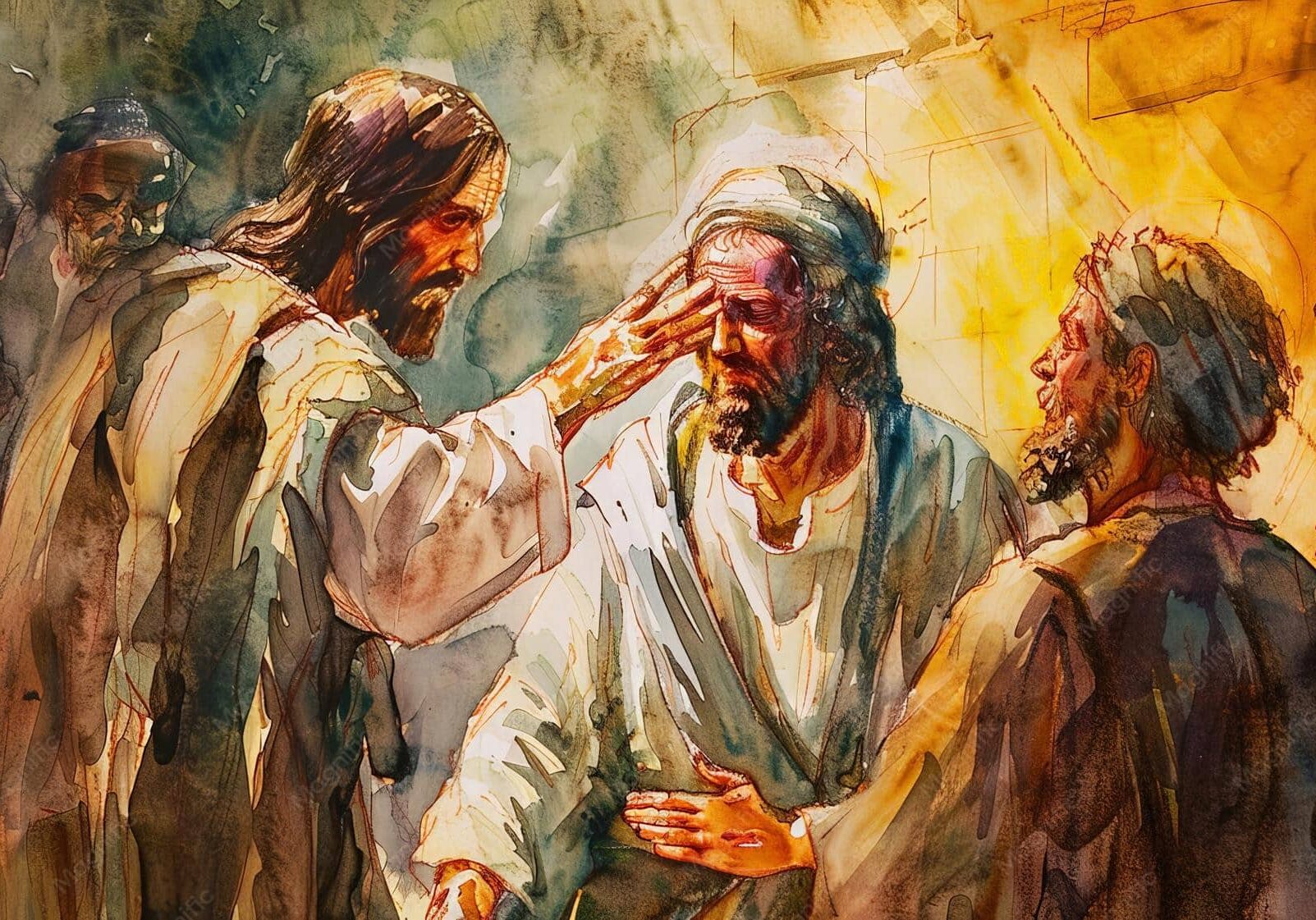
JESUS confirms this belief in the blind man, drawing near to him and saying: “What do you want me to do for you?” (Luke 18.41). — And so, the man specifies his need: “LORD, that I might receive my sight.” (Luke 18.41) — This man that St. Mark names as Blind Bartimaeus “was not only blind, but poor, had nothing to subsist on, nor any relations to maintain him; he was the fittest emblem of the world of mankind which Christ came to heal and save … for we are both poor and blind before we meet the LORD JESUS.”7 And so JESUS says to him: “Receive your sight; your faith has made you well” (Luke 18.42).
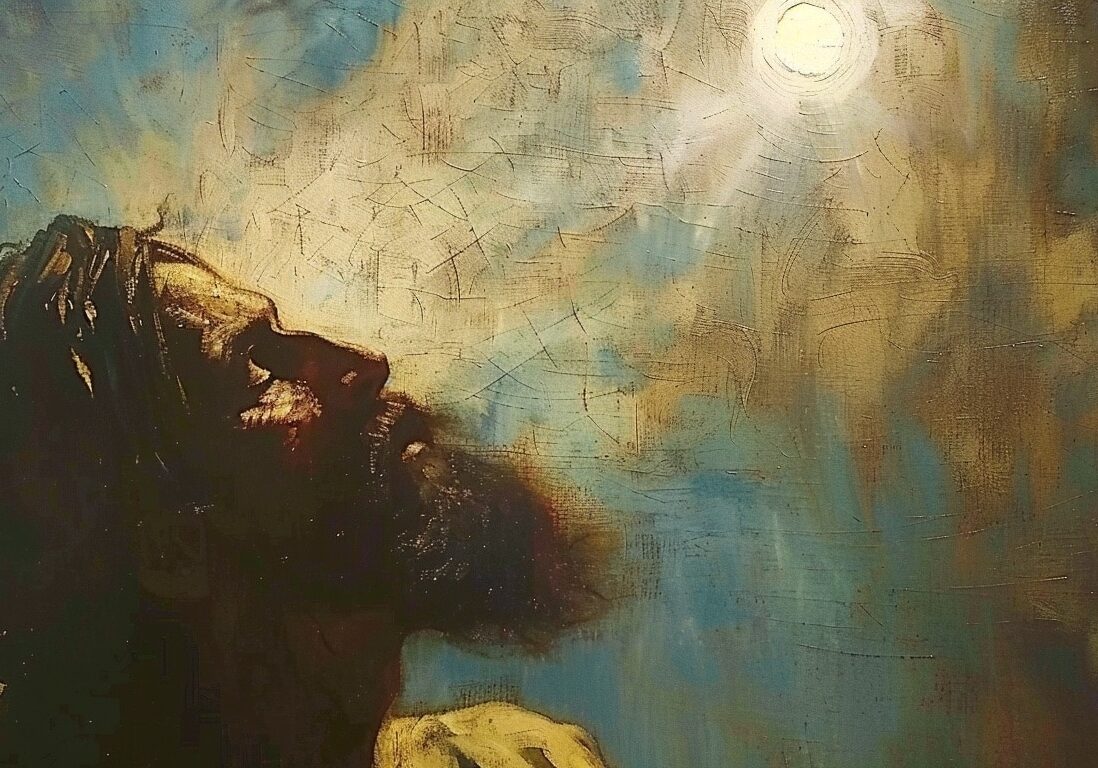
The contrast to the disciples’ presuppositions and their blindness to GOD’s truth is Blind Bartimaeus’ presupposition that JESUS was the Light of the World, giving spiritual sight to all who believe in Him. Bartimaeus believed that all things are possible with GOD, and he was right. It was not that he was a smarter man than the disciples, or that he had more experience in theological matters, or that he was older and more mature. Apart from all these things, he believed that JESUS was who He said He was, and that He was the true Light that lightens the world, where, how, and when He deems it right. — I think Bartimaeus would have agreed with Clive Staples Lewis, who said: ‘I believe in Christianity as I believe in the sun. Not because I can see the truth of it in the sky, and thus I know that it exists. Rather, I believe in it, because by it, I can see everything else.’
After this miracle, Bartimaeus and all the people followed after JESUS, giving praise to GOD, but the disciples were more circumspect. What did He mean: “They will scourge Him and kill Him. And the third day He will rise again?” How could He say such a thing, unless it were true; this man, this JESUS, the One, who by His own power and no other’s, could calm the storm, raise the dead, heal the lame, unbind the dumb tongue, and give sight to the blind by His divine command? — We must hold these truths in tension, hoping that by obedient pursuit of the Son of David, that He will have mercy on us and reveal to us what His death and resurrection mean for us in our poor, blind, and beggarly states. — “In this world truth exists in shadows and conjectures. That is why there is need for the blessed passion of holy and godly love of these mysteries, which binds the intellect to spiritual contemplation.”8
And so, we contemplate His question: “What do you want Me to do for you?” — What do we want you to do for us??? — LORD JESUS, Son of David, have mercy upon us – give us sight in the areas of our lives where we are blinded to your Truth. Resurrect our faith! — For, “LORD, to whom else shall we go if not to you? We believe that You have the words of eternal life. (cf. John 6.68) We believe that you are the Christ- the Son of the Living GOD – our Savior and our Friend. Amen.
—
1 BibleHub.org. “Commentary on St. Luke 18.31.” Accessed 10 February 2026. https://biblehub.com/greek/4290.htm.
2 BibleHub.org. “Commentary on St. Luke 18.31.” Accessed 11 February 2026. https://biblehub.com/greek/2928.htm.
3-4 Henry, Matthew. BlueLetterBible.org. “Commentary on St Mark 10.32.” Accessed 11 February 2026. www.blueletterbible.org/Comm/mhc/Mar/Mar_010.cfm?a=967001.
5-6 Ancient Christian Commentary of Scripture: New Testament III – Luke, ed. Just Jr., Arthur A., Oden, Thomas C. (Downers Grove: Intervarsity Press, 2003), 287-288.
7 Henry, Matthew, BlueLetterBible.org. “Commentary on St. Luke 18.41.” Accessed 14 February 2026. https://www.blueletterbible.org/Comm/mhc/Luk/Luk_018.cfm?a=991035.
8 St. Maximos the Confessor (Third Century on Love no. 67). Accessed 14 February 2026. https://www.lectionarycentral.com/quinquag/OrthoGleanCharity.html.

Join Us for Biblical Worship, Study, & Fellowship
Sundays:
Coffee and Fellowship 8:30 am
Catechesis for all ages 9:00 am
Holy Communion 10:30 am
Recent Sermons
Twelfth Sunday after Trinity

Worship with Us
Join us for Biblical worship, study, and fellowship. We currently meet in the sanctuary of Christ the King Lutheran Church in Waxahachie.
Catechesis for Adults and Children 5+
Sundays at 9:00 am
The Order of Holy Communion
Sundays at 10:30 am
Fellowship Opportunities
See our calendar for other weekly and special events.