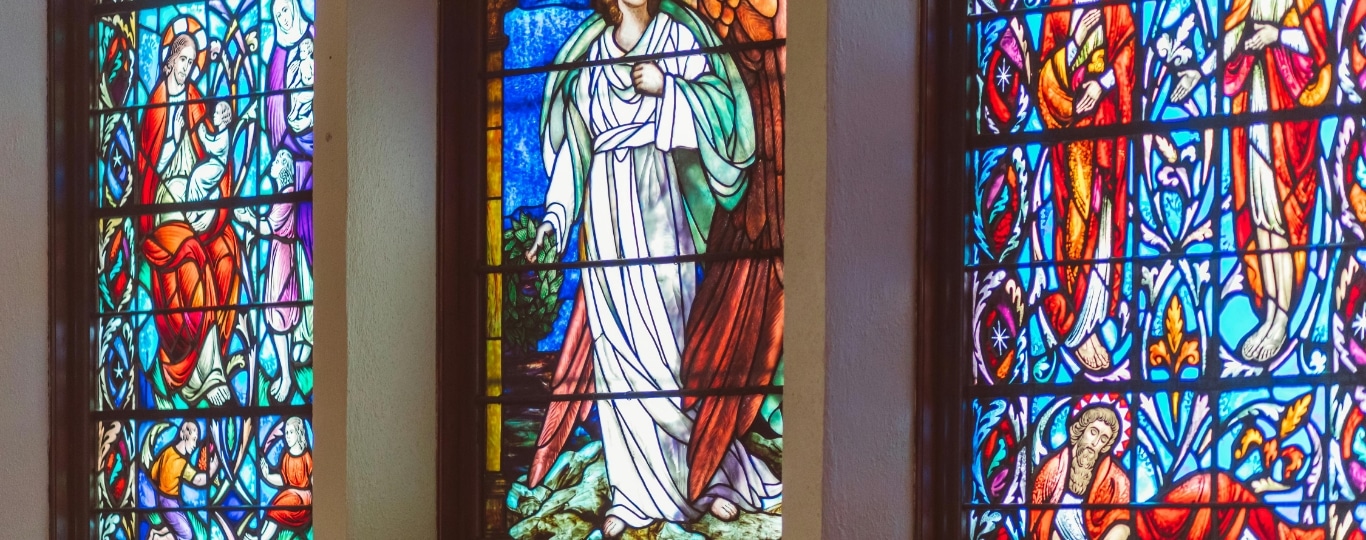
Second Sunday after Epiphany

†
The expected response to the Epiphany, or the manifestation of Christ, is captured, as a type, in our Old Testament reading from Zechariah. There we read: “Speak each man the truth to his neighbor; Give judgment in your gates for truth, justice, and peace. Let none of you think evil in your heart against your neighbor. And do not love a false oath” (Zech. 8.16-17). Speak truth, judge for justice and peace, do not think evil of your neighbor, and do not love false oaths. These are typical virtues of the Kingdom of GOD that Christ came to inaugurate by and in His Epiphany – His First Coming – His Incarnation. — John the Baptist summed up the expected response to the resultant Kingdom that would come, based upon the manifestation and Epiphany of Christ, when he was asked by the people who came out to be baptized by him, ‘What shall we do then?’ “John answered and said to them, ‘He who has two tunics, let him give to him who has none; and he who has food, let him do likewise … [Do not commit extortion of any kind] … do not intimidate anyone or accuse falsely and be content with your wages’” (St. Luke 3.11, 13-14). — And St. Paul, he summarizes the expectation of our response to the epiphany or manifestation of Christ and His Kingdom in this world by saying the following: “Let love be without dissimulation, [hypocrisy, or guile]” (Romans 12.9).
The Epiphany of GOD the Father in the Face of GOD the Son, which happened on Christmas Morning, issued forth the New Kingdom, and it demands a response – ambivalence is not excusable – we must be hot or cold. And if we are hot and ‘on fire’ for communion with GOD through Christ, then we must act. We must convert our faith in the word and person of JESUS Christ into action, and that action, says St. Paul, is to love without guile – without dissimulation – without hypocrisy. We are to speak the truth, judge in our hearts for justice and peace, think not evil of our neighbors, and love not false oaths. — I don’t know about you, but I am going to need a mind transplant if I am going to be able to respond to the epiphany of Christ and live as a citizen in His Kingdom in the way that Zechariah, John the Baptist, and St. Paul say we should.
The Kingdom of GOD that Christ brought in with His manifestation to the world does not come powerless, but with great power and authority. Zacharias, John the Baptist’s father, described the arrival of the Christ and His Kingdom in this way. He said, “The Dayspring from on high has visited us. To give light to those who sit in darkness and the shadow of death, and to guide our feet into the way of peace” (Luke 1.78-79). The Dayspring from on High – the Dawn of Heaven – the Daybreak of GOD has come to visit us – the Daybreak of the Light of GOD is seen in the Person of JESUS Christ, and He has given His Light to transform our minds, that we might learn to hate that which is evil and clinging to what is good. And having that transformation, that metamorphosis actuated by faith and by the Holy Spirit, the expectation of us is then to act in the fashion after the Kingdom and its King. To love without dissimulation as a people upon which a new Light, the Light of Heaven, has dawned and broken.
Instead of turning to the latest scientific discovery, self-help trend, or podcast counsellor, Fr. Henri Nouwen took this truth to heart and sought out the Daybreak on High by taking the Gospel seriously, desiring to be a true disciple and apprentice of JESUS in His Kingdom, now. As such, Fr. Nouwen went to be the pastor of The Daybreak Community in Toronto, Canada, in 1983. Henri’s friends and associates professed that this was to be, perhaps, the most paradoxical pairing that there ever could be – Nouwen and the Daybreak community. You see, Fr. Henri, a renowned writer, theologian, and professor of religious studies at Yale and Harvard Universities, decided to answer ‘the call’ he received to live and serve at a secluded, Christian retreat house with a population of physically and mentally challenged adults. Though Fr. Nouwen had spent some time with his niece, who had Down Syndrome, this highly affluent Roman priest was best known for his high-energy and dependence upon others. It was said of Fr. Nouwen that he could barely make a cup of tea, a sandwich, or drive a car. “So it was that at fifty-four years of age, a cosmopolitan and cultured university professor, but admittedly a total incompetent when it came to simple practical matters, took up residence in the New House at Daybreak. It is a measure of his humility that he would agree to this type of basic training at his stage in life … Living alongside the handicapped in a community where no one was exempt from doing the chores would have been challenging for anyone. Yet, Fr. Henri had accepted the role of not only being the pastor of the community, but also a house parent at Daybreak, with the responsibility to cook, clean, dress, bathe, feed, and spend time with the disabled members of the community.”1 – Yes, love without dissimulation is paradoxical, unless you think about it with a renewed mind, enlightened by the Dayspring from on High.
Like I think we all do, Fr. Nouwen wanted to find purpose as a member of Christ’s Kingdom on this earth, by humbling himself and condescending his ego and will to the will of GOD. Even though Fr. Henri was a very successful priest, author, and teacher, finding meaning and purpose had been a lifelong struggle for him. – And though often travelled, with much acclaim, to speak and teach, his journey through peaks and valleys of depression and shame always overcame him. His mind could not escape the battle of self-doubt. Yet, Fr. Henri knew that JESUS promised His Church liberty and victory over our sense of ‘little worth’, if we would follow His good example by laying down our lives for our friends, turning the other cheek for our enemies, and seeking to serve others instead of ourselves. JESUS said, “You know that the rulers of the Gentiles lord it over them, and those who are great exercise authority over them. Yet it shall not be so among you; but whoever desires to become great among you, let him be your servant. And whoever desires to be first among you, let him be your slave — just as the Son of Man did not come to be served, but to serve, and to give His life a ransom for many” (Matthew 20.25-28). In Pauline parlance, this descent of the self to condescend one’s will to the association of the meek and humble is also described as ‘not setting our minds on high things – not being wise in our own minds.’ (cf. Rom 12.16) — Yet a significant theological secret must be understood before one can renew their mind. St. Paul tells us that secret in Romans 12. — There, the Apostle is careful to note that before we can be transformed so that we are not high-minded – willing to be disciples and apprentices of Christ JESUS in His Kingdom – we must “present our bodies as living sacrifices, holy and acceptable to GOD, which is our reasonable service” (Romans 12.1). — For a true believer, keen on renewing his mind, this sounds reasonable enough. Problem is, though, living sacrifices tend to squirm off the altar!
The author of Hebrews makes it clear, Christ JESUS has “entered the Most Holy Place [of the Tabernacle of Heaven], once for all [with His blood], having obtained eternal redemption for us” (Hebrews 9.12). Thus, ours is not to be a dying sacrifice, with its blood pouring out in solicitous hopes of redemption and forgiveness, ours is to be a living sacrifice – a sacrifice of praise and thanksgiving to GOD. We do not need to kill anything again and offer the blood of a living being to have communion with GOD, JESUS has finished this already for us. Yet, as we say in the Eucharistic prayer during Holy Communion, “we offer and present unto thee, O LORD, ourselves, our souls and bodies, to be a reasonable, holy, and living sacrifice”2. The living sacrifice of the apprentices of Christ is made in the form of prayer, praise, tithing, and service. All of these are sacrifices that we can offer to GOD. In so doing, we offer to GOD a reasonable and appropriate offering, holy and pleasing in His sight.
Thus, Fr. Nouwen had it right! If we are to submit our egos to GOD, to align our wills to His will, and to have our minds transformed into the minds of citizens of Christ’s Kingdom, then we must love without dissimulation, first. — Love, first, not as an emotion or idealistic pursuit, but love as ‘action.’ In Fr. Nouwen’s context, becoming the pastor and a house parent at a community for mentally handicapped adults, this was his form of offering a living sacrifice to GOD. — Granted, having a mind transplant is the most arduous task of the Christian faith. Indeed, it is the most difficult thing a person must do to be an apprentice of JESUS, and to be a citizen in His Kingdom. Yet, for this exact reason, Fr. Nouwen set out for the Daybreak Community and was willing to take up residence there: to offer his life as a living sacrifice to GOD, through service to the humble-minded and physically handicapped. And, although Fr. Henri had been called to be the pastor of the Daybreak community, it was felt that he could not truly connect to the core members with handicaps – (to love them without dissimulation with the gifts and talents that he possessed) – if he had not himself experienced the unique life that they were engaged in living.”3 To bring his talents and gifts to bear, Fr. Nouwen would need not to be high-minded, but humble in spirit, living in the ‘now’ – in the very present reality of the members of Daybreak. This, dear friends, is a key component of our sacrifice and mind transplant.
Again, from Romans, St. Paul says: “For I say, through the grace given to me, to everyone who is among you, not to think of himself more highly than he ought to think, but to think soberly, as GOD has dealt to each one a measure of faith … Having then gifts differing according to the grace that is given to us, let us use them: if prophecy, let us prophesy in proportion to our faith; or ministry, let us use it in our ministering; he who teaches, in teaching; he who exhorts, in exhortation; he who gives, with liberality; he who leads, with diligence; he who shows mercy, with cheerfulness.” (Romans 12.3, 6-8). All of these are the gifts of the Holy Spirit, distributed among the Kingdom’s citizens – among the Body of Christ.
All of these gifts are to be deployed by Christ’s apprentices faithfully, soberly, and humbly within the Body of Christ, the faithful community of GOD’s people. Love without dissimulation precedes the transformation of the mind, and GOD has given us the means to accomplish this task. To offer up ourselves as living sacrifices by teaching the commands of JESUS, ministering in mercy and lovingkindness to one another, encouraging one another in the truth, and giving to one another and the mission of the church, with liberality and joyfulness. — Now, perhaps exercising these gifts, you have found that you have not done them perfectly and your mind is little changed. Or maybe you have not even begun to exercise such gifts in the Body of this community of Christ. Do not worry, loving without dissimulation is a life-long journey of descent – a life-long journey of grabbing that squirming, wriggling, ever-flailing sacrifice, and wrestling him or her back on the altar of praise and thanksgiving to GOD. This is our reasonable and appropriate act of service unto GOD.
And if we think this is too challenging a task for us, and that our minds will never change, then we should take encouragement from the life and example of Fr. Henri Nouwen. To be transformed and to renew his mind, Fr. Henri left his life as a professor, priest, and theologian to take on a whole new identity – the only identity that JESUS says will allow us to overcome our wriggling fears and find liberty for our minds. Through his service to and for others, Fr. Henri found transformation – he found a spiritual ministry, a spiritual home at Daybreak, if you will, by taking the gifts that GOD had given him and becoming kindly affectioned to his brothers and sisters – truly loving them without dissimulation. — Today my friends, we would be wise to learn from Fr. Nouwen. With the gifts and talents GOD has bestowed upon us, we would be wise to give liberally, forgive cheerfully, and learn to think less highly of ourselves than we ought. Like Fr. Nouwen, we should always try to give preference to others with patience and diligence above ourselves. And through this life-long journey as citizens of the Kingdom of GOD in Christ, we will successfully, to GOD’s glory and honor, travel the path of the life of descent of our egos and our wills to our own Daybreak , such that the living sacrifice we offer unto GOD will stop wriggling, squirming, and fighting, and we will settle into a life of love, joy, and peace. We will then be able to satisfy GOD’s command spoken through Zechariah, by speaking the truth, judging for justice and peace, thinking no evil of our neighbors, and loving not false oaths.
At the end of his time at Daybreak, Fr. Nouwen remarked: “People born with mental handicaps have little, if anything, that the world wants. They have no degrees, no reputation, no sway, no connections with influential people … They have to trust that they can receive and give pure love without dissimulation. And so did I.”4 — By serving those who could not repay him in any specific way, (for some of the community’s members could not even speak), Fr. Nouwen learned what reasonable and acceptable Christian service really is – it is the descent of the ego and personal will into selfless love for others without boundaries or expectations. This is love without dissimulation – this is the appropriate response to the Epiphany of Christ – this, if you desire it, can be your reasonable service unto GOD, too. — It won’t be easy, but it will be rewarding. It won’t be easy, but it will be transformationally renewing! — “I beseech you therefore, brethren, by the mercies of GOD, that ye present your bodies a living sacrifice, holy, acceptable unto GOD, which is your reasonable service.” (Romans 12.1). Amen.
—
1 O’Laughlin, Michael, Henri Nouwen: His Life and Vision, (Maryknoll: Orbis Books, 2005), 118.
2 1928 Book of Common Prayer, 81.
3 O’Laughlin, 117.
4 O’Laughlin, 120.

Join Us for Biblical Worship, Study, & Fellowship
Sundays:
Coffee and Fellowship 8:30 am
Catechesis for all ages 9:00 am
Holy Communion 10:30 am
Recent Sermons
Twelfth Sunday after Trinity

Worship with Us
Join us for Biblical worship, study, and fellowship. We currently meet in the sanctuary of Christ the King Lutheran Church in Waxahachie.
Catechesis for Adults and Children 5+
Sundays at 9:00 am
The Order of Holy Communion
Sundays at 10:30 am
Fellowship Opportunities
See our calendar for other weekly and special events.