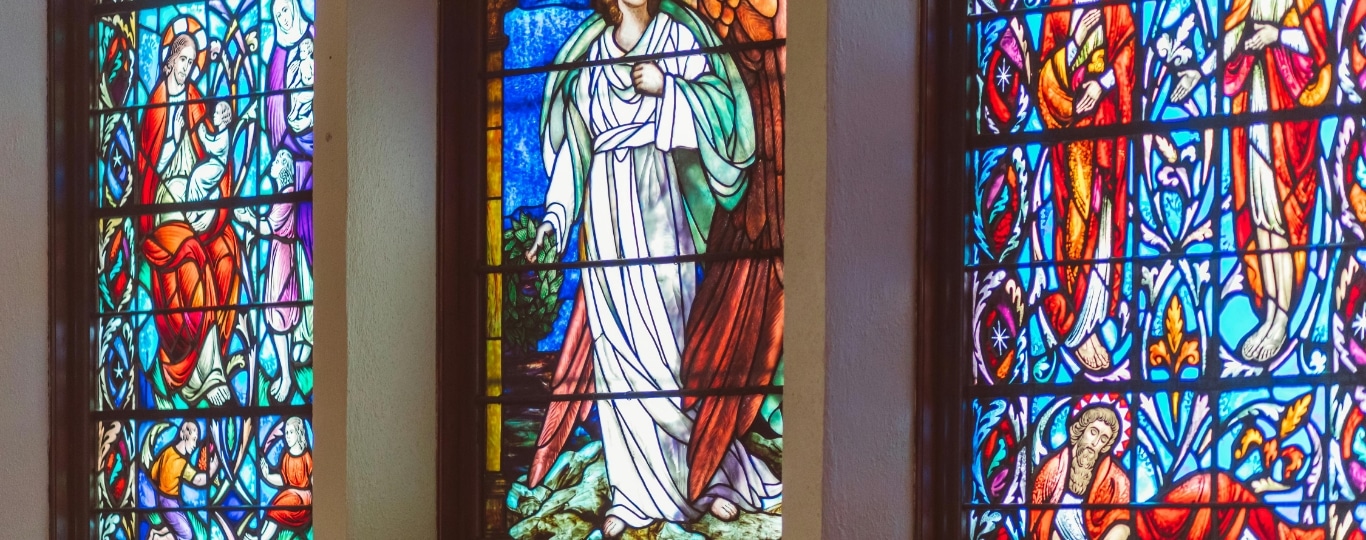
Second Sunday in Advent

†
“Mighty Word, GOD’s Spirit gave Man for heavenly life to save; Word through whose, all holy might, Man can and will do right. || Word of Life, most pure and strong, Word for which the Nations long; Spread abroad, until from night, all the world awakes to light.” (Book of Common Praise, #513)
The 1928 Book of Common Prayer contains many beautiful phrases, each pregnant with deep, biblical, and theological meaning. There is this phrase, for example: “We bless thee for our creation, preservation, and all the blessings of this life; but above all, for thine inestimable love in the redemption of the world by our Lord Jesus Christ.”1 Or this one, which you all must know as well as I do: “And we earnestly desire thy fatherly goodness, mercifully to accept this our sacrifice of praise and thanksgiving; most humbly beseeching thee to grant that, by the merits and death of thy Son Jesus Christ, and through faith in His blood, we, and all thy whole Church, may obtain remission of our sins, and all other benefits of His Passion.”2 — Yet, without a doubt, one of my most preferred phrases in the Prayer Book’s liturgical record, is the Collect for the Second Sunday in Advent: “Blessed LORD, who hast caused all holy Scriptures to be written for our learning; Grant that we may in such wise hear them, read, mark, learn, and inwardly digest them, that by patience and comfort of thy holy Word, we may embrace, and ever hold fast, the blessed hope of everlasting life, which thou hast given us in our Savior Jesus Christ. Amen.”3
“This is a 1549 Collect, one of the first that the Archbishop Thomas Cranmer wrote, reflecting upon the new interest of the Reformation period in acquainting the people with the contents and teachings of the Bible, in (as ++Cranmer himself put it), the ‘vulgar tongue;’ viz., ‘the English language.’ This favorite Collect of mine, and many Anglicans besides, has given a peculiar tone to this day, such that it is commonly called ‘Bible Sunday.’ Today’s Collect was suggested by our Epistle, but it has little to do with the primary themes of Advent, other than the general thought that our hope of eternal life ‘given us in our Savior Jesus Christ,’ is established for us by the revelation of God’s written Word (cf. Article VI).”4 Of course, the challenge for Christians of all time, and especially, perhaps for the 21st century Church, is to understand how we go about interpreting the Bible and applying it to our lives? In some circles, the choice is between an academic and a pragmatic approach. — If we choose an academic approach, then the debate of historical accuracy, claims to inerrancy, as well as textual analysis of authentic authorship, will be those things we might weigh as the most important when addressing Holy Scripture. Or, if our goal is to apply the Bible pragmatically to our lives, then we might debate whether the text, in every situation, is to be taken literally or figuratively in our application. — Either way, academic or practical, both will influence our faith and practice in the culture in which we live as Christians.
Yet, the Bible does not give us the option of choosing between an intellectual or pragmatic approach. In fact, carefully we should listen carefully again to today’s Collect, which lays out for us exactly how we are to approach GOD’s Holy Word: we are to hear, read, mark, learn, and inwardly digest it. That is, we are to engage the narratives, proverbs, poetry, history, and the commands of Holy Scripture holistically – mind, heart, and body. — We would be wise, nonetheless, to carefully study GOD’s Word, so that we can properly understand and apply it. For it would be unwise to take seriously certain applications of the Scriptures within the culture of our contemporary lives? I mean, should we take Leviticus 11:7? If so, does that mean we can no longer play or admire the game of American football, as no God-fearing Christian would thus touch or promote the touching of the skin of a dead pig? Or how about Leviticus 19:19, taking this text literally, is my family required at our next holiday gathering to stone my mother-in-law because she regularly wears garments made of two different types of thread, or my brother-in-law, because he plants corn next to his potatoes in his garden?
These are commands of the Bible, and they were applied (seriously and really) to the ancient people of Israel, who first received these divine oracles. Yet, they were done so for a purpose, and only for a particular time in GOD’s salvation plan in history. Thus, we seek the wise counsel of the Thirty-Nine Articles of Religion of the Anglican Church. These contemplate and make clear that we are no longer required to adhere to these ancient Hebrew ceremonial and civil laws, while yet remaining responsible for GOD’s moral laws, summarily referred to as the Decalogue (the Ten Commandments). (cf. Article VII– Of the Old Testament) — So, how should we, St. Mark the Evangelist, in Waxahachie, TX., of Ellis County, understand and apply the Holy Scriptures of GOD to our lives?
This is where I think many people check out from what the Collect encourages in the pursuit of patience and comfort by saying to themselves: “I am too busied about matters of the commonwealth of the USA; I bear this office, or that; I am a craftsman, a homemaker; I must apply myself to my occupation. I have a spouse, my children must be fed, and I must provide for my household. I am a man or woman of the world. It is not for me to read the Scriptures. That belongs to them that have bidden the world farewell, and which live lives in solitude and contemplation, being brought up and continually nuzzled in learning and religion; [like our vicar – that is his role].”5 And there are some here who “will say, per chance, ‘These things apply to the Old Covenant Jews, what have we to do with them?’ Indeed, they pertain to them and, no less, to us Christians. For if we be the people of GOD, how can the word and law of GOD from the Old Testament or New Testament Scriptures (understood correctly), not appertain or apply to us?”6
For example, St. Paul, in today’s Epistle Lesson from Romans fifteen, draws one text out of the Old Testament, concluding generally, that ‘Whatsoever is written before is written for our instruction.’ — There, the Apostle is drawing an inference from Psalm 69:9, where the Christ, who is JESUS of Nazareth, assumes the shame of sin that would otherwise fall onto GOD’s people for their misdeeds. And yet, He, the Christ, though being innocent and without sin, says: “The reproaches of those that reproach you, fell on me.” — By hearing, reading, and marking, learning, and inwardly digesting GOD’s Word, we will understand that Paul is encouraging the church in Rome to assume the attitude of Christ, thereby bearing the burdens of conscience for the benefit of their weaker brothers and sisters. For there were some new Christians in Rome who were at risk of offense, and therefore risk of falling away from the Faith.
Paul was discouraging the more mature brothers and sisters from participating in certain meats, drinks, rites, and ceremonies which would otherwise offend the younger Christians’ sensibilities. Thus, St. Paul directs them all to the study of the Scriptures, and thus, he writes to the Roman Christians exhortingly: “We then who are strong ought to bear with the scruples of the weak, and not to please ourselves. Let each of us please his neighbor for his good, leading to edification [of the whole congregation.] For even Christ did not please Himself, but as it is written, ‘The reproaches of those who reproached You fell upon Me.’ For whatever things were written before [in the Old Testament], were written for our learning, that we through the patience and comfort of the Scriptures might have hope” (Romans xv.1-4). — Such learning of the revealed knowledge of GOD for the salvation and edification of mankind in the Christian Faith comes by hearing, reading, marking, learning, and inwardly digesting the Holy Scriptures.
Brothers and sisters, “If we profess Christ, why are we not ashamed to be ignorant in His doctrine? I ask you, is it not normal that every man should be ashamed to be ignorant in that learning which he professes? Is not the man ashamed to be called a philosopher who reads not the books of philosophy, or to be called a lawyer, an astronomer, or a physician, that is ignorant in the books of law, astronomy, and physic? How can any man then say that he professes Christ and His religion, if he will not apply himself to read and hear, to learn and mark, and so to know the books of Christ’s Gospel and doctrine?”7 Remember what the LORD JESUS said to the people of His own making of the Pharisees and Sadducees, who refused the clairvoyant truth of the revelation of His divine oracles: “Are you not therefore mistaken, because you do not know the Scriptures nor the power of GOD?” (St. Mark 12.24). The point being, JESUS says, ‘whoever reads the Holy Scriptures, let him understand, obey, and live.’
Dear St. Mark’s, let us not forget how fortunate we are to live in this day and time, when we have access to every modern and historic translation of the Bible, either in the vulgar English, Greek, and or Hebrew tongues. “For, at the time when today’s Collect was drawn up, the case was a very common one indeed of those who, while they could ‘hear’ the Scriptures read, could not (either from want of education, or from scarcity of Bibles) ‘read’ them for themselves … At that time, the people of the parish (stimulated partly by curiosity to know its contents, partly by a sincere desire for some acquaintance with GOD’s Word), were forced to gather around the lectern, to which the great black letter Bible was chained. And there they listened to the reading of the Holy Scriptures by the village schoolmaster, or anyone who happened to be a scholar among them. — Our ‘hearing’ of the Scriptures, nowadays, is mostly confined to hearing them read in the Church Service; and how listless, alas, has that hearing oftentimes become; when instead, it might be a real means of grace, if the hearers made an effort to attend, either by following the reader in their Bibles, or by reading, marking, learning, and inwardly digesting the lessons privately before coming to Church, gaining the more from hearing them read and explained.”8
In this humble and exciting time of penitence, preparedness, and expectation, which we call Advent, let us, dear St. Mark’s, heed the exhortation of today’s Collect prayer. Let us with patience and comfort, readying ourselves for Christ JESUS’ Return, embrace and ever hold fast to the blessed, everlasting hope that is found in Christ JESUS alone, through hearing, reading, marking, learning, and inwardly digesting all Holy Scriptures which have been written for our learning. “These books, therefore, ought to be much in our hands, in our eyes, in our ears, in our mouths, but most of all in our hearts. For the Scriptures of GOD are the heavenly meat of our souls; the hearing and keeping of them maketh us blessed, sanctified, making us holy; they turn our souls unto the knowledge of GOD; they are a lantern which enlightens our feet; they are a sure, steadfast, and everlasting instrument of salvation; they give wisdom to the humble and lowly hearts; they comfort, make glad, cheer, and cherish our consciences; they are a more excellent jewel or treasure than any gold or precious stone; they are more sweet than honey or the honeycomb; they are called the best part, for they hath in them everlasting comfort. The words of Holy Scripture are GOD’s instrument; they have power to enlighten us to GOD’s promises, and being received in a faithful heart, they have an ever-heavenly and spiritual working in them … such by true knowledge and understanding of them, the most necessary points of our duty towards GOD and our neighbors might be known.”9 — The Holy Scriptures, they be the Word of Life, most pure and strong; Word for which the Nations long – Word through whose all holy might, men like you and me, can and will do right. — St. Mark’s, dear church, may we be thus persuaded by GOD’s Holy Word, written for our learning. — Happy reading, marking, learning, and inwardly digesting! Amen.
***
1 1928 Book of Common Prayer, 33.
2 1928 BCP, 81.
3 1928 BCP, 92.
4 Shepherd Jr., Massey, H., The American Prayerbook Commentary, (New York, Oxford University Press, 1950), 166.
5 Thomas Cranmer, Archbishop of Canterbury. LectionaryCentral.com. “A Prologue or Preface to The Great Bible, 1540.” Accessed December 2025. https://www.lectionarycentral.com/advent2/1540Preface.html
6 Cranmer, LectionaryCentral.com.
7 Various Anglican Divines, The Book of Homilies, (Nashotah: Nashotah House Press, 2013), 169.
8 Various Anglican Divines, 4-5.
9 Various Anglican Divines, 2-4.

Join Us for Biblical Worship, Study, & Fellowship
Sundays:
Morning Prayer 9:45 am
Coffee & Catechesis 10:30 am
Holy Communion 12:00 pm
Thursdays:
Holy Communion 6:00 pm
Recent Sermons
Advent Sunday

Worship with Us
Join us for Biblical worship, study, and fellowship. We currently meet in the sanctuary of Christ the King Lutheran Church in Waxahachie.
The Order of Morning Prayer
Sundays at 9:45 am
Coffee and Catechesis
Sundays at 10:30 am
Holy Communion
Sundays at 12:00 pm and Thursdays at 6:00 pm