Second Sunday in Lent
†
The Old Testament lesson opened today by saying that ‘GOD has no grandchildren.’ – Well, those were not the exact words used in the text written by the prophet Ezekiel, but that is what was meant. The words were: “What do you mean when you use this proverb concerning the land of Israel, saying: ‘The fathers have eaten sour grapes, and the children’s teeth are set on edge’?” (18,2). – You see, Ezekiel was pronouncing a forthcoming judgment of GOD upon His people which would be so profound, that “Though these three men, Noah, Daniel, and Job, were in Jerusalem, they should deliver but their own souls by their righteousness, [and none else]” (Ezekiel 14,14). – This judgment of GOD, would come in 586 B.C. in the form of the Babylonian invasion, resulting in the captivity and death of many in Jerusalem, and the ultimate destruction of the Temple. And as he laid out the judgment to come, the people of Ezekiel’s day proclaimed this proverb that laid the blame of their inevitable punishment at the feet of their forefathers, who they said, had eaten ‘sour grapes’, (viz. sinned against GOD). Israel was questioning GOD’s justice, for they could not see the reason for His anger towards them, in which they were having their teeth set on edge for fear of divine retribution. – Israel did not understand, as many Christians do not either: GOD has no grandchildren. – “‘Even though Noah, Daniel, and Job were in [Jerusalem’s Israel], as I live,’ says the LORD GOD ‘they would deliver neither son nor daughter; they would deliver only themselves by their righteousness’” (Ezekiel 14,20).
We do not often think of it, but the driving force of JESUS’ gospel message during His earthly ministry was one of repentance. Early in the LORD’s ministry, just after He was baptized and John was put in prison, JESUS said to His followers: “The time is fulfilled, and the Kingdom of GOD is near. Repent and believe the Gospel!” (St. Mark 1,15). Much later, when He turned His face towards Jerusalem on His was to the Cross, the LORD preached repentance to all as He went through Israel’s cities. On one occasion, one of His disciples said to Him, “‘LORD, are there few who are saved?’ And JESUS said to them, ‘Strive to enter through the narrow gate, for many, I say to you, will seek to enter and will not be able’” (St. Luke 13,22-23). — Whether overtly, or cloaked in His parables, the LORD’s message to Israel and her people was personal repentance and accountability. – Why? – It is because GOD does not have grandchildren.
To help us understand this point better, on this the Second Sunday in Lent, our Anglican forebears appointed that we should read this day from the book of the prophet Ezekiel. – In this text, as we have already pointed out, the people of Israel were wrestling with Ezekiel’s prophecy that the LORD would command the Babylonians to come from the north to sack and destroy Jerusalem, with many of the people being taken into captivity, killed, or dispersed amongst the Gentile nations. The LORD said to Ezekiel, “Son of man, you dwell in the midst of a rebellious house, which has eyes to see but does not see, and ears to hear but does not hear; for they are a rebellious house … they shall be carried away into captivity … Then the cities that are inhabited shall be laid waste, and the land shall become desolate, and you shall know that I am the LORD” (Ezekiel 12, 2, 11c, 20). – And in response to this, the people were embittered against GOD.
The people of Israel knew well, “That those who are guilty of willful sin, eat sour grapes; they do that which they will smart and bruise – sooner or later. The grapes may look well enough in the temptation, but they will be bitter as bitterness itself in the reflection. They will set the sinner’s teeth on edge. When conscience is awake, and sets the sin in order before them, it will spoil the relish of their comforts as when the teeth are set on edge. But Israel suggested [GOD’s judgment] as unreasonable that the children should smart for their fathers’ folly – feeling the pain of that which they never tasted the pleasure of…”1
The mistake that Israel made was presumption. They thought that they could leverage their status as the chosen people of GOD to define justice on their terms. – Such a privilege was never presumed upon them, and thus the ALMIGHTY responds to them in Ezekiel 18,25 by saying: “Yet you say, ‘The way of the LORD is not fair.’ Hear now, O house of Israel, is it not My way which is fair, and your ways which are not fair?” – To prove His point, the LORD tells Israel that He has no grandchildren. He says, “When a righteous man turns away from his righteousness, commits iniquity, and dies in it, it is because of the iniquity which he has done that he dies. Again, when a wicked man turns away from the wickedness which he committed, and does what is lawful and right, he preserves himself alive. Because he considers and turns away from all the transgressions which he committed, he shall surely live; he shall not die” (Ezekiel 18,26-28).
The reason GOD has no grandchildren is because every soul is responsible to GOD for his/her own life: for sin and for obedience. – Earlier in Ezekiel 18, the LORD explains, “Behold, all souls are Mine; the soul of the father as well as the soul of the son is Mine” (v. 4). – As beings created in the image and likeness of GOD, our accountability is to Him, and we can blame only ourselves for a lack of a personal relationship with Him. – Thus, the LORD says, “If [a man] begets a son who sees all the sins which his father has done, and considers but does not do likewise … He shall not die for the iniquity of his father; he shall surely live! … [Conversely], If [a man] begets a son who is a robber or a shedder of blood … He shall surely die; his blood shall be upon him … The righteousness of the righteous shall be upon himself, and the wickedness of the wicked shall be upon himself” (Ezekiel 18, 14, 17, 10, 13, & 20b).
Unfortunately, Israel of JESUS’ day was not much different than Israel of Ezekiel’s day. They too thought that their status as GOD’s special people entitled them to special privileges – kind of like grandchildren. – The irony is that they were special, and this is the point. For, to Israel were committed the oracles of GOD – to them was the divine adoption as sons, the glory, the covenants, the giving of the law, the service of GOD in His Temple, and the promises [in the flesh, of the coming of the Jewish Messiah]” (Romans 9,4-5). And like in Ezekiel’s day, the Jews of JESUS’ day needed Ezekiel’s lesson all over again: the righteousness of the righteous upon himself, and the wickedness of the wicked upon himself.
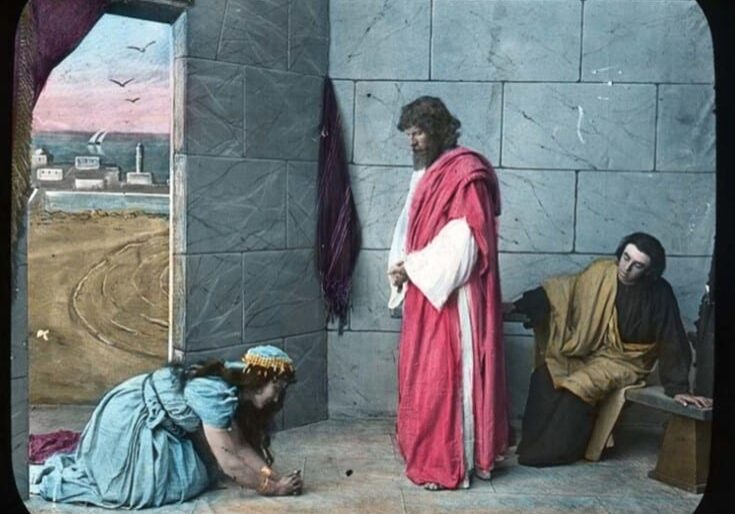
To underscore this truth of personal accountability, we meet a most interesting protagonist and heroine in today’s Gospel Lesson. In enters a Syro-Phoenician woman. The purpose of her introduction, I believe, is not to affix blame as to who sinned or who did not sin, but to underscore a greater theological truth, which I will soon make known to you.
The first thing we should note, is that this Gentile woman knew, not only the importance of personal accountability, but also the virtue of selflessness and personal sacrifice for the lives of others. We see this truth, because this woman had come from the area north of Israel, learning of JESUS healing ministry, for the sake of her daughter, who was stricken with demon-possession. As one commentator writes, if her daughter’s teeth were to be set on edge, it would not be because of the Syro-Phoenician woman’s predilection for sour grapes. She was not interested in blame, but healing. Thus, “she made the misery of her little child, her own.”2 This is incredibly important, because this woman, a Gentile, does not come to JESUS seeking justice, but mercy. She does not come to take issue with the LORD that her daughter’s infirmity is the blame of GOD or of anyone else. Instead, she concludes that JESUS is the Jewish Messiah – the One, she has heard, has blessed many people with the power of His healings.
The woman approaches JESUS and cries out after Him repeatedly: “Have mercy on me, O LORD, Son of David! My daughter is severely demon-possessed” (St. Matthew 15,22). – Not being a child of the promises of the covenants of GOD to Israel, this was a strange appellation to make, a Gentile unto JESUS. Many commentators explain that this request, formulated as the Syro-Phoenician woman did, as the reason JESUS does not respond to her. – This woman could have used the title ‘Son of David’ rightfully, if she had understood the meaning of the promises made by GOD to Israel concerning the Messiah. “If used without that knowledge, it was an address by a stranger to the Jewish Messiah, Whose works would have only been miracles, and not primarily signs, [pointing to His divinity, and thus Lordship] … To have granted her the help she so entreated, would have been, as it were, to reverse the whole of His Teaching, and to make His works of healing merely works of power.”3
Do you understand? – JESUS was not a parlor magician with a few tricks up His sleeve. He was not a wizard or a conjurer of spells and enchantments to amaze the people. His power pointed towards something greater than the works themselves – towards Who He is, and Whose representative He was on earth. — Listen to the LORD’s words carefully as we overhear Him speaking with the Apostle Philip about His works and their meaning: “Have I been with you so long, and yet you have not known Me, Philip? He who has seen Me has seen the Father; so how can you say, ‘Show us the Father’? Do you not believe that I am in the Father, and the Father in Me? The words that I speak to you I do not speak on My own authority; but the Father who dwells in Me does the works/miracles/signs. Believe Me that I am in the Father and the Father in Me, or else believe Me for the sake of the works/miracles/signs themselves” (St. John 14,9-11). – JESUS’ miracles were not solely works of power; they were signs/tokens that declared that He was not only the ‘Son of David’, but the divine ‘Son of GOD.’
As for the Syro-Phoenician woman’s plea for the release of her daughter from the demon’s control, that plea “meant something to which Christ JESUS could not have yielded.”4 Her approach as a heathen to the Jewish world was correct – but for the power of the Messianic LORD, she was short in her understanding and approach. – As such, JESUS remained silent, having only the bread of blessing for Israel. – – – JESUS’ silence is uncomfortable to the point that even the disciples ask the LORD to speak and tell the woman to leave for her persistent appeal.
The woman then cries out to JESUS in desperation, apparently moved to confession in truth to another rumor that she must have also heard about JESUS. – This time, she uses a cognomen that spoke to JESUS’ heart, and one which He could not ignore. It was the title used to describe JESUS in New Testament dialogue by those who trusted in His profound self-acclaim to divinity. – She said, “LORD, rescue me!”
This Gentile woman abased herself to the One to Whom her soul was owned. To communicate her belief and trust, she made herself so low for the sake of her daughter and cried out to GOD in Christ for salvation. Not being able to share with her the fineries of the promises of Israel’s table as the ‘Son of David’, the woman begged the Master of the House, only for the crumbs that fell from the Divine LORD’s table. The woman positioned herself as a domesticated animal under the care of a gracious householder, because she desired for her daughter, only the smallest crumbs of mercy from the Master’s table. – The Syro-Phoenician woman, by faith, did what the Jewish people of Ezekiel’s day and the Jewish people of JESUS’ day refused to do: to be made free by the words and works of Christ JESUS, accepting Him for the Person His words and works proclaimed Him to be: LORD and Savior. She understood that she was a daughter, and not a granddaughter of GOD, and turned from unbelief to belief so that she and her family would not die in their sins. — Even without the oracles, the Law, the Temple, and the promises, she knew she was accountable to none other than GOD in Christ, and thus she submitted to Him, and He heard His child’s cry, and healed her daughter.
Brothers and sisters of St. Mark’s, we are not GOD’s grandchildren, and whether sin, tribulation, or trials, our hope must be in the LORD GOD for deliverance. As King David contemplated GOD’s role in his life in Psalm 32, he wrote, “Thou art a place to hide me in; Thou shalt preserve me from trouble; Thou shalt compass me about with songs of deliverance.” (v.8)
If today you have learned that as a Christian you are not a grandchild of GOD, but a child of His, then something good has happened! I understand that for some, the thought of GOD as Father and JESUS as LORD is unsettling – our personal histories color over the idea of intimacy with GOD as Father with memories of the wounded-past. But this is why today’s message is so important. It is the same reason why it was important for Israel in Ezekiel’s time – for Israel in JESUS’ time – for the Syro-Phoenician woman – and for you and me in our present time. “The LORD does not afflict willingly, nor try the [human soul] needlessly, nor disguise His loving thoughts and purposes, to bring about some effect in us. He needs not such means; and, with reverence, be it said, we cannot believe that [our Father ever uses such devices on His children].”5
Like a child before his/her father, everyone is accountable before GOD for his/her life and the way he/she leads that life, be they Jew, Gentile, ‘children’, or ‘dog’. – But the Holy Scriptures are clear: GOD does not desire the suffering a little Syro-Phoenician girl, or a blind man, or a member of St. Mark the Evangelist Church. So, whatever our travails are, have been, or will be, let us not misunderstand who JESUS is – He is the One that shalt preserve us from trouble and compass us about with songs of deliverance. – We are accountable to none other, for our souls are His. — Let it not be said of us, dear Church, that our teeth are set on edge because of the grapes our forefathers ate. – Let us in this season of holy Lent, ‘Cast away from ourselves all the transgressions which we have committed, and get ourselves a new heart and a new spirit, for why should we die, O house of GOD? For the LORD has no pleasure in the death of one who dies. Therefore, let us turn to Him for crumbs and live!’ For He is our Father, and we are His children – of grandchildren, He has none. Amen.
1 BlueLetterBible.com. “Matthew Henry’s commentary on Ezekiel 18,2”. Accessed 13 March 2025. https://www.blueletterbible.org/Comm/mhc/Eze/Eze_018.cfm?a=820002
2-4 Edersheim, Rev’d Fr. Alfred, The Life and Times of JESUS the Messiah, (Peabody : Hendrickson Publishers, 1993), 501.
5 Edersheim, 502.

Join Us for Biblical Worship, Study, & Fellowship
Sundays:
Coffee and Fellowship 8:30 am
Catechesis for all ages 9:00 am
Holy Communion 10:30 am
Recent Sermons
Sixteenth Sunday after Trinity

Worship with Us
Join us for Biblical worship, study, and fellowship. We currently meet in the sanctuary of Christ the King Lutheran Church in Waxahachie.
Catechesis for Adults and Children 5+
Sundays at 9:00 am
The Order of Holy Communion
Sundays at 10:30 am
Fellowship Opportunities
See our calendar for other weekly and special events.