Seventh Sunday after Trinity
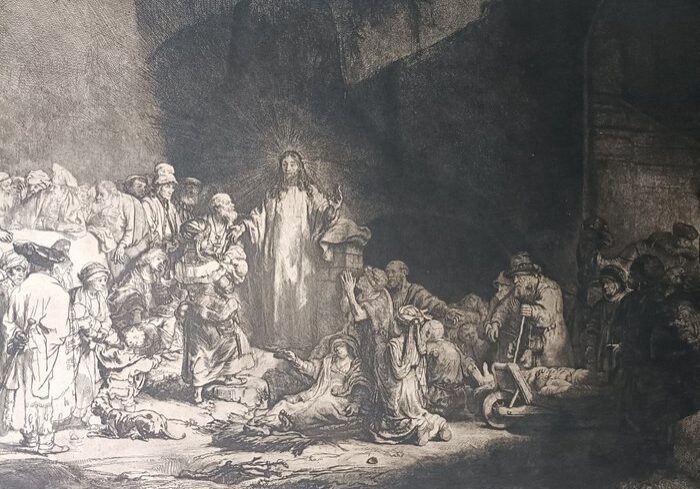
There are significant similarities in JESUS’ miraculous feedings, of which there were two. The first was to the five thousand Jews in Galilee, and the second is found in today’s Gospel Lesson of St. Mark, eight. Here, JESUS feeds four thousand people, a mix of Jews and Gentiles in the Decapolis, or ten northern cities to the east of the Sea of Galilee. The LORD had recently come from healing the Syrophoenician woman’s demon-possessed daughter in Tyre and Sidon, on the coast of the Mediterranean Sea. Still moving away from the ire of the religious leaders of Jerusalem (who sought to apprehend Him and kill Him), JESUS finds himself at the farthest northern territories of His earthly trek. And here, the LORD does what He has done before: He has compassion on the multitudes by feeding them.
As with the five thousand, JESUS has the four thousand sit down and prepare themselves for a meal. The LORD takes the means which are provided to Him, seven fish and a few loaves of bread, and He gives thanks to GOD the Father, blesses them, breaks them, and then gives them to the disciples to distribute to the people. As with the meal for the five thousand, this meal is transformed into food which provides life and nourishment for the representatives of the nations – Jew and Gentile. Then, after the meal, JESUS has his disciples gather up the leftover fragments, sends the people away, and then departs with His disciples.
Now, where these two miraculous feedings grow dissimilar, we can find several distinctions. The first is that these people from the region of the Decapolis, besides not being a purely Jewish multitude, had been with JESUS, faithfully for three days, enduring with Him until He would heal every sick person among them. — They had heard of JESUS from His work in the Gentile territory of Tyre and Sidon, and for His ministry in and around the Sea of Galilee. — It was not far from this place that JESUS currently ministered, that the man had lived from whom JESUS had driven a legion of demons, even the demoniac of the region of the Gerasenes. Thus, JESUS has mercy on them, as they, being prepared initially for their extended time with Him, were now running low on provisions. — Reading from the parallel account of this story from St. Matthew’s Gospel, chapter fifteen, we read: “Then great multitudes came to Him, having with them the lame, blind, mute, maimed, and many others; and they laid them down at JESUS’ feet, and He healed them … Now Jesus called His disciples to Himself and said, ‘I have compassion on the multitude, because they have now continued with Me three days and have nothing to eat. And I do not want to send them away hungry, lest they faint on the way’” (St. Matthew 15.30 & 32).
Like the Syrophoenician woman who would not let JESUS go until He healed her daughter, these mainly Gentile followers of Christ would not let Him go until He healed their sick and needy. Thus, the LORD fed these people so well, that they had seven baskets of leftovers collected after they finished eating. — I know what you are thinking, if you know the result of the feeding of the five thousand: ‘They had twelve baskets leftover after finishing JESUS’ miraculous meal. So, what is the point you are trying to make?’ — Let us just say, not all baskets are the same.
The Greek words used for the baskets in the feeding of the five thousand and the four thousand were very different. The baskets of the five thousand were small handbaskets, carried in everyday journeys by individual Jews, which might hold a lunch for two people. After the miraculous lunch of the five thousand, twelve baskets had been gathered; probably one for each of the Disciples. — The baskets of the miraculous feeding of the four thousand were large hampers and were probably what these people used to store their food, intent on being with JESUS for several days. This same type of basket was also said to be the type of basket that St. Paul used to escape a death trap in Damascus when his friends lowered him “by night through the wall in a basket” (Acts 9.25). — As one commentator wrote, highlighting the distinction of the two feedings, and the faith of the crowds found therein: “The deliberate alternation between kophinos (handbasket) and spyris (hamper) underscores the accuracy of the eyewitness accounts and the LORD’s intentional teaching: two different crowds, two different miracles, two different words (teachings) for two different containers (people).”1
Undoubtedly, both meals were wonderful miracles, no matter the intentions of the hearts of the people who partook of them, or their ultimate verdict on the case for Christ. What is worth noting is the response of the people of the Decapolis versus the response of the people of the Sea of Galilee to GOD.
After their feeding, the five thousand went looking for JESUS the next day, so that they could, as St. John records in his Gospel, ‘seek a sign from JESUS, that they might believe in Him.’ (cf. St. John 6.30) On the other hand, the four thousand, after their feeding, we are told, dispersed satisfied, trusting the LORD for His goodness and promises, not demanding any more proof that He was the Messiah, but “glorified the GOD of Israel” (St. Matthew 15.31). — Two different crowds … two different receptions by two different types of people. The Jews rejected the message and the miracle – the mostly Gentile crowd, received the message and the miracle, like the Syrophoenician woman, begging like dogs for the crumbs of the children. Thus, JESUS fed them with the Bread from Heaven that the Jews would not eat.
How do you respond to GOD? Sometimes He does what we hope He will, and sometimes He does not. How do you respond to Him? Is not He the same GOD whether He gives you a sign or not. — Sign or no sign, do you go away glorifying Him? — The response to the miraculous feeding of the two groups, the five and the four thousand, reflected their heart attitudes toward GOD. JESUS led both groups to the same point of seeing the power of GOD and the love of GOD, yet their responses were entirely different. — Like a shepherd, JESUS leads us every single day, if we are following Him, living in His Word and walking with His Body, to a place where we can see the glory of GOD and the work He has done. Every day, He gives us new heart beats, new breaths, new panoramas of His creation, new time to spend with our loved ones, new words to communicate His life, truth, and love to the world that He wants to redeem as He has redeemed us. And more importantly, He transforms His precious Body and Blood that we bless, break, and give into the life of His Son, so that we can all have life in His Name. And having life in His Name, through Christ, GOD mysteriously give us His identity – for we are the ‘people of His pasture, and the sheep of His hand.’ He longs for union with us through His Mediator, JESUS.
I think the most profound commentary I have yet given on today’s Gospel is the most mundane aspect of it. However, it’s certainly not ordinary, is it? That is, that the feeding of the five thousand and the feeding of the four thousand were so similar in their execution, that one must infer that JESUS was no respecter of persons; viz., He neither favored the Jew over the Gentile, nor the Gentile over the Jew. — Yet, the people did favor the LORD JESUS differently. The one wanted to make JESUS king for their own purposes (cf. John 6.15), and the other saw in Him a reason to bless the King of Heaven. One group sought salvation through the Head of a political and military system, while the other found salvation in the Head of the Church of GOD, content with His provisions and glorifying the ALMIGHTY as they went.
The five thousand made the mistake of ethnic Israel at the time of Saul, and they desired an earthly king like Saul, so they could ‘be like all the nations; their king judging them, and going out before them, and fighting their battles.’ (cf. 1 Sam.8.20). In so doing, the five thousand ‘rejected GOD, that He should not reign over them.’ (cf. 1 Sam. 8.7). On the other hand, the four thousand, like Peter and the disciples, by their trust of JESUS and His leading as their Shepherd, they faithfully proclaim, “You have the words of eternal life, [JESUS]. Also, we have come to believe and know that You are the Christ, the Son of the living God” (St. John 6.68-69). — “The pattern is clear: wherever the LORD acts, His people respond with visible and audible verbal glory. This connection between divine initiative and human exaltation mirrors the Old Testament refrain, ‘Not to us, O LORD, but to Your Name be the glory, for Thy mercy, and for Thy truth’s sake (Psalm 115:1).”2
Of the two, which kind of people are we? Do we look for salvation from within the systems of the world’s kingdoms, or do we look for salvation from the spiritual Kingdom of Heaven? Do we look to the temporal things which are seen for salvation, or do we look to eternal things that are unseen by faith? (cf. 2 Cor. 4.18). How do we respond to GOD and go away from Him when He sends us out?
Good people of St. Mark’s – I hope we would side with the four thousand and gladly trust GOD in Christ for the fullness of His provisions to care for us and to give us eternal life, putting not our trust in anything else, no matter how good, beautiful, or virtuous in this world. — St. Paul sayeth, “For we were saved [from the bondage of corruption] in this hope [that we are heirs of GOD, and joint-heirs with Christ in eternal life] – but hope that is seen is not hope; for why does one still hope for what he sees? But if we hope for what we do not see, we eagerly wait for it with perseverance” (Romans 8.24-25).
On this Seventh Sunday after Trinity, let us hope with the saints of old in Christ, and trust in GOD’s eternal provisions, unseen. Let us, with the Psalmist say, ‘Not to us, O LORD, not to us, but to Your name be the glory.’ Let us, like the four thousand of the Decapolis, glorify GOD for His saving works and gracious provisions for our bodies and souls through the Bread He has sent down from Heaven. — And let us, with the saints of GOD in our age, say boldly with faith: “Guide me, O thou Great Jehovah, pilgrim through this barren land. I am weak, but Thou art mighty; hold me with Thy powerful hand. Bread of Heaven, Bread of Heaven, feed me now and evermore. Feed me now and evermore!”3 Amen.
1 BibleHub.org. “Lexical Summary of kophinos and spyris in Luke 12.58.” Accessed 30 July 2025. Strong’s Greek: 2894. κόφινος (kophinos) — Basket
2 BibleHub.org. “Lexical Summary of glorifying GOD (δοξάζω) in Matthew 15.31”. Accessed 31 July 2025. Strong’s Greek: 1392. δοξάζω (doxazó) — To glorify, to honor, to praise
3 Book of Common Praise, “Guide me, O Thou Great Jehovah”, (Newport Beach, Anglican Liturgy Press, 2019), 551.

Join Us for Biblical Worship, Study, & Fellowship
Sundays:
Coffee and Fellowship 8:30 am
Catechesis for all ages 9:00 am
Holy Communion 10:30 am
Recent Sermons
Twelfth Sunday after Trinity

Worship with Us
Join us for Biblical worship, study, and fellowship. We currently meet in the sanctuary of Christ the King Lutheran Church in Waxahachie.
Catechesis for Adults and Children 5+
Sundays at 9:00 am
The Order of Holy Communion
Sundays at 10:30 am
Fellowship Opportunities
See our calendar for other weekly and special events.