Third Sunday in Trinity
†
The world is not so sideways in its luck as people say; there still are futures of a healthful gain; rain still rains.
Lichens droop from spruces, wizard-gray; there are yet handsome gambles in this living game; rain still rains.
Below the dust crust, we strike water in the hushing cave; crystals lengthen, treasuring the downward way; rain still rains.
The world is not so startled in its lack as people say; we find lively flowers on the [cathedral’s] long [grave of] decay; rain still rain still rains.1
To appreciate the Parables of the Lost in our Gospel Lesson for today from St. Luke 15, we need to understand the theological variants of the concept of ‘finding’ and what it takes to be ‘found.’ Perhaps we should first say, within the Christian worldview, being ‘lost’ does not necessarily mean something fatal and irreversible. In JESUS’ Parables, the lost things were very lost, yet they could be found again; they were not irretrievable, viz., rain still rains. The Gospel narrative that epitomizes this theological concept best is something we will have to wait to hear in its full context on the Ninth Sunday after Trinity. Yet, for our purposes today, the zenith of that Gospel Parable climaxes with these shocking, yet hopeful and regenerative words raining down: “For this my son was dead and is alive again; he was lost and is now found” (St. Luke 15.24). The story of the Bible, and truly of all human history, is the story of being lost and found again … by GOD. — In the Garden, Adam and Eve, due to their sin, were lost in shame and nakedness, and GOD brought them near again by the blood and skins of the animals in which He covered them. The whole world was lost in evil beyond all understanding, and though humanity’s divine judgment caused them to be covered in the dousing deluge, GOD found mankind again by landing him on dry land; eight souls being saved through water and the grace of The Ark. — And perhaps most poignantly, the Nation of Israel was lost many times – in Egypt, in the wilderness, in Assyria, in Babylon, and in Jerusalem – And yet, even though their lostness was a result of their sin, GOD found them and brought them back to Himself again. Their lostness was not in every case irretrievable; they were, without a doubt, lost in the long grave of decay, but rain still rains.
We see an example of Israel’s lostness and its return to GOD highlighted in today’s Old Testament lesson from Jeremiah. — Even before the just judgment had been carried out against Judah for her sins of idolatry and faithlessness, GOD was wooing His people with a promise that He would one day find His Beloved. — In GOD’s worldview, repentant sons and daughters can be found and live again, in Him who is the Sovereign over time, space, matter, life, death, and regeneration. — Seventy-years before Judah would be released from her captivity in Babylon (the place where she was to be carried after the destruction of Jerusalem and the Temple), Jeremiah prophesied the Word of the LORD, saying: “The LORD hath appeared of old unto me, saying, ‘Yea, I have loved thee with an everlasting love, [Judah]: therefore, with lovingkindness have I drawn thee [back to myself]. Again, I will build thee, and thou shalt be built, O virgin of Israel: thou shalt again be adorned with thy tabrets, and shalt go forth in the dances of them that make merry. Thou shalt yet plant vines upon the mountains of Samaria: the planters shall plant and shall eat [their plantings] as common things. For there shall be a day, that the watchmen upon the mount Ephraim shall cry, “Arise ye, and let us go up to Zion unto the LORD our God” … Behold, I will bring them from the north country, says the LORD, and gather them from the coasts of the earth, and with them the blind and the lame, the woman with child and her that travaileth with child together: a great company shall return thither” (Jeremiah 31.3-6,8). — ‘For this my son was dead and is alive again; he was lost and is now found.’ — There still are futures of a healthful gain; handsome gambles in this living game, if GOD be the Purveyor of the rain that still rains still rains.
The Church Fathers upheld this view as well – the view that once lost, one’s ‘finding’ is still possible. Take Clement of Alexandria, for example. The head of the Catechetical School in Alexandria during the second century of Christianity, Clement is well known for his exposition on how all things impossible with man are possible with GOD – even more possible than threading a camel through the eye of a needle. — Clement published a long exposé on the ‘finding’ of the lost soul who loves his riches more than Christ. He says that such rich men think nothing of the Kingdom of GOD in Christ, either because the world selfishly and ingratiatingly kowtows before them unto an avarice end, or because they despair of themselves as unqualified to receive GOD’s merciful admission into His Kingdom. These men, thereby, take no precautions to prepare their souls for what they might hope in the form of salvation. – Of these, St. Clement says the following. These uniquely lost souls, due to the love of riches, “must first, by the Word of Christ, be relieved of their groundless despair, [for ‘whoever believes in Christ, shall be saved.’ Then,] with the requisite explanation of the oracles of the LORD, [that by obeying Christ’s commands in love], that the inheritance of the Kingdom of Heaven is not quite cut off from them, if they obey His commandments … for the LORD JESUS gladly receives them back who are willing, [no matter how vast their ‘lostness’].”2
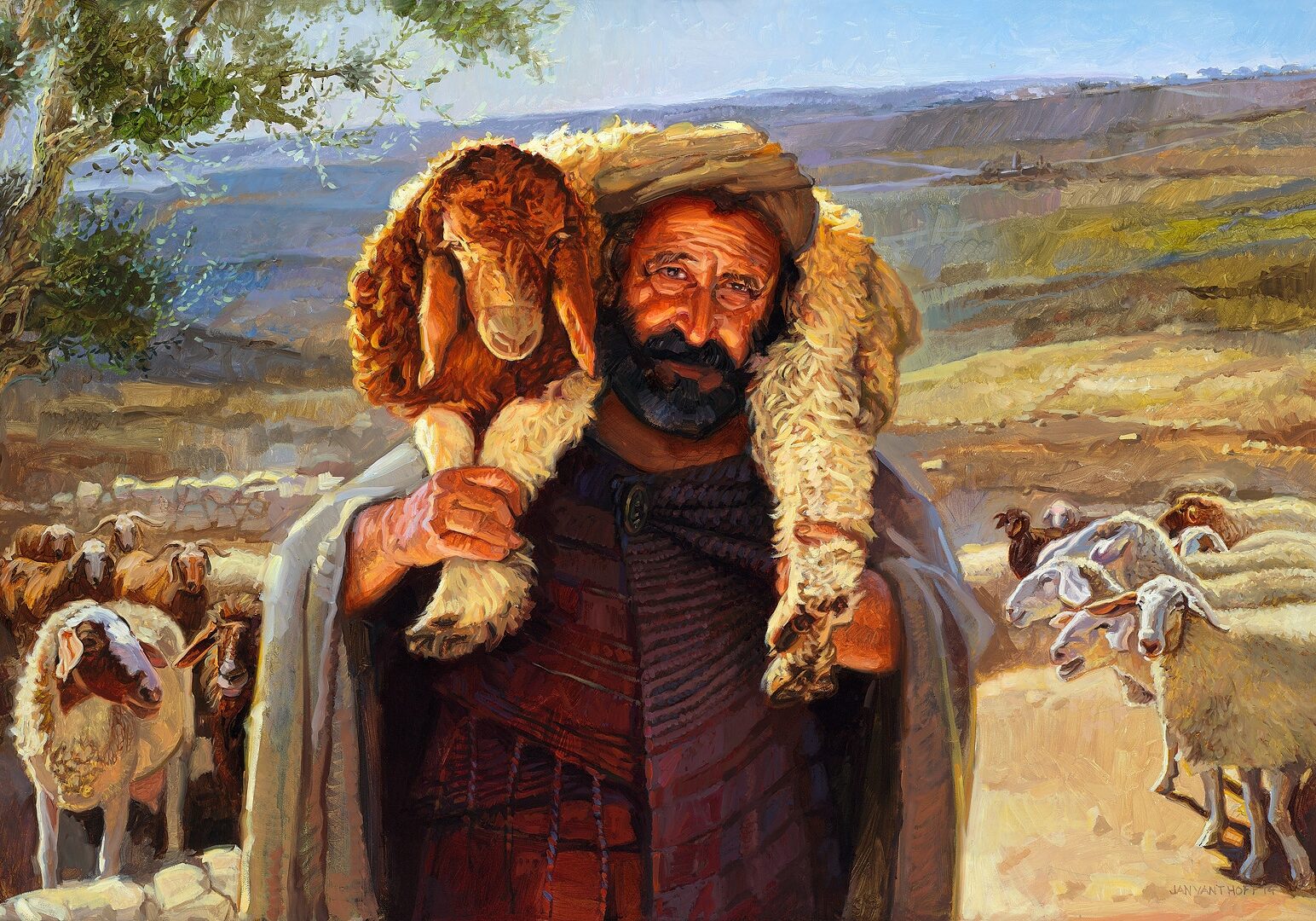
Considering what Clement has said, we should say that ‘finding’ is something GOD does for us; not something we do for GOD. It is the principal reason Christ had to come, to dutifully and diligently look for us, with Heaven’s boundless compassion and merciful endurance. We see this mercy and grace exemplified for the Church in the very Gospel Parables we have read this morning. Each of them highlights, not how something was lost and then found, but rather, how someone found something that was lost. — In the first instance, a shepherd loses 1% of his flock. This would seem a meager loss on the grand scheme of things. For certainly 99% of the flock, well preserved and healthy, could, by their sheer numbers as a force multiplier, easily make up for the lost one of the flock. And in fact, through their multiplication, replace the lost one many times over. Any pragmatical entrepreneur would write off the loss as a function of doing business and move on, but not the Good Shepherd. The Good Shepherd, as we learned the Second Sunday after Easter, “knows His sheep … and lays down His life for [each] sheep” (St. John 10.14-15). Thus, JESUS says in His Parable: “What man of you, having a hundred sheep, if he lose one of them, doth not leave the ninety and nine in the wilderness, and go after that which is lost, until he find it? And when he hath found it, he layeth it on his shoulders, rejoicing” (St. Luke 15.4-5). — Dear church, this is the Good News: In the economy of the Father’s heart, all who are willing are welcomed back home again. For it is GOD who values each of His sheep, no matter their lost condition, even over the ninety and nine that are already ‘found’; safe and sound in their sheep pen.
The longing of the Father is to welcome the lost home again, but the strength of this point is missed if the context of JESUS’ telling of this parable is not drawn out. Luke captivates our imagination with the Gospel’s potency in JESUS’ opening words of this parable. — “Then drew near unto JESUS all the publicans and sinners for to hear him. And the Pharisees and scribes murmured, saying, ‘This man receiveth sinners, and eateth with them'” (St. Luke 15.1-2). — It appears JESUS was always at odds with the Pharisees and scribes over the way the LORD treated the ‘lost’ versus the way the religious leaders treated the ‘lost.’ — “It was shown that the Jewish teaching concerning repentance was quite other than – nay – quite contrary to that of Christ. Theirs was not a Gospel to the lost: in fact, the Pharisees and scribes had nothing nice to say to sinners. They called upon them to ‘do penitence,’ and then Divine Mercy, or rather Divine Justice, would have its reward for the true penitent – if they be a “true” penitent. Contrarily, Christ’s Gospel was specifically to the lost. It told them of forgiveness, of what the Savior was doing to bring them home, and of how the Father felt for them. Furthermore, and perhaps most significantly, that now, due to GOD’s grace and mercy, the truly penitent soul would inherit his reward of ‘welcome home.’ — a bouquet of flowers in the cathedral’s graveyard of long decay.
From what we know of the Pharisees, we can scarcely wonder that ‘they were murmuring at Him, saying, this man receiveth “sinners,” and eateth with “publicans.” … Their charge, as made, was true, ‘this One – JESUS,’ in contrariety to the principles and practices of Rabbinism in Israel, ‘received sinners,’ and, as such, [found them, and laid them over His shoulders, rejoicing as He brought them home with painstaking care and tenderness to His fold.]”3 For in the parable of the lost sheep, it is the result of the unwearied labor of the Good Shepherd, passionately desiring to always keep His sheep with Him and in Him. — Isaiah is bold to encapsulate the doctrine of GOD’s ‘finding’ theology in his prophecy, when he says of YHWH Elohim: “I have been found by those who did not seek me; I have shown myself to those who did not ask for me” (Romans 10.20). Hallelujah, rain indeed still rain, still rains!
And unlike the cold Rabbis and Scribes of the abandoner party, the Good Shepherd not only rejoices within Himself that He has found His lost sheep, but the Scriptures also tell us that “when He cometh home, He calleth together His friends and neighbors, saying unto them, ‘Rejoice with me, for I have found my sheep which was lost'” (St. Luke 15.6). GOD rejoices over the ‘finding’ of one of His lost ones, “even more (if that were possible), over the safety of those at home.”4 For, JESUS says in another place, “It is not the will of your Father which is in Heaven, that one of these little ones should perish” (St. Matthew 18.14).
Please don’t forget dear brothers and sisters, these Gospel Parables are stressing the importance of reclaiming that which was once lost in Israel, and they begin with this theological question: ‘What man of you…?’ — The question is theological, because ‘while we were yet sinners and wretchedly knee-deep in our sin, the love of GOD was manifested towards us, in that He sent His only begotten Son as a man into the world, so that we might be found by One we were not looking for, nor asking for. (cf. Rom. 5.8; 1 Jhn. 4.9) He is the Man of the ‘what man among you.’ And in the telling of His parable, JESUS is directly saying to the shepherds of Israel, you too “should share in GOD’s rejoicing over the salvation of the outcasts.”5 For JESUS’s theology is plain: “Just so I tell you, there will be more joy in heaven – [more joy in the heart of the Father] – over one sinner who repents than over ninety-nine righteous persons who need no repentance” (St. Luke 15.7).
And knowing the hardness of the hearts, JESUS doubles down on the point. He tells another parable of a woman who lost one of her ten coins. Whether lost while counting them or moving them, we know not. What we do know is that this woman was of meager means, as she needed to light a lamp in her home (obviously without windows and a low, narrow opening for an entrance), to be able to seek and search for that which was lost. And having lit the candle, the woman “sweeps the dwelling and seeks diligently until she finds the lost coin” (St. Luke 15.8). Again, the theology of ‘finding’ is revealed to us. For as in the first parable, how the coin was lost is not considered. What is considered, though, is that the lost coin holds great value of worth to the woman, and she, as GOD does, through her anxious care for the coin, restrains no amount of effort of time, energy, and devotion until she finds that which was lost.
“This woman’s silver was lost in the dirt; like a soul plunged in the world and overwhelmed with the love and care of it … as anyone might say, ‘it is a pity that it would lie there.”6 Yet, illustrative of how much the Father desires that none should perish, but all should come unto His saving ‘finding,’ the Father lights the light of the Gospel, so that all that are lying in the mud and muck of this world might be found. And being found, that they might, now, today, receive the eternal life that is in GOD the Son – even JESUS Christ. — As one theologian understands it: “GOD in Christ has lighted the candle of the Gospel, not to show us the way to Himself, but rather, to show Him the way to us … “For GOD seeks diligently to bring lost souls to Himself.”7
Dear church, these Gospel Parables of the theology of GOD’s ‘finding’ of the lost, reveal the heart of GOD and Christ’s Gospel, which is primarily this. “That the work of the Father and of Christ, as regards ‘the Kingdom,’ is the same; that Christ was doing the work of the Father, and that they who know Christ, know the Father also. That the work of restoration of the Christ was the Father’s and the Son’s co-terminally; Christ has come to do it, and it is the longing of the Father to welcome the lost home again. Further, the lost were/are still GOD’s property, now; and he who has wandered farthest off is still a child of the Father and considered as such.”8
Pharisaism said: ‘There is joy before GOD when those who provoke Him, perish from the world.’ JESUS says: “There is joy before the angels of GOD over one sinner who repents.”9 With this Good News made known to us today, I say this to you, dear friends in Christ: The world is not so sideways in its luck as people say; there still are futures of a healthful gain; rain still rains. Lichens still droop from spruces, wizard-gray; there are yet handsome gambles in this living game; rain still rains. Below the dust crust of the earth, we can still strike water in the hushing cave; crystals of the liquid stuff still lengthen, treasuring the downward way; rain still rains. The world is not so startled in its lack as people say. We can still find lively flowers in the [cathedral’s] long [grave of] decay, for Christ JESUS in Heaven, at the Father’s side, now, reigns while it rains still rain still rains. Amen!
—
1 TheNorthAmericanAnglican.com. Pastor, Paul J. “Cherry on, Lost John.” Published 2 September 2022. Accessed 16 June 2026. https://northamanglican.com/cherry-on-lost-john/.
2 ClassicChristianEtherealLibrary.org. Clement of Alexandria. “On the Salvation of the Rich Man.” Accessed 18 June 2026. https://ccel.org/ccel/schaff/anf02/anf02.vi.v.html
3 Edersheim, Rev’d Alfred, Collection: Sketches of Jewish Social Life, The Temple, and Jesus the Messiah, (Kindle Edition, 2019), 14424.
4-5 Carson, France, Moyter, & Wenham, New Bible Commentary, (Nottingham, Intervarsity Press,1994), 1005.
6-7 BlueLetterBible.org. Henry, Matthew. “Commentary of St. Luke 15.” Accessed 19 June 2026. https://www.blueletterbible.org/Comm/mhc/Luk/Luk_015.cfm?a=988001.
8 Edersheim, 14431.
9 Edersheim, 14445.

Join Us for Biblical Worship, Study, & Fellowship
Sundays:
Coffee and Fellowship 8:30 am
Catechesis for all ages 9:00 am
Holy Communion 10:30 am
Recent Sermons

Trinity Twenty Sunday


Worship with Us
Join us for Biblical worship, study, and fellowship. We currently meet in the sanctuary of Christ the King Lutheran Church in Waxahachie.
Catechesis for Adults and Children 5+
Sundays at 9:00 am
The Order of Holy Communion
Sundays at 10:30 am
Fellowship Opportunities
See our calendar for other weekly and special events.