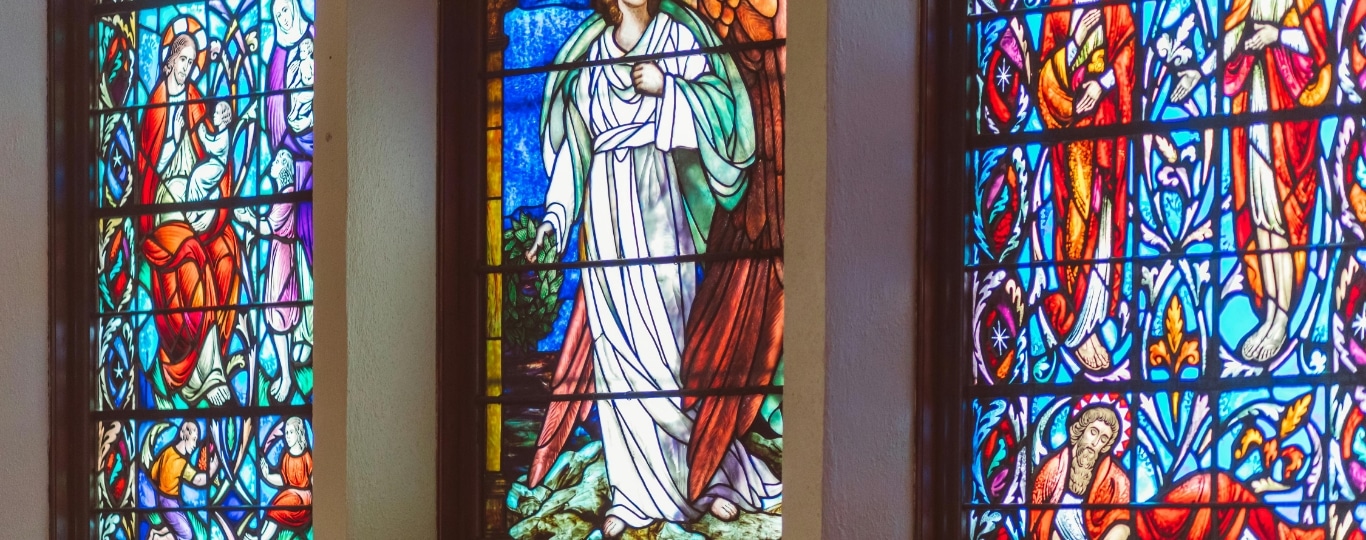
Whitsunday

†
In his effort to rediscover beauty, after believing he had been given a new lease on life, having shed the graveclothes of the arranged vocation that his parents had thrust upon him, the Artist strolled along the shoreline in pursuit of hopeful inspiration. Then, “A girl stood before him, midstream in an estuary, alone and still, gazing out to sea. She seemed like one whom magic had changed into the likeness of a strange and beautiful seabird. Her long, slender legs were delicate as a cranes and pure ivory in color, save where an emerald trail of seaweed had fashioned itself upon her ankle, as if a sign that she was not preternatural … Her slate blue skirts were kilted boldly about her waist and dovetailed behind her … Her long fair hair was girlish and touched with the wonder of mortal beauty upon her face. — She was alone and still, gazing out to sea; and when she felt his presence and the worship of his eyes, her eyes turned to him in quiet sufferance of his gaze, without shame or wantonness. Long, long she suffered his gaze and then quietly withdrew her eyes from his and bent them towards the sea once again … a faint reflection of the sun’s flame trembling on her cheek. — ‘Heavenly GOD’, said the Artist, ‘what sublime beauty…truly, sublime.'”1
James Joyce, the Irish novelist, paints a picture of realized beauty in his work entitled A Portrait of the Artist as a Young Man. Beauty appears to him in the particular form of a woman on the shores of the Irish Sea, just south of Dublin. — Who is the woman? — Whoever she is, she epitomizes the earthly form of transcendental beauty in the eyes of the Artist. — I like to think she is representative of the Church; she whom the Artist’s parents sought to obligate and betroth him, before he broke free – free from the artistry of her sacerdotal offices, and free to report her theological beauty through painting her epiphanies. The point is that the outward and particular thing, the woman and the wholeness, harmony, and splendor of her form, silhouetted by sky and sea, this deep moment of introspection in the Artist’s heart, pointed him to the Source of all that is beautiful, and there he found his inspiration. Beauty, capturing his long and suffering gaze, the Artist’s subjective will and mind are provoked by the objective Source of all that is good and true which he sees reflected in the woman’s form. From the vision, he seeks to know, understand, and participate in the transcendental Source from which this beauty, truth, and goodness flow. — He later describes his epiphany in the following words: “Her eyes had called me, and my soul leaped at the call. The call to live, to err, to fall, to triumph, and to recreate life out of life! … Heavenly GOD, what sublime beauty.”2
Beauty, infused with the fullness of the Divine reflection, proportional and not preternatural to the created order, yet beckoning a greater metaphysical ideal, provokes the subjective human mind to apprehend the intelligibility of the thing, which the will and mind find good and true. Thus, seeing the cloven tongues of fire over every head, and hearing the sound of a roaring and rushing wind come from Heaven as the Gospel was professed in foreign but intelligible tongues, the Jewish faithful from fifteen different parts of the Greco-Roman world, seeking to understand the intelligibility of the Thing, must have uttered, as did the Artist: “Heavenly GOD, what sublime beauty!” — What else could they have said? Those whose subjective minds and wills were not enchanted by the beauty of that Pentecost scene, contrarily and mean-mindedly quipped: “They are full of wine” (Acts 2.13) This is not how the disciples themselves saw it. Saint Peter, standing erect on behalf of His Master before the crowds that had gathered, translated the scene as something come from GOD – beautiful, good, and true – quoting the prophet Joel. He says: “‘And it shall come to pass in the last days,’ says GOD, ‘that I will pour out My Spirit on all flesh; Your sons and your daughters shall prophesy, your young men shall see visions, your old men shall dream dreams. And on My menservants and on My maidservants, I will pour out My Spirit in those days, and they shall prophesy … And it shall come to pass that whoever calls on the name of the LORD Shall be saved’” (Acts 2.17-18, 21).
Peter, overwhelmed by the Person and Presence of the Holy Spirit applies Joel’s apocalyptic vision to the Pentecost scene. He sees not men drunk on wine, for it was only the third hour of the day. Instead, Peter is led by the Spirit to interpret the event of Acts 2 as the wonderful and beautiful vision from Joel. His vision is of GOD’s elect speaking revelations about things that are good and true concerning what they have seen, heard, and touched with their hands. And, for any that would respond to the outpouring of the Paraclete, the Comforter, the One who JESUS said would come to bring peace, they would be saved, if they would but call upon the name of the LORD. Those who would not call upon Him, thinking it a movement of drunken enchanters and soothsayers, they would perish. — Let us not concern ourselves with the latter, but with the former; those who did believe the theological beauty of that Pentecost event; those who the Bible says were provoked viscerally, intellectually, and spiritually by that event which smacked of a divine memory and a transcendental truth.
First, there was the beautiful. It all started with the disciples being gathered together in one accord in Jerusalem, faithfully abiding by JESUS’ command to wait, “and that in a few days they would be engulfed by the Holy Spirit (Acts 1.4-5). As Luke 23.49 worded it, they were to wait in Jerusalem until they were ‘dressed with power from the heights.'”3 Their witness was to begin in Jerusalem, as a sound like a rushing wind came from Heaven and cleft-tongues of fire rested, as a sign, upon them. Again, how beautiful this must have been to all the onlookers. It must have struck them viscerally, in their viscera, their guts, just like a dynamic Texas summer sunset might with its trailing fire colors of orange and red upon the blue sky fading into black on the horizon. Or like an eclipse of the sun by the moon, when one moment the orb is too bright to gaze upon, and in the next, it is nothing but a bright rimmed, black circle in the sky, solar bursts visible on its margins. — Such enchanting, particular things of beauty cause us to stop and wonder; to gaze upon their otherworldliness, contemplating how such a thing could be, and what kind of GOD would make something so breath-takingly arresting. One seventeenth-century philosopher described this state of the human experience as when the smile of a mother awakens her child to being. Being, not in the abstract, nor in its brutalist, fallen form, but being that is apprehended as desirable because it is good, the truth of which one longs for more and more. The infant is awakened to this being by the form of his mother’s beautiful smile, and his subjective mind focuses on her, and the objective truth she reveals to him every new and unfolding day. — We know this is true, for we can see it in ourselves. Why else do we go back, trying to apprehend the desirability of the beautiful, good, and true of another Texas sunset if its objectivity does not tug at our ancestral subjectivity, which longs to know, understand, and participate in the Source of that beauty, who is GOD? An attempt to experience GOD’s epiphany again and again.
And if you will accept it, this seems a perfect description of the Pentecost scene in Jerusalem. The epiphany of GOD came down in the Person of the Holy Spirit while the people gathered around, their subjective minds and wills being provoked to new being by the goodness of the words they heard in their own tongues. They then sought to apprehend the objective meaning of why such a beautiful and magnificent thing was happening in Israel.
The beauty of the Pentecost scene was not an original beauty; it was the fulfilled beauty of another scene in Israel’s redemptive past; similar in form and its representative meaning. That scene took place at Mt. Sinai in Arabia, when GOD descended upon the holy mountain in a dark cloud of smoke, fire, and a rushing sound of wind that Moses describes as the sound of great trumpet blasts. This sight was also inspiring, but instead of running toward the sublimity of the moment as they did at Pentecost, the people of Israel wanted to run away. The fearsome presence of the LORD was too much for them for the LORD’s glory had broken into the fallen world with such fearsome righteousness that His foreign language of truth and holiness was unintelligible to that world. In fact, after YHWH GOD spoke the Ten Commandments to the Wilderness Church from atop Mt. Sinai in flaming smoke and wind, the people of Israel said to Moses, “Speak thou with us, and we will hear; but let not GOD speak with us, lest we die” (Exodus 20.19). — In contrast, at Pentecost, the Spirit descended upon the Disciples in flame and sound, and they spoke the New Commandment of Love to the people, and the Church of Zion, because of the gracious speech of the Holy Ghost, spoken in a language that the people could understand, were bewildered and intrigued, wondering how every man heard the disciples speak the wonderful works of GOD in his own language. (cf. Acts 2.6,11)
The Law of Moses revealed the will and statutes of GOD, yet it was a foreign letter from Heaven that men could not completely understand, nor obey. Moses, the vicar of GOD to the Sinai Church, brought the letter of the Old Testament down from atop the mount, and gave it to the people on cold stones and commanded it as a law of ‘dos and don’ts.’ At Pentecost, the Vicar of Christ, the Holy Spirit, gave the Letter of the New Testament, which men can hear and obey. He gave it to them, written not on impersonal tablets expressing rigid statutes, but on the personal contours of our hearts as a commandment of intimate communion and relationship with Him and our neighbor.
And the beauty of this New Law of Love provoked the intelligible mind of the people to the goodness of a new being. They desired to apprehend how they could know the truth of what was happening in their hearts because of what they had seen and heard. Thus, in reply to Saint Peter’s Gospel Message, wherein He proclaims JESUS as the promised Messiah come, forsaken, killed, resurrected, and ascended into glory at the Father’s Right Hand, the people were pricked in their hearts. Then they “said unto Peter, and the rest of the Apostles, ‘Men and brethren, what shall we do?’ To wit, Peter replied, ‘Repent and be baptized every one of you in the Name of JESUS Christ for the remission of sins, and ye shall receive the gift of the Holy Ghost” (Acts 2.37-38). — The people understood from what they had seen and heard, that it would be good to change their status with GOD and His Apostles, for by the message that Peter preached, their hearts were smitten with sorrow. The people honestly believed the truthfulness of Peter’s words, when he said: “JESUS of Nazareth, a man approved of GOD among you by miracles, wonders, and signs … ye have taken and by wicked hands have crucified and slain” (Acts 2.22a,23b). Thus, the people desired a new state of being with GOD, not in the abstract, but in the concrete. They apprehended the Gospel’s message and spiritual power as desirable, as it pointed them toward the transcendent truth of Him who is good. — Thomas Aquinas, that renowned 13th-century Christian theologian and philosopher, is known for positing the idea that ‘being’ is good, because it appeals to the will as the will desires understanding of that good thing and to be one with it. Thus, the people, by GOD’s grace, receiving their responsibility and role in the execution of JESUS, they sought to understand the goodness of the Gospel and to be one with the forgiveness and redemption being offered to them by the Holy Ghost. Their wills were moved to seek asylum and forgiveness in the counsel of the Apostles; their sins being removed by the goodness and truth of the Holy Spirit.
And now, receiving the gracious and merciful invitation to participate in the promise of the Gospel (which was unto them and their children), the Bible tells us that “they gladly received Peter’s word and were baptized; and that same day there were added unto their numbers about three thousand Jewish souls … steadfastly continuing in the Apostles’ doctrine and fellowship, and in the breaking of bread, and in prayers” (Acts 2.41-42).
Pentecost was when the Holy Ghost came down from Heaven to birth the New Testament Church and to give her the New Law of love in Christ. To do so, He provoked the Church first, with beauty. The beauty of the Spirit’s outpouring out captured the subjective intellect of all who saw and heard the wonderful works of GOD in their own languages. What they heard, they understood as good by GOD’s grace, and they apprehended it as desirable for their souls. And of that goodness, the people saw the Gospel truth as an attractive splendor that they desired to know, understand, and participate in. And when they were invited to do so – O heavenly GOD, what sublime beauty! – The Church was born, and the Spirit was bestowed in the hearts of the Remnant of Israel. Wonders in heaven above and signs in the earth beneath, just like Joel prophesied. — Dear St. Mark’s, this beauty, goodness, and truth in the Holy Spirit is also made available to us. If we and our children will embrace the light of the Holy Spirit, we too will have right judgment in all things and evermore rejoice in His comfort. — Mother Church is smiling upon us, dear brothers and sisters. Will we awaken to the new being she offers and seek the catechesis she provides in the truthful name of her Bridegroom? — The upcoming season of Trinitytide will seek to persuade us to this reality by GOD’s self-disclosure at this point in the Church calendar. It is here, at Pentecost, that He has revealed Himself as He has been throughout all eternity: GOD the Father and Creator of the world, GOD the Son and Savior and Redeemer of mankind, and GOD the Holy Spirit and Sanctifier of the faithful. — May the theological beauty of Pentecost enrapture our intelligible but subjective minds to the objective Source of all beauty, that we might see Him as the Good that He is, striving by faith to know, understand, and participate in His truth, more and more. Amen!
—
1 Joyce, James, A Portrait of the Artist as a Young Man, (New York: Viking Press, 1964), 170-171.
2 Ibid, 172.
3 Willards, Dallas, The Divine Conspiracy: Rediscovering our Hidden Life in GOD, (San Francisco: Harper Collins, 1998), 278.

Join Us for Biblical Worship, Study, & Fellowship
Sundays:
Coffee and Fellowship 8:30 am
Catechesis for all ages 9:00 am
Holy Communion 10:30 am
Recent Sermons

Sixteenth Sunday after Trinity
Worship with Us
Join us for Biblical worship, study, and fellowship. We currently meet in the sanctuary of Christ the King Lutheran Church in Waxahachie.
Catechesis for Adults and Children 5+
Sundays at 9:00 am
The Order of Holy Communion
Sundays at 10:30 am
Fellowship Opportunities
See our calendar for other weekly and special events.