Eleventh Sunday after Trinity
†
In my estimation, Charles Schulz nailed it! The creator and animator of The Peanuts Gang ‘hit it out of the park’ in terms of the thematic lesson for this, Trinity XI Sunday. — Lucy Van Pelt, Linus’ dark-haired sister, seeing Snoopy out back of Charlie Brown’s house and atop his red doghouse, observed how his friend’s family pet was hunched over and busily poking at his typewriter; Woodstock perched on Snoopy’s shoulder. Lucy approaches Snoopy and says, “I hear you are writing a book on theology?” Sarcasm detectable in her voice, Snoopy does not look up, nor does he stop beating on his typewriter. Instead, he simply says: “I am.” Lucy then replies, walking away with a disbelieving look on her face and rolling her eyes. “Hugh, man’s best friend, now man’s theological expositor – right? I hope you have a good title.” — While still in earshot, Snoopy looks thoughtfully into the heavens, then begins rapidly beating on his keyboard once again while he says: “Has It Ever Occurred to You that You Might be Wrong?”
This is the exact sentiment that our Collect is implying on this Trinity XI Sunday. Let us hear it again. — “O GOD, who declarest Thy almighty power chiefly in showing mercy and pity; Mercifully grant unto us such a measure of thy grace, that we, running the way of Thy commandments, may obtain Thy gracious promises, and be made partakers of Thy heavenly treasure; through JESUS Christ our Lord. Amen.” (1928 BCP 204) — This Collect prayer offers GOD the position that He should occupy in every Christian’s heart: the position chiefly concerned and chiefly offended by our ‘wrongness.’ By seeking the LORD’s chief property, which is always to have mercy and pity, we agree with Snoopy and the title of his theological treatise, which is most important to men. — Has it indeed occurred to us that we might be wrong? That we might need a measure of GOD’s grace to cure us of our craftiness which we sometimes set up as the foundations of our lives; our counsels (as a result) being thrown headlong and disturbed? — The Church knows this is frequently the case in the lives of her people; thus, she encourages us to confess, and seek GOD’s pity and mercy, that the way of His commandments might be obtainable to us. And though we might be wrong this morning, having followed Mother Church’s advice, this afternoon we will be able to run the way of GOD’s commandments, being partakers of His Heavenly treasure. — If we ignore this enlightened path, Job says: “We will meet with darkness in the daytime, and grope in the noonday as in the night (Job 5.14).
This is certainly the lesson that JESUS intended when He told His parable to those who thought themselves above reproach; those whom Saint Luke says: ‘Trusted in themselves that they were righteous and despised others.’ — In no way trying to mix metaphors and simplify the Gospel Lesson for today, JESUS was trying to persuade His hearers who were haughty to turn from their craftiness. Due to their placement in society, tribal pedigree, and religious zeal for the Law of Moses, the LORD told His parable to those who had ears to hear the same message that our dear Snoopy was trying to get Lucy Van Pelt to receive: “Has It Ever Occurred to You that You Might be Wrong?” — Now before you pile on and start thinking how today’s homily gives license for you to go to those near and far in your personal sphere of influence, and to pressure them to consider if it has ever occurred to them that they might be wrong, let us understand the following. — In JESUS’ parable, there is only One Party that is rightly offended and only one party that is rightly justified.
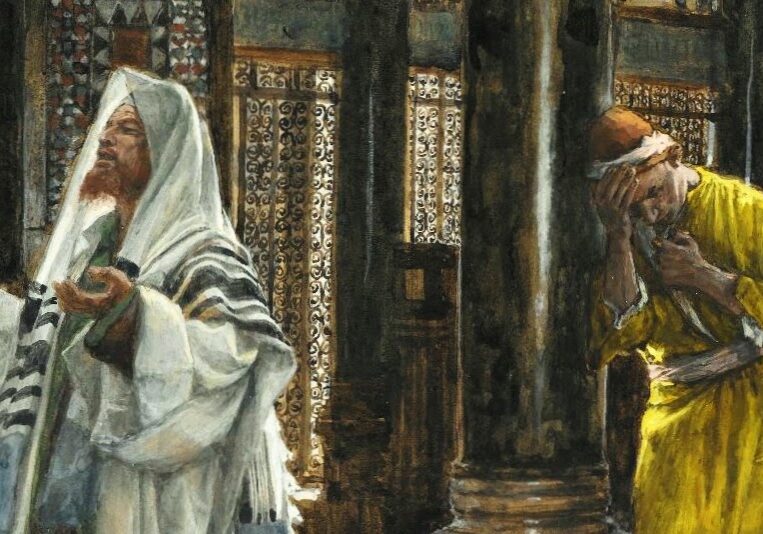
To contextualize the parable, the LORD JESUS describes two men who went up to the Temple to pray: one a Pharisee, and the other a tax collector. — Before GOD, to whom both men ascend up to the Temple, there is only one true Judge, as David confesses: “You [only, O LORD], are just when you confront me; you [only] are right when you condemn me” (Psalm 51.4). — Any man, going up to the Throne of GOD to seek the Most-High in His Holy space, must understand that the One he seeks is greater than himself; else the climb from the terrestrial to the heavenly is a vain errand, frivolous, and repugnant to His Creator, at best. Thus, by their action of ascending to pray, each man in JESUS’ parable had in mind what he wanted from GOD.
What did each man desire that would drive them to seek succor and comfort through audience with GOD? With the Pharisee, it appears hard to tell. As was His custom, JESUS uses the character of the Pharisee and tax collector as foils to make His point. The LORD draws off the extremes in first-century Jewish society, but every character in real life, in between these two extremes, is being put on notice. — JESUS’ first point concerns the Pharisee; that class of Zealots from Jerusalem who would bend the neck of anyone, young or old – even their own mothers – under the yoke of legalism of the Mosaic Law. These zealots were so punctilious and careful to abide by the Law of Moses that they would (as JESUS said), ‘strain out a gnat’ from their drinking vessels as not to make themselves unclean. They would tithe mint, anise, and cumin to the Temple, yet, at the same time, in pursuit of religious purity and orthodoxy, they preferred to swallow a camel instead of abiding by the weightier matters of justice, mercy, and faith. Outwardly, the Pharisees appeared righteous unto men; but within his heart, the Pharisee was full of dead men’s bones; full of hypocrisy and iniquity. (cf. Matt. 23.23-24)
Thus, we can understand that the Pharisee in JESUS’ parable did not go up to GOD to be justified; rather, he went up to GOD to be glorified. This is evidenced by what he said: “GOD, I thank Thee that I am not as other men: extortioners, unjust, adulterers, or even as this tax collector” (St. Luke 18.11). The man went up to GOD to present his pomp, not his piety, to the Creator. He wanted, as JESUS describes, to pray standing in the Temple to be seen of men,’ not to be heard by his Maker. (cf. Matt. 6.5) — Please note, the theme of the man’s prayers and be wise never to do the same: God, I thank thee, that I am not as other men are …I fast twice in the week, I give tithes … I, I, I … Such prayers are always about me, me, me, and never about Thee, Thee, Thee, O LORD. This was the Pharisee’s first act of abasement; the second was his comparison of himself to others. ‘I thank Thee, O GOD, that I am not like other men – unjust, extortioners, adulterers, or like the publican over there.’ — When we pray to GOD, we should be reminded that we are not in a court of law defending our case, such that we should feel compelled to persuade GOD ALMIGHTY that we are His one and only ideal child. Instead, let us remember what the Psalmist hath written: “There is none righteous; no not one” (Psalm 14.3) — In other words, when we pray, when might with this principle: ‘Has it ever occurred to you that you might be wrong?’
Himself a Pharisee, Saint Paul realized he was wrong. He confessed as much, even when describing his status as an Apostle of JESUS Christ. For that, he said, “I am as of one, born out of due time. For I am the least of the apostles, [and I] am not meet, to be called an apostle, because I persecuted the Church of GOD” (1 Corinthians 15.8-9). In essence, Paul considered himself a stillborn child that was resuscitated and able to live. The visual image of the Pharisee in JESUS’ parable could have easily described Paul before his conversion on the road to Damascus. He was not only wrong in his attitude towards his neighbor and his Creator because of his hubris and pride; he was also the epitome of what occupies the majority of the canvas in Caravaggio’s painting of ‘The Conversion of Saint Paul.’ This 17th-century masterpiece, housed in the Chapel de Santa Maria del Popolo in Rome, consists primarily of, well, the rump of a horse.
On the other spectrum – the spectrum of Godfearers – is the Publican or Tax Collector. His attitude and posture are radically different from that of the Pharisees. JESUS tells us he stood afar off from the other worshippers and the Altar. He would not so much as lift up his eyes unto Heaven. Instead, he smote his breast and said: ‘God be merciful to me a sinner.’ — That same unnaturally born Saint Paul, the least of the Apostles, argues in his letter to the Romans that which we have already heard from the Psalmist: both Jew and non-Jew are under the power of sin, and so we are all guilty before GOD. Even our most righteous righteousness, before the all-Holy GOD, is as filthy rags, and we fade like a leaf. (cf. Jer. 64.6; Rom. 3.23) This the Publican understood – and now, if we are a humble people too, we understand the Publican’s posture and the importance of his words in the Temple. He felt his righteousness was fading as a leaf, and he needed GOD’s resuscitation.
We are not told what the tax collector had done wrong, other than what we might glean from the social and religious hazards of his profession. Being a publican, this man was required to tax his family, friends, and neighbors, usually at very extortionate rates. A publican would do so to satisfy the Roman, as well as his own, financial quotas. Besides dogs, lepers, and Samaritans, there were few others in Jewish society more disrespected for their infamy of association, cabal, and confederation with the Gentiles as were the racketeering publicans. Yet, this man recognized that he was wrong while the so-called righteous ruler, the Pharisee, did not. — He beat his breast as a profession of his shame at being a miserable sinner; he would not look up to GOD in Heaven, to whom he knew he had offended; and he required only of GOD what he knew was His natural property – His mercy. — The Pharisee believed GOD owed him something; the tax collector knew he owed GOD everything. The Pharisee believed, because of his good deeds, GOD was indebted to him; thus, he went up to the Temple to receive spiritual payment from His Creator. On the other hand, the Publican knew he was indebted to GOD; that he was spiritually penniless and unable to pay His Creator for his waywardness. The Publican knew that he had left undone those things which we ought to have done, and that he had done those things which he ought not to have done. Therefore, he knew there was no spiritual health in him. Thus, he cried out: ‘God be merciful to me a sinner.’
It takes humility to be aware of GOD’s grace, and faith to receive it. The traditional Rabbinical school (which included the scribes and Pharisees of JESUS’ day) deemed intellectual or religious inferiors unworthy of their discourse and society. Worse still, they would say: “This people who knoweth not the Law of Moses, are cursed.”1 Yet it was the religious class that got it wrong, JESUS said. — The Pharisees were too insistently pompous and fiercely hubristic, such that the Charles Schulz comic strip, and Snoopy’s quip, would have gone right over their heads. As such, so too did GOD’s mercy. Not because GOD was unwilling to give His mercy to them, but rather, they refused to see their need for it. Thus, JESUS said in His parable: The Publican went down from the Temple justified, rather than the other; “for everyone that exalteth himself shall be abased; and he that humbleth himself shall be exalted” (St. Luke 18.14). Because of his deep and honest sorrow for his wrongdoings, the Publican believed, by faith with an attitude of humility, that GOD could and would forgive him. Thus, his prayer was answered, and he was deemed righteous, and therefore accepted by GOD. — The Pharisee, on the other hand, because of his haughtiness before GOD and his fellow men, was demoted and ranked below the other man; unacceptable to GOD.
It is not hard to imagine how offensive to the fashionable norms of the Temple’s pathos, JESUS’ parable must have been; it must have stung the ears of those who trusted in themselves that they were righteous and despised others. — How about us? Are we offended at JESUS’ teaching? Have we come to this Holy Communion service today to get spiritually paid by GOD, being keen upon our own godliness? Or are we still holding the meek and penitential words of the Morning Office in our minds as pertinent and applicable to us: “But Thou O LORD, have mercy upon us, miserable offenders”? (1928 BCP, 7). — If the latter, then Prayer Book Christianity is truly for you. In the Anglican Way, the Liturgy of the Eucharist is designed to accentuate our humility before GOD, asking only of Him, by faith, what we know He will do for us: to have mercy upon us, miserable sinners. — Each Sunday, we begin our worship of GOD by proclaiming His greatness and glory in our opening hymn. We then, collectively, confess a prayer of purity that openly reveals our knowledge that no desire or secret in our hearts is hidden from Him. We move through the liturgy hearing GOD’s Word read and prayed. We then come to the Holy Sacrament of Christ’ Body and Blood, but before we can receive it with our brothers and sisters from His Holy Table, the Liturgy instructs our hearts and minds to pray these words: “We acknowledge and bewail our manifold sins and wickedness, which we from time to time, most grievously have committed, in thought, word, and deed, against Thy Divine Majesty … We do earnestly repent, and are heartily sorry for these our misdoings … Have mercy upon us Most Merciful Father … forgive us all that is past … For we are not worthy to so much as gather up the crumbs under Thy table … yet we beseech Thee to accept our bounden duty and service; not weighing our merits, but pardoning our offences, through JESUS Christ our LORD” (1928 BCP, 75, 81, 83).
The Anglican Liturgy’s structure and content foster humility in the Anglican worshipper, while also providing words and suggesting a posture of body, soul, and mind that allows us to approach GOD with the same attitude as the Tax Collector. From the Prayer Book, words are placed on our lips that allow us, by faith, to commune with the all-merciful GOD, to receive His grace, and to go down from His Holy Temple, justified. — But even though we have this wonderful inheritance of prayers, rites, and ceremonies, “there is a constant need to fight, spiritually, against the self-righteous attitude of the Pharisee. In fact, the longer we live as Christians, and the longer we celebrate the liturgical forms of the Prayer Book, Sunday by Sunday, the more dangerous Pharisaism becomes – the more guarded we have to be about exalting ourselves over and above our neighbors who might yet be struggling with sin and the faithful call to the religious exercises of the Church.
Has it ever occurred to you that you might be wrong before GOD? If so, dear church, humble yourself that you might not be abased. “For happy is the man whom GOD correcteth: therefore, despise not the chastening of the ALMIGHTY” (Job 5.17). Otherwise, know this, my friends: he who exalts himself before GOD and men will be abased; but he who humbles himself before GOD and his neighbor will be justified. — GOD, be merciful to us, sinners. Amen.
—
1 Edersheim, Rev. Dr. Alfred, Sketches of the Jewish Life, Kindle Version, (New York: Hodder & Stoughton, 1876) 468 of 18,578.

Join Us for Biblical Worship, Study, & Fellowship
Sundays:
Coffee and Fellowship 8:30 am
Catechesis for all ages 9:00 am
Holy Communion 10:30 am
Recent Sermons

A Nuptial Eucharist of Holy Matrimony: Humberto and Kathryn
Worship with Us
Join us for Biblical worship, study, and fellowship. We currently meet in the sanctuary of Christ the King Lutheran Church in Waxahachie.
Catechesis for Adults and Children 5+
Sundays at 9:00 am
The Order of Holy Communion
Sundays at 10:30 am
Fellowship Opportunities
See our calendar for other weekly and special events.