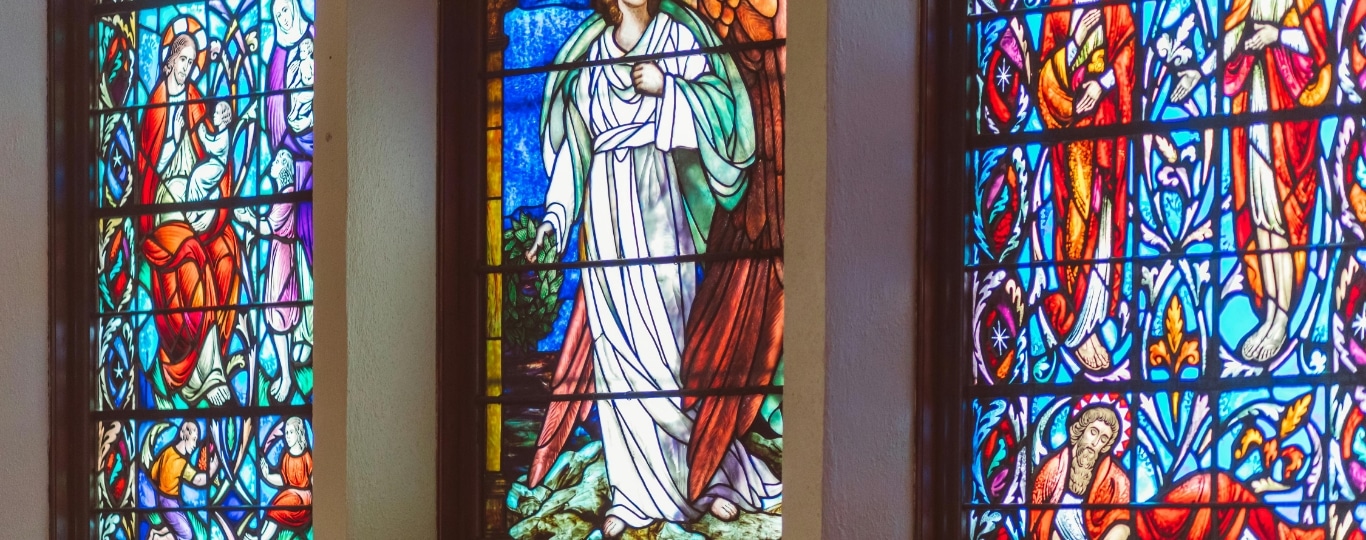
Fifteenth Sunday after Trinity

†
The theme of this Trinity XV week concerns the frailty of man and our dependence upon GOD to hold us up. Our Collect frames Holy Mother Church’s thematic focus for the week in this way: “The frailty of man, without Thee, O LORD, cannot but fail….” Like the Samaritan leper that returned to give glory to JESUS for his healing, the Church reminds us that we can never retreat from the acknowledgement that our wholeness and strength depend upon our submission to the Triune GOD in every experience – to humble ourselves before His Throne, whether life’s experiences be desirable or undesirable. — The words of our processional hymn concur with this exhortation; the exhortation to walk humbly with our GOD, ever depending upon Him for our life, breath, and our very being. In ‘Praise my soul the King of Heaven,’ we sang: “Father like, He tends and spares us; Well, our feeble frame He knows; In His hand He gently bears us, rescues us from all our foes …”1
So frail and needy are we, that without GOD as our Shepherd, Father, Champion, Nurturer, and Deliverer, we would be without any hope in this world. The Psalmist calls us to this sensibility, telling us not to forget all of the LORD’s benefits, “Who forgiveth all thy sin, and healeth all thine infirmities. Who saveth thy life from destruction, and crowneth thee with mercy and loving-kindness. Who satisfieth thy mouth with good things, making thee, young and lusty/renewed as an eagle. The LORD GOD executing righteousness and judgment for all of them that are oppressed … Praise the LORD, O my soul; praise His Holy Name” (103:3-6, 1). — Even JESUS reasons with us that it is GOD the Father who feeds the fowls of the air and clothes the lilies of the field, how much more should we, JESUS says, who are more important to Him than these creaturely things, be beholden to the Father for all our earthly needs, ‘Who knoweth ye have need of all these things, before you ask Him’ (cf. Matt. 6:32, 8) — Again, the Psalmist rightly confesses: “Yea, like as a father pitieth his own children; even so is the LORD merciful unto them that fear, honor, and respect Him” (103:13). And so, we must pray today: “Keep us, we beseech Thee, O LORD, ever by Thy help from all things hurtful, and lead us to all things profitable to our salvation.”2
With this truth clearly understood and received, we would be wise today, brothers and sisters, to ‘lex orandi, lex credendi’; that is ‘to believe as we pray.’ — With the evidence of our frailty ever before us, it would behoove us, for spiritual consolation and enrichment, to begin to believe what we know and thus pray: “Whom have I in Heaven [and all the earth], save Thee, O LORD? And there is none upon the earth that I desire beside Thee … For he satisfies the longing soul, and the hungry soul he fills with good things.” (Psalm 73:25; 107:9).
So how do we start trusting GOD with our human frailty? — I believe the clue is in this ‘perpetual’ phrase from today’s Collect: “Keep, we beseech Thee, O LORD, Thy Church, with Thy perpetual mercy…” — It is not only GOD’s immediate nature of mercy that we need (moment by moment), but also His ‘perpetual’ nature of mercy. — In our prayer, Holy Mother Church’s desire is for the Father, not only to forgive her precious children “at the outset of their Christian careers on the first exercise of their faith, and in the administration of Holy Baptism to regenerate them, but the Church also prays that GOD will make His forgiveness concurrent with our whole Christian pilgrimage; viz., that our entire Christian Walk would be something perpetuated by GOD’s washing away, in the Blood of Christ, any and all of the moral defilements we might contract as we live in this world, but not abiding by this world. — In a word, as the LORD JESUS told Peter: ‘He [whose hands and head] are washed by My sanctification, need not but to have his feet washed by Me.’ (cf. Jhn. 13:10).
The spiritual and theological reality is that we have been washed in the Blood of the Lamb when we first believed on Christ’s saving work on the Cross by faith. We are then brought into His Kingdom and made citizens by His Grace through water Baptism by the Holy Spirit. This door to the Kingdom of Heaven, JESUS opened at His Resurrection. Thus, we, like the saints envisioned by Saint John in the Revelation of JESUS Christ, chapter seven and verse fourteen, have “washed our citizen-robes, and made them white in the Blood of the Lamb.” — Due to GOD’s perpetual mercy in Christ, we now only need to have our feet washed; viz., that is, to have our consciences wiped free of any failings through repentance and absolution. You see, GOD’s perpetual mercy is ever available to us because of the atoning sacrifice of JESUS Christ, acting as the ‘once for all’ propitiation/atonement/expiation for our sins. Our cry should now be as the cry of the tax collector in the synagogue that went home justified before GOD, which in the Greek reads: “LORD, have propitiation on me a sinner” (St. Luke 18:13). Thus, it might be more appropriate to pray our Collect saying: ‘Keep, we beseech Thee, O LORD, Thy Church, with Thy perpetual propitiation…’
One theologian has pointed out that mercy flows out of propitiation, as the Blood flowed out of the side of JESUS on the Cross. It is a River of Living Water to be mercifully applied, perpetually, to our lives. We should understand that “The word ‘propitiation’ implies a great deal more than ‘mercy.’ — ‘Everyday’ mercy is merely a sentiment in the mind, independent of anything which may be done or suffered to procure the outflow of that mercy towards its object. ‘Christian Propitiation,’ on the other hand, is not only mercy, but mercy shining through the atoning and propitiating sacrifice of JESUS. When GOD is propitiated towards mankind, He is reconciled toward him on the grounds of what Christ did and suffered, [in spite of any iniquity we have currently on our ledger].”3 Any iniquity accrued after our faith and Baptism, because of the perpetual mercy of GOD shown towards us in Christ’s expiating sacrifice, can be washed from our soulish feet like dust; our soulish bodies having already been dipped in Christ’s resurrecting Baptism. — With bodies and souls cleansed of all guilt of conscience, and shame from fault, we can grow to trust the Father to lead us and provide for us, all things that are profitable for our salvation through His perpetual mercy – His perpetual propitiation, as our Collect prays.
Unfortunately, there are those who do not learn to trust GOD for a variety of reasons, though He ever be propitiatingly merciful. We learn of two of those reasons in today’s Gospel Lesson: love of mammon (worldliness and riches), and the love of worry (concern for one’s well-being). For some, Solomon points out in Proverbs 13:8, that instead of ransoming their lives in the trust of GOD’s providence and proper provisions, they ransom their lives to their riches. That is, some people with worldly riches would rather keep their wealth than to trust GOD with their frailty. — Saint Augustine, in the fourth century, encouraged his flock to consider that the retention of wealth to the exclusion of the benefit of the poor was a fleshly frailty needing spiritual discipline. To cure him, Augustine believed, the rich man must make himself frail before GOD, which can only be done through almsgiving. He said, “‘When you possess surplus goods, you possess the goods of others’ … It is in the poor person, after all, that the One who is never hungry wishes to be fed.”4 ‘For what you do to the least of my brothers, JESUS said, ‘you have done it unto me.’ — As Augustine saw it, the man with riches must learn to trust GOD in the frailty of his giving away of that which he longs to retain for himself. Trusting his earthly riches to the Kingdom of GOD’s purposes forces a man to put His faith where it is rightly placed: in Him who satisfies the hungry soul with goodness.
Is this theological truism only for the wealthy? — No, the love of Mammon is the natural sinful allure of the rich, poor, and everyone in between. And equally important is the fact that each will fail without placing their trust in the perpetual mercy of GOD to lead them from all things hurtful towards all things profitable for their salvation. — For, which man, be he a pauper or a prince, will not stand to gain immensely from the eternal, spiritual riches of GOD’s Kingdom? All who come to GOD through Christ, ‘haves’ or ‘have-nots’, are at one time or another poor in spirit, mourning for comfort, meek in heart for lack and want, hungering and thirsting for righteousness, are persecuted for righteousness’ sake, and hope for justice and mercy. None of these things can be purchased or preserved with worldliness or riches. It is dependent upon us, then, to turn our trust away from the pursuit of Mammon and towards GOD’s perpetual, propitiatory mercy in Christ if we care to be saved. For the people of Christ’s Church cannot have even a tenth of one tenth of one percent of their trust invested in Mammon. We cannot serve two masters, JESUS said.
“Some people disagree with this saying from JESUS. They refuse to be confronted with such a stark and outright choice and see no necessity for it. They gladly assure us that it is perfectly possible to serve two masters, simultaneously; after all, they manage it very nicely themselves. — Such people appeal to several possible arrangements and adjustments to make this so. — They serve GOD on Sundays and Mammon on weekdays, or GOD with their lips and Mammon with their hearts, or GOD in appearances and Mammon in reality.”5 — As human beings, we are not naturally autonomous; we are naturally dependent creatures. Either we will hate one master and love the other; or else we will hold onto one master and despise the other. Yet, as for GOD and Mammon, you can serve only one. For GOD says: “I am the LORD, that is my Name; my glory I give to no other, neither my praise to any graven image” (Isaiah 42:8).
Now, depending upon what or who we will serve (GOD or Mammon), JESUS calls us to think upon one of those entities for the necessities of our life: natural and spiritual – as our Collect says: ‘for our salvation.’ As man is not naturally autonomous, but naturally dependent, man is also naturally a seeker, a finder, and a knocker. Thus, knowing that he is dependent upon another for his salvation, his daily bread, and his spiritual life, man gives purposeful thought to who might provide for his deepest needs. JESUS goes to the heart of our deepest desires and confronts our thinking, seeking, and knocking, assuming we will choose to be dependent upon GOD and not Mammon. He says: “Give no thought for your life, what ye shall eat, or what ye shall drink; nor for the body, what ye shall put on. Is life not more than meat, and the body more than raiment?… For all these things the Gentiles seek. Your Heavenly Father knoweth ye have need of all these things. But seek ye first the Kingdom of GOD, and His righteousness; and all these things shall be added unto you” (St. Matthew 6:25,32-33).
Before we choose who to follow, GOD or Mammon, we must reconcile ourselves to whom we will serve and why. — Before we take action to pursue one of these entities, we have two things to choose from: thought for what we will eat and wear or thought for the pursuit of GOD’s Kingdom and His righteousness. — Fealty to GOD or Mammon will determine our path and pursuit. — “The choice should be seen for what it is – a choice between Creator and creature, between the glorious personal GOD and a miserable thing called money; between worship and idolatry … For now, it is a question, not just of comparative durability and comparative benefit (viz., which choice will serve us the best for the longest period of time), but of comparative worth: the eternal worth and benefit of the One, and the intrinsic worthlessness and fleeting nature of the other.”6
Friends, we are being asked today to choose the Supreme Good of Life. Will we choose the good of GOD or the pursuit of our well-being? JESUS rhetorically asks: ‘Is not life more than the pursuit of food and health, and the use of the body more than the pursuit of fashion and beauty?’ True, GOD has made the body, and he desires the good of it in wellness and comfort. GOD also desires us to make “prudent provision for the future, without wearing, worrying, and self-tormenting anxiety for that future.”7 — The challenge for the Christian is preoccupation: the preoccupation of feeding, watering, clothing, and housing the body, or the preoccupation of producing the fruits of righteousness of the Kingdom of GOD. — JESUS is here promising us today; if it is the former, then we are denigrating our life’s value and purpose to that which suits the consumption of continual thought of animals and plants. If the latter, then we are exalting our hope and faith to attain to those things that lead to our salvation and the salvation of the world by GOD’s perpetual, propitiatory mercy.
Friends, GOD desires a people for Himself who bear good fruit; the fruit of love, joy, peace, patience, kindness, goodness, faith, meekness, and self-control. He desires not a people who rove around all day moaning and groaning for the things that the Gentiles seek after, yet never truly find. GOD desires a people that seek His Kingdom and Righteousness first. A people who desire to spread the reign of Christ, first in their own hearts and in every department of their lives, in joyful and free submission to Christ. And then, GOD desires His people to spread this fervor for Christ to their family, friends, neighbors, colleagues, and ultimately to be mindful of a global cast of the attractive vision of the Gospel-call to the pursuit of individual and corporate moral and social righteousness in every community; Christian and secular.
The choice before us is absolute, not optional; it is an undeniably transcendental reality affecting our meaning and purpose as human beings – as Christians. And because we must choose between GOD and Mammon, it reveals another universal reality about us: we are frail, and without the LORD we cannot but thus fail. — Thus, GOD’s good people of St. Mark’s, let us agree to pray to the ALMIGHTY: Keep us, O LORD, we beseech Thee and lead us to all things that are profitable for us and help us to take no thought of the morrow: for the morrow shall take thought for the things of itself. Aid us in taking thought of your Kingdom this day and your Righteousness; give us this day our daily bread and forgive us our trespasses as we forgive those who trespass against us. And lead us not into temptation, for sufficient for the day is its own trouble for those who seek Mammon over you, and Him who reigns with you, and the Holy Ghost, too, world without end. Amen.
—
1 Book of Common Praise, “Praise my soul the King of Heaven,” (Newport: Anglican House Media Ministry Inc., 2017), 350.
2 1928 Book of Common Prayer, 210.
3 Goulburn D.D., D.C.L., Edward M., The Collects of the Day: An Exposition Critical and Devotional of the Collects Appointed at The Communion, Vol. 2, (London: Longmans, Green, & Co., 1901), 85.-
4 Harmless, William, Augustine and the Catechumenate, (Collegeville: Liturgical Press, 1985), 303.
5-6 Stott, John R. W., The Message of the Sermon on the Mount, (Downer’s Grove: Intervarsity Press, 1978), 158-159.
7 Stott, 163.

Join Us for Biblical Worship, Study, & Fellowship
Sundays:
Coffee and Fellowship 8:30 am
Catechesis for all ages 9:00 am
Holy Communion 10:30 am
Recent Sermons
Fourteenth Sunday after Trinity
Worship with Us
Join us for Biblical worship, study, and fellowship. We currently meet in the sanctuary of Christ the King Lutheran Church in Waxahachie.
Catechesis for Adults and Children 5+
Sundays at 9:00 am
The Order of Holy Communion
Sundays at 10:30 am
Fellowship Opportunities
See our calendar for other weekly and special events.