Eighteenth Sunday after Trininty
†
‘I cannot think of anything worse’, Hobbes, mopingly replies. ‘Worse? Worse? It is all about perspective, I tell you; perspective,’ Calvin tells Hobbes. Hobbes replied: “What cha mean?’. Calvin excitedly says: ‘You see, the problem with people is that they do not look at the big picture! Eventually we are each going to die; our species will go extinct; the sun will explode; and the universe will collapse!’ — Calvin grasps Hobbes by the shoulder and begins to shake him unto alertness at the dire situation, while yelling into his face: ‘Existence is not only temporary; it is pointless! We are all doomed, and what’s worse, nothing matters! — Hobbes pauses as he considers all of Calvin’s fatalism, and then he says: ‘I now see why people don’t like to look at the big picture.’ — Satisfied, Calvin replies, winningly: ‘At least it puts the right perspective on a bad day, eh?’ (Bill Watterson)
Reading today’s Gospel Lesson, without the proper perspective and frame of reference, the scene before us is challenging to understand. If we step back and look at the previous two chapters in Saint Matthew, our interpretation of the scene improves. — We see JESUS’ teaching and sayings growing more intense, describing judgement for GOD’s enemies in Israel. In Matthew 20, JESUS predicted, for the third time, that these enemies would betray Him, condemn Him to death, and hand Him over to the Gentiles (Romans). (cf. Matt. 20:17-19) In Matthew 21 we read about JESUS’ Triumphal Entry into Jerusalem, which is the beginning of His Passion Week, leading to Good Friday and the Cross. In Matthew 22, we shadow JESUS’ movements and overhear His conversations, mainly with His opponents, who are trying to trap Him in an error against the Law of Moses or the Law of the Roman State.
The two conversations we read about in today’s Gospel Lesson are the last two in this series of debates, two days after JESUS’ Triumphal Entry into Jerusalem. The first is with a lawyer, a scribe, who, along with the Pharisees, is trying to achieve compromise in JESUS by persuading Him to summarize the Law. — The Law, as we have discussed here before, is the Decalogue (Ten Commandments). To view the Decalogue summarily is to understand that there are four commands that dictate how we are to relate vertically to GOD, and six commands that dictate how we are to relate horizontally to our fellow men. The scribe that engaged JESUS was trying to trip Him up in making the vertical more important than the horizontal, or vice versa. This man was not seeking an answer to understand, but rather to connive, hoping for JESUS’ rhetorical downfall. — What the man received instead was an answer of impeccable brilliance!
In His response, JESUS takes the core texts of Deuteronomy that delineate the Ten Commandments with specific prescriptions and combines them into a summary – The Summary of the Law, to be exact. – Moses had written two commands to Israel. The first in Deuteronomy 6:5 and the second in Leviticus 19:18. We read: “You shall love the LORD your God with all your heart, with all your soul, and with all your strength,” and, “You shall not take vengeance, nor bear any grudge against the children of your people, but you shall love your neighbor as yourself: I am the LORD.”
The LORD JESUS, parrying the man’s challenge and providing him with an exquisite summary, says: “‘Thou shalt love the LORD thy GOD with all thy heart, and with all thy soul, and with all thy mind.’ This is the first and great commandment. And the second is like unto it, ‘Thou shalt love thy neighbour as thyself.’ On these two commandments hang all the law and the prophets” (Saint Matthew 22:37-40). — With this reply, the Gospel writer says: “No man after that durst ask JESUS any question” (Saint Mark 12:34). — Yet, JESUS was not finished; He had a question for His opponents. First, though, some important perspective.
To this point in His ministry, JESUS was very careful about how He described Himself. The LORD never calls Himself the Messiah, yet He does allow others to describe Him with the Greek word of the same meaning: Christ. The most popular term JESUS used of Himself was ‘the Son of Man’; i.e., the Son of Man hath nowhere to lay His head; the Son of Man hath power on earth to forgive sins; the Son of Man be three days and nights in the heart of the earth, etc. — This dominant use of the descriptive, ‘the Son of Man’, is a clear reference to the vision of the glorified One – the Anointed – the Christ, as seen in Daniel’s vision in chapter seven of that prophet’s book. And what was clear to all in Israel (the lay and clergy who had been catechized in Torah and the Prophets), was that Daniel’s ‘Son of Man’ would be the heir of David and the Messiah of Israel; the One who would set-up an eternal, global Kingdom, which GOD promised to David in 2 Samuel 7.
Comprehending this amalgamation of terms to describe the biblically promised, historical character of GOD’s Anointed, JESUS allowed for another term to describe His person and purpose: ‘the Son of David.’ — Now why is this important? It is important for two reasons. — First, at the Triumphal Entry, JESUS rode upon a beast of burden, which symbolized a peaceful entrance into Jerusalem as Israel’s promised King. If He had been upon a war horse, it would have meant something very different to the Jews and the Romans. — Nonetheless, the Jewish people apprehended well what JESUS’ intentions were, and they cried out many times: “Hosanna to the Son of David: Blessed is he that cometh in the name of the LORD; Hosanna in the highest” (Saint Matthew 21:9). — Interestingly, JESUS did not even try to stop the people from crying out in this way, while they spread palm branches before Him. — ‘Hosanna to the Son of David: Blessed is he that cometh in the name of the LORD; Hosanna in the highest.’ — JESUS did not stop them, though the chief priests and scribes insisted; JESUS kept silent.
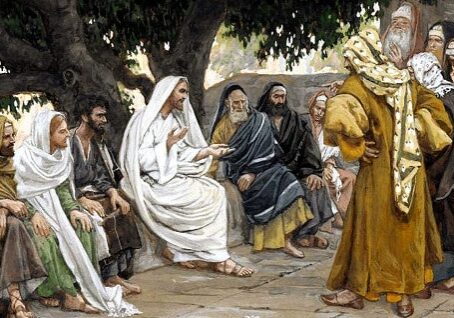
Full of contempt over this scene, for the next two days, the chief priests, scribes, Pharisees, Sadducees, and even the Herodians all came out to challenge JESUS, testing Him to prove He was false. Yet, as we just heard, after their best and brightest tried to pin the LORD down on His summary of the Law, as the scribe was, so too were all the others: marvelously unsuccessful. Thus, to all His enemies, those who were denying every sign, every miracle, every testimony, and every evidence that JESUS was who He said He was, JESUS had for them a question. And curiously, it was not even difficult to answer. — JESUS asked: ‘What think ye of Christ? Whose Son, is He?’ And His opponents said unto Him: ‘The Son of David.’ JESUS saith unto them, ‘How then doth David, in spirit, call him Lord, saying, “The LORD said unto my Lord, ‘Sit thou on my right hand, till I make thine enemies thy footstool?’” JESUS said: ‘If David then called him Lord, how is he then his son?'” (Saint Matthew 22:41-45). — In other words, if YWHW GOD said to this exalted person that David called his Lord and Master, ‘take the highest seat and position in My Heavenly Kingdom while I make your adversaries your conquered’, how could this exalted one be David’s son? In Israel, the father was always more highly esteemed than the son, so how could the religious leaders say He was David’s son?
This passage from Psalm 110 shows that David’s Lord is also the Christ, the Son of GOD who sits at His Right Hand; His inheritance and position even greater than David’s. — The conclusion was straightforward! This esteemed person of whom David exalted, with God-sanctioned power and authority, JESUS claimed to be. — With His point of reference established and the implication of His question undeniable, Saint Matthew tells us: “And no man was able to answer Him a word” (Saint Matthew 22:46).
If they had answered JESUS, His adversaries would have been forced to acknowledge what they absolutely refused to acknowledge: that JESUS of Nazareth, the unassuming, meek, mild, gentle, kind, forgiving, and immoveable man, the One who rode into Jerusalem atop of an ass, a foal of a donkey – He was the One Israel had been waiting for: Divine in power and authority, and birthright heir to the line of David’s monarchy. — They would not do it! To do so would mean the complete obliteration of their personal and private religious fiefdoms of power and position, including all the amenities and luxuries that went along with being exalted rabbis and priests in Israel; all things which their hearts trusted in so much.
During one of the most individualized and obtuse centuries since the high Middle Ages, when man’s mantra became, ‘I think, therefore I am’ (cf. Descartes), Blaise Pascal (1623-1662), a French mathematician and religious philosopher, wrote of such men that loved themselves more than they loved their Messiah. He said: “The self that is loved above everything else becomes hateful, not because self-love is wrong, but because it has displaced the love of itself over Someone much larger.”1 — Of course, the Someone much larger is GOD, and unhealthy self-love replaces Him with ‘I’; viz-à-vis, I think, therefore I am. This was the problem with the religious leaders and those in Israel who rejected JESUS as the Son of David and the Christ: they had appropriated themselves and their personal kingdom-agendas higher than GOD’s Kingdom; their self-love had displaced the possibility that they would cast their crowns before the King, even JESUS the Christ.
The enemies of Christ, unlike the people who put their complete trust in Him to be their King and Savior, were unwilling to mortify their own flesh and die to themselves, that they might live unto GOD. — Instead of abiding by the Psalmist’s encouragement to allow their “souls to truly wait still upon GOD; believing, that from Him cometh their salvation,’ instead, “their device was only how to put Him out whom GOD exalted; for their delight was in lies; they gave good words with their mouth, but curses with their hearts” (Psalm 62:1,4). Thus with His question, ‘If David then call him Lord, how is he his son?’, JESUS “laid a twofold charge against the so-called religious leaders: want of spiritual earnestness and love, and of mere externalism, vanity, and self-seeking.”2 — And lest we think ourselves immune, blind spots of haughtiness leading to lovelessness and self-seeking might creep upon us as well, making us just as imperious as the shepherds of Israel in Jerusalem were.
Please consider again our Collect prayer for today, and judge for yourselves if Holy Mother Church is not warning us against arrogance and imperiousness against GOD. — “LORD, we beseech Thee, grant thy people grace to withstand the temptations of the world, the flesh, and the devil; and with pure hearts and minds to follow Thee, the only GOD.”3 — Why request this? — It is because it is a possibility. — If being justified – if being sanctified – if being glorified is sufficient enough, then why do we need to abide by Saint Peter’s admonition to “Be sober, be vigilant; because your adversary the devil, as a roaring lion, walketh about, seeking him whom he may devour” (1 Peter 5:8). —
C.S. Lewis is an outstanding guide for us in this matter. “There is no fault,” Lewis says, “which makes a man more unpopular, and no fault which we are more unconscious of in ourselves. And the more we have it ourselves, the more we dislike it in others. The vice I am talking of is Pride or Self-Conceit … According to Christian teachers, the essential vice, the utmost evil, is Pride. Unchastity, anger, greed, drunkenness, and all that, are mere fleabites in comparison: it was through Pride that the devil became the devil: Pride leads to every other vice: it is the complete anti-GOD state of mind … The other, less bad vices, come from the devil working on us through our animal nature. But pride does not come through our animal nature at all; it comes directly from hell. It is purely spiritual, subsequently, it is far subtler and deadlier.”4
To the religious leaders of every stripe in Jerusalem, it mattered not at all that the signs, prophecies, and hearts of the people pointed to the reality that JESUS was the Messiah of GOD in Israel. It did not matter that particular proof texts in Holy Scripture showed that JESUS was fulfilling comprehensively; the religious leaders were so full of pride of heart they were blind to reality, to common sense, to the truth, to humility. — Thomas Merton, the twentieth-century American Trappist monk, wrote a delightfully humbling and instructive manual for the interested soul, entitled The Silent Life. In his exegesis of monastic humility, Brother Merton unveils this insight about the deceit of pride in the hearts of men: “The Fathers of the Church explained that man, created in the image of GOD, has lost his likeness to GOD by becoming centered on himself. In losing his divine likeness, man has plunged into unreality, for he is no longer united to the source of his reality. He still exists. He is still in the ‘image’ of his Maker. But he does not have in him love (charity), which is the life of GOD Himself, especially since GOD is pure Love (Charity). Since he does not have this Life in him, conceited man is unreal; he is spiritually dead; he is not what he is supposed to be; he is only a caricature of himself. — An image, unlike what it represents, is necessarily a distortion. And this proud distortion is, in fact, in complete spiritual opposition to the Will and Love of GOD.”5
Thankfully, “As cold waters to a thirsty soul, so is good news from a far country” (Proverbs 25.25), and that far country is the Church. And in the Church, today, there is Good News! And that is why we are all here, is it not, brothers and sisters – for good news? — Lewis serves up this cold water by giving us two tests to measure whether the anti-GOD mindset of pride of Hell is working on us. — First, if you would consider yourself religious, “whenever you find that your religious life is making you feel that you are good above all, that you are better than someone else – then you can be sure that you are being acted upon, not by GOD, but by the Devil.”6 — Secondly, if you do not find yourself particularly religious, your test is not dissimilar. “It is in comparison to others that makes you proud as well. Taking pleasure in being above the rest, this is the self-love of the Pharisees and those like them. If this is your attitude, then you can be assured of pride and vanity in your heart. — In every situation (Lewis points out), once the element of competition has gone from our hearts, pride is gone too.”7
To ameliorate and overcome pride, faith in Christ is the first prerequisite; for without faith, it is impossible to please GOD and to receive His salvation. The second prerequisite is Holy Baptism. In Holy Baptism, we are made dead to our sin nature and alive to Christ’s glorified nature. In Baptism, the Spirit of GOD gives us a new, spiritual heart, a sign that we have been engrafted (adopted) into GOD’s Heavenly Family, the Church. Once these things are complete, we must trust in the Spirit, medicating our souls with GOD’s Word and Sacrament. With GOD’s wisdom and spiritual nourishment, we are ready to walk the way of the Sacrament of the Cross – the way of self-denial – the way of the mortification of our human passions that would deny Christ as King and Savior.
JESUS said: “If any man will come after me, let him deny himself, take up his cross, and follow me” (Saint Matthew 16:24). And to obey Christ, mount our cross and follow Him, Thomas Merton says, we must “renounce our determination to rebel against GOD, accept reality as He has willed it to be, and place our wills at the service of His divine Will, which is perfect freedom. It is when we love as He loves that we are made pure (of arrogance), and when we will what He wills that we are made free from (imperiousness) …”8
C.S. Lewis says that repentance is no fun; not even for the Christian. Yet, brothers and sisters, to overcome any remnants of pride in our lives, we must re-order our lives to the good, the true, and the beautiful; viz., to the truth of things as GOD has ordained them. “It means disciplining one’s life to live a life to glorify GOD and help others in love.”9 — Practically speaking, this requires making the time for reading of GOD’s Word, meditating in silence upon what you have read, contemplating in prayer what GOD intends His words to mean in your heart and mind, and then, with action, see those divine intentions lived out, faithfully – daily. It not only requires those prescriptions above, but also participation in Sunday’s Holy Eucharist, and opportunistically, to say the Morning and/or Evening Prayer Office from the 1928 Book of Common Prayer. This cannot be a resolution but must become a determined habit, if we are to be faithful and spiritually humble people.
And most importantly, dear church, to overcome pride and to comprehend who your King and Savior is, look up! “A proud man is always looking down on things and people: and of course, as long as you are looking down, you cannot see the One who is above you.”10 — May GOD ALMIGHTY grant us, all of us, pure hearts and minds to dispose of the pride our personal fiefdoms, to cast our proud crowns at His feet, and to follow Him humbly, loving our neighbors as ourselves, through JESUS Christ, our LORD, the Son of David. Amen.
—
1 TheClassicalMind.org. “Blaise Pascal on Ego.” Accessed 30 September 2026. https://theclassicalmind.org/lens/alignment/blaise-pascal-ego-2-timothy-3-2.
2 Edersheim, Rev. Dr. Alfred, The Life and Times of Jesus the Messiah, (Peabody: Hendrickson, 2016), 574.
3 1928 Book of Common Prayer, 214.
4 Lewis, C.S., Mere Christianity, (New York: The MacMillan Co., 1960), 94.
5 Merton, Thomas, The Silent Life, (New York: Noonday Press, 1957), 12.
6 Lewis, 96.
7 Lewis, 95.
8 Merton, 13.
9 Dreher, Rod, The Benedict Option, (New York, Penguin Publishing House, 2017), 54.
10 Lewis, 96.

Join Us for Biblical Worship, Study, & Fellowship
Sundays:
Coffee and Fellowship 8:30 am
Catechesis for all ages 9:00 am
Holy Communion 10:30 am
Recent Sermons

Seventeenth Sunday after Trinity


Worship with Us
Join us for Biblical worship, study, and fellowship. We currently meet in the sanctuary of Christ the King Lutheran Church in Waxahachie.
Catechesis for Adults and Children 5+
Sundays at 9:00 am
The Order of Holy Communion
Sundays at 10:30 am
Fellowship Opportunities
See our calendar for other weekly and special events.