Feast of St. Bartholomew the Apostle / Trinity Ten Sunday
†
Considering the backdrop of our Gospel Lesson on this Feast of St. Bartholomew, it seems odd that the Twelve disciples would come to such a place of dispute over who would have the greatest eminence and authority in the Kingdom of GOD. As was consistently the case throughout the life and ministry of our LORD, His followers were slow to take in the full meaning of His words and actions, interpreting them as something temporal – something transitory. — Here the disciples gathered correctly, that JESUS was bringing about a ‘new thing’. At the Last Supper, in the Upper Room, the New Covenant and New Kingdom order was being ushered in by the Son of Man who claimed to be doing the will of His Father in Heaven.
In the narrative of the Pascha Feast, the Passover Remembrance that Christ JESUS instituted, the disciples were misinformed, or at least their opinions about the matter before us were skewed, and they thought their rights and privileges as JESUS’ most faithful followers would lead to positions of greatness in JESUS ‘new world order.’ Yet, ultimately, “true greatness is measured by GOD, revealed in JESUS Christ, and reflected in His people [as the Church. Not in the offices held by men in a religious institution.]”1
Let us take a moment and think through the scene once again. The scene of the Pascha, the Passover Meal that JESUS celebrated – the only one, which scholars say, He sacrificed. “The Passover Meal celebrated in Israel was a Sacrifice, yet one distinct from all others. It was not of the Law, for it was instituted before the Law and had been given before the first Covenant was ratified by blood on Mt. Sinai. In a sense, it was the cause and foundation of all the Levitical Sacrifices and of the Covenant between GOD and Israel itself. It could not be classified with either one or the other of the various kinds of Levitical, priestly sacrifices – the Passover combined them all and yet differed from them all. For as all Israel gathered around the Paschal Lamb on the eve of the Passover Meal in commemoration of the past, in celebration of the grace given them in the present, and in anticipation of GOD’s future redemption, so too the Church gathers around the Pascha Lamb of Heaven, at His table, celebrating and anticipating the redemption of the sons and daughters of the Faith of Abraham.”2 — So, the disciples’ question is apt and necessary for the Church today: ‘Who should be accounted the greatest in the Kingdom of GOD – who alone is worthy of honor and glory in the Kingdom – who is it that should lord it over the Church’s members, and draw all men, women, and children unto the Blessed Table of the New Covenant?’
A few of us were at the Cathedral in Dallas on Wednesday night of this past week to witness and rejoice in the setting-apart of another deaconess in the REC, along with the ordination of three men to the office of a deacon. — In the service, his Grace, Bishop ++Sutton, called the diaconal candidates to their new station and office in the Church, and to perform the work and ministry of a deacon. In his call, Bishop ++Sutton reminded us of what the characteristic of greatness is in the Kingdom of GOD, which is tied to our Gospel Lesson for this feast day of St. Bartholomew.
Though the argument had arisen earlier in JESUS’ ministry amongst the Twelve (cf. Lk. 9.46-48), as I said before, it seems very odd that it would have emerged again at this late date under the somber atmosphere of the Passover Meal that JESUS celebrated. At least, looking back, it seems odd. There the disciples were in the Upper Room, believing that JESUS was on the cusp of launching a vigorous kinetic action against the forces arrayed against Him and His movement. It seemed to the disciples that with JESUS’ heavenly authority, charisma, and gifting of divine powers in miracles, He would rise up and launch a plan to reclaim the physical and political inheritance of Israel in Judea and Samaria from the Romans. Further, it seemed an unspoken certainty by the LORD’s inner circle, judging by the attitude of the Hebrew people, that if JESUS would give the word, they would make Him King, and He would have their full support to reinstitute the monarchy as the true heir of David. For it had been only a few days earlier that JESUS made His triumphal entry into Jerusalem with all the people joining Him and ascending up through the streets of Jerusalem unto the Temple, waving palm branches and shouting: “Hosanna! Blessed is He who comes in the name of the LORD! The King of Israel!” (St. John 12.13). To this, “the Pharisees said among themselves, ‘You see that we are accomplishing nothing. Look, the whole world has gone after Him!’” (St. John 12.19) — Yet, in the Upper Room with all this fresh in their minds, again, the disciples were mistaken.
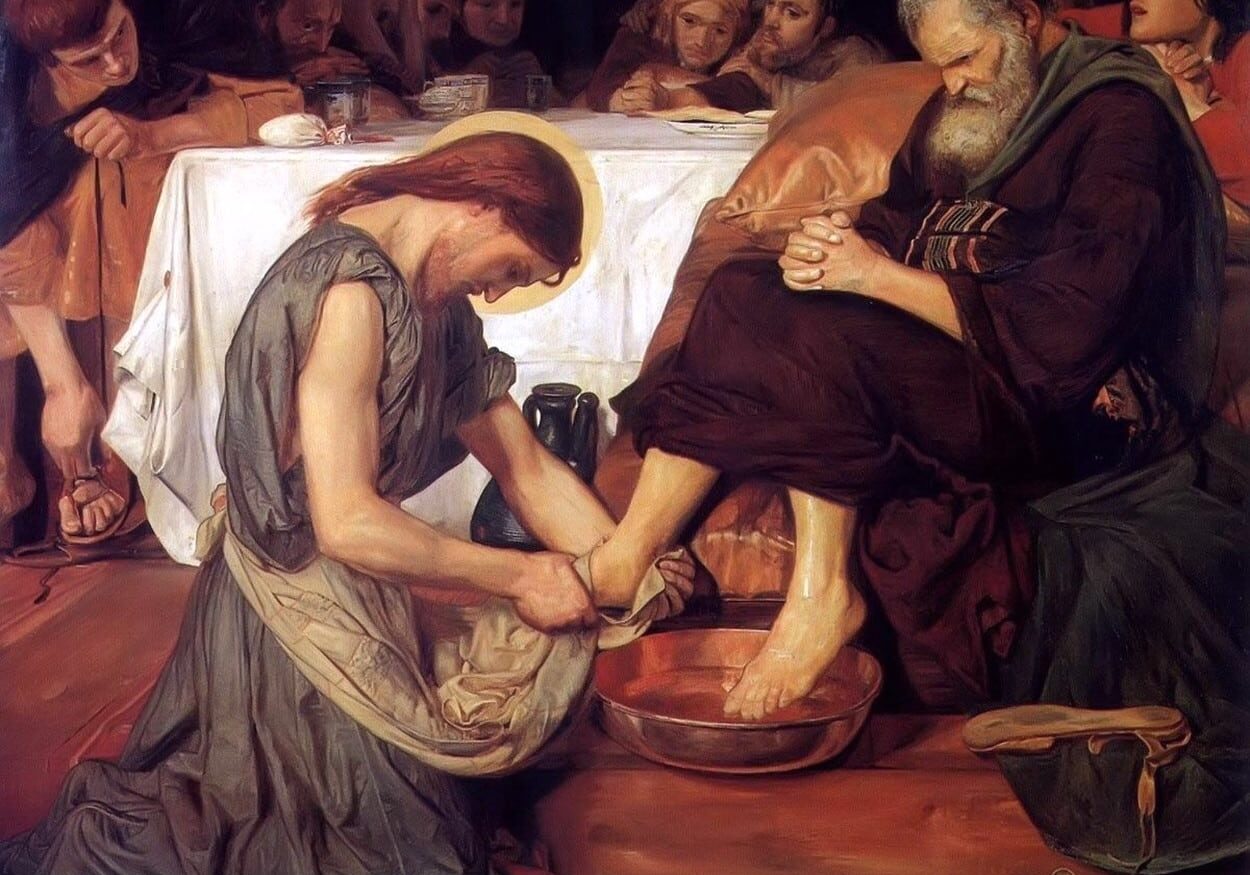
The whole world was truly going after JESUS with ideals of greatness much different than His own. For before this second fruitless discussion in the Upper Room about who would be the greatest, the LORD JESUS had done something that would offend many, epitomizing the true meaning of greatness in the Messianic Kingdom He had come to inaugurate. JESUS, “having loved His own who were in the world, [for] He loved them to the end … rose from supper and laid aside His garments, took a towel and girded Himself” and began to wash their feet (St. John 13. 1 & 4). By washing the feet of His disciples, the LORD JESUS reveals the work and ministry of a deacon, unveiling the path to greatness in His Kingdom – the washing of feet.
It was not simply that JESUS was willing to condescend Himself to a level of humility that showcased servant leadership, it was that JESUS revealed that redemption includes the cleansing of the dust from mankind’s feet. — As Bishop ++Sutton pointed out, dust possesses a theological, as well as an anthropological, meaning in Holy Scripture. First, in Genesis 2.7 we read, “Then the LORD GOD formed the man of dust from the ground and breathed into his nostrils the breath of life, and the man became a living creature.” — Man is from the dust of the earth – he is a creation of the Creator. As a creature, held down by his limited earth-boundedness, man’s purpose is not to define nature’s laws nor the universe’s moral principles; that is the role of the Creator. Mankind’s role is to “Be fruitful and multiply; fill the earth and subdue it; [to] have dominion over the fish of the sea, over the birds of the air, and over every living thing that moves on the earth” (Genesis 1.28) – Being of dust, mankind is to be subservient to the will of the Creator.
Yet, after the Fall, because of mankind’s disobedience in the Garden, dust has also come to represent the rebellion in man’s heart, due to his insatiable and rapacious appetite to be his own ‘Master of the world and Maiden of the nations’, apart from GOD. And because of his insurrection against the Most-High, mankind was cursed and relegated to separation from His Maker, inheriting instead, spiritual death, thus returning to the dust from which he came. In view of his sin, mankind was told by GOD, “Cursed is the ground for your sake; in toil you shall eat of it all the days of your life … In the sweat of your face, you shall eat bread till you return to the ground, for out of it you were taken; for dust you are, and to dust you shall return” (Genesis 3.17 & 19).
Further, we can see that by his physiological form, man walks the earth symbolically, in order to his position in creation as a subservient creature. Man lives, moves, and has his being in this world, walking with his feet connected to the earth from which he was made, connected to the dust. — Thus, the greatest in the Kingdom of GOD is the one who can clean the dust, the sin, and the fallenness from mankind’s feet. The greatest is the one who can transform man into a new creation by the cleansing of his body and the washing of his soul.
From the ‘sanctifying of Water to the mystical washing away of sin’ in the wilderness with St. John the Baptist, to the Water of New Birth discussed by night with Nicodemus, to the offering of Living Waters at the well in Samaria to the woman, to the Pool of Siloam and the washing away of spiritual blindness at the Temple, JESUS is the firth and source of the living waters that cleanse, renew, and transform mankind into the resurrection image of GOD.
Who is to be the greatest in the Kingdom GOD? It is JESUS, and all those that follow after Him – condescending to be a servant to all, and ready to do any office of kindness and service for them that would hear the Gospel of Christ and join in our right hand of Christian fellowship – our koinōnia. By rising up and girding ourselves with the Gospel in word and deed, we can help our LORD to wash the dust of sin from our fellow men. “For what they feel are temptations; what they know are sins; what they experience are trials; what they suffer are the sorrows of life; what they want is to be helped, served, washed, cleansed…”5 We can help them – we understand – our feet have been washed, too!
Who will be the greatest in the Kingdom of GOD? Will it be you? Will it be me? If it is to be so, then may GOD give us His grace to be as the younger and as ones who serve, wash, and cleanse. GOD help us to be servants to our fellow men. Let us be great like JESUS and condescend to help our brothers and sisters in need in Ellis County, that we might be truly called, ‘the greatest in the Kingdom of GOD.’
Let us pray:
“Pity the nations, O GOD. Constrain the earth to come. Send thy victorious Word abroad and bring the strangers home. We long to see thy churches full, that all thy chosen race may, with one voice, and heart, and soul, sing thy redeeming grace. Amen.”4
1 BibleHub.org. “Lexical presentation of μέγας or greatness – St. Luke 22.26”. Accessed 20 August 2025. https://biblehub.com/greek/3173.htm
2 Edersheim, Rev. Dr. Alfred, The Life and Times of JESUS the Messiah, (Peabody: Hendrickson Publishing, 1993), 814.
3 McLane, William W. “The Professor versus the Pastor.” The Biblical World, Vol. 44, No. 5, (Nov. 1914), pp. 334-335. http://www.jstor.org/stable/3142780. Accessed 22 August 2025.
4 The Book of Common Praise, “How sweet and awful is the place with Christ within the doors”, (Newport: Anglican Liturgy Press, 2017), 511.
Join Us for Biblical Worship, Study, & Fellowship
Sundays:
Coffee and Fellowship 8:30 am
Catechesis for all ages 9:00 am
Holy Communion 10:30 am
Recent Sermons
Twelfth Sunday after Trinity

Worship with Us
Join us for Biblical worship, study, and fellowship. We currently meet in the sanctuary of Christ the King Lutheran Church in Waxahachie.
Catechesis for Adults and Children 5+
Sundays at 9:00 am
The Order of Holy Communion
Sundays at 10:30 am
Fellowship Opportunities
See our calendar for other weekly and special events.