First Sunday in Lent
†
The words we hear from the priest during the Ash Wednesday service are intended to cause us to recapitulate, or remember, with humility and grievousness, our mortality and corruptibleness. Yet, those words should not cause remorse nor shame in us as Christians; instead, they should inspire us to the faithful pursuit of our commitments vowed at our Christian Baptism and Confirmation. Further, we should not hear the words of the priest during the Ash Wednesday service as a simple maxim like, ‘only two things are certain in this word: death and taxes.’ Instead, the hauntingly true words of the priest, ‘Remember O man, dust thou art, and to dust thou shalt return,’ should stiffen our Christian resolve, causing us to live more determinedly for Christ, as our Collect for the First Sunday in Lent describes. The Christian life that the Collect compels the Church to desire is one wherein ‘we may ever obey the LORD’s godly motions in righteousness and true holiness. — Such a life as this, being full of Christian faith, hope, and charity, requires that we must live not unto ourselves, but unto the LORD.
Sounds straight forward – living unto the LORD – but it is no easy task. – Let us begin by defining what it means. For as one theologian has said, “If we would know what way we [should] walk in, we must enquire what end we [must] walk towards.”1 And as we think about living unto the LORD, we should think about the way we are walking towards. Is it the way of our personal wills, or the way of GOD’s will? – Living unto GOD, in the simplest terms, is the opposite of living unto ourselves.
St. Paul in his epistle to the Romans, chapter 14, teaching the Roman church what it means to live unto the LORD and not unto oneself, contextualizes the concept by putting it into an illustrative, everyday experience that we can all identify with: eating. – In Rome, you had a mix of people in the Christian population – some Jews and some Gentiles – some mature Christians and some immature. Both groups of people were in different stages of their Christian journey, and St. Paul was instructing the stronger Christians not to look down their noses at their brothers and sisters for their youthfulness in The Faith. The most instructive place to teach this lesson, Paul felt, was at their dinner table. — St. Paul says, “Receive one who is weak in the faith, but not to disputes over doubtful things. For one believes he may eat all things, but he who is weak eats only vegetables. Let not him who eats despise him who does not eat and let not him who does not eat judge him who eats; for GOD has received [them both] (14,1-3).
The contention, living is a society so shot through with pagan practices, was whether the meat purchased in the market had been tainted by idols.– Where the older, more mature Christian would have had no problem eating these meats, the immature Christians did. For the experienced Christian knew “that an idol is nothing in the world, and that there is none other GOD but one … and one LORD JESUS Christ, by whom are all things…” (1 Corinthians 8,4b & 6b). On the contrary, the less experienced Christian would rather not “eat a thing offered unto an idol; their conscience being weak and possibly defiled” (1 Corinthians 8,7).
Now Paul’s point is not ultimately about what a Christian eats or drinks, for salvation does not come by way of food. What Paul is concerned about is whether the Christian is eating or not eating (doing anything) ‘unto the LORD’, and not ‘unto himself’. Paul summarizes his point by saying, “He who eats, eats to the LORD, for he gives GOD thanks; and he who does not eat, to the LORD he does not eat, and gives GOD thanks. For none of us lives to himself, and no one dies to himself. For if we live, we live to the LORD; and if we die, we die to the LORD” (Romans 14,6b-8). – Dear church, the object of the Christian life is GOD, and all our doings, as we learned from 1 Corinthians 13, are nothing worth, without love for Him.
As you might suspect, today’s Gospel Lesson offers us an ideal model of this living unto the LORD and not unto ourselves. This model, or archetype, is found in the Person of JESUS Christ, the Monarch of Heaven.
In St. Matthew 4, JESUS, having just been baptized by John in the Jordan, turns to the wilderness, being led by the Holy Spirit. – From the beginning of His ministry, JESUS submitted Himself to the leading, not of His own will, but to the will of the Father through the Holy Spirit. – JESUS was anointed by the Holy Ghost at His blessed Baptism, after which, the Father spoke these words: “You are My beloved Son; in You I am well pleased” (St. Matthew 3,17). – The idea of GOD being pleased with anyone revolves around that person’s faithfulness and obedience to Him. JESUS began His ministry in the attitude of submission and living unto the LORD as a sign of His faithfulness and obedience, not to Himself, but to the Father. — Before anything else, JESUS made a commitment to the Father, like Israel before Him: “All that the LORD hath spoken, we will do” (Exodus 19,8).
As we begin to think about it, we might say to ourselves, ‘Well JESUS is GOD, of course He lived unto GOD and not Himself. What else could He do?’ Yet, the simplicity of what that statement is driving at, misses the glory of the Incarnation, and it is not taught in the Bible. The Bible teaches us that JESUS had to live as a man in this world, with every temptation, challenge, and heartache, just as we do. If fact, we might say JESUS’ life was even more difficult than ours, for He was contested, tempted, and persecuted directly by Satan and his evil host, and yet without sin.
It is certainly a mystery, but the Holy Scriptures teach us (without mincing words), that JESUS the Christ, the Second Person of the Holy Trinity, yielded His divinity – His omniscience, omnipotence, and omnipresence – to dwell among men; to walk as one of us; to live and die as one of us. The Bible describes JESUS’ condescension of His divine nature, and his voluntary inclining to equality with His inferiors, in this way: “He made Himself of no reputation, taking the form of a bondservant, and coming in the likeness of men” (Philippians 2,7). Thus, while on this earth, walking as one of us, JESUS chose to be ‘led up of the Spirit’, living unto GOD, and not unto Himself.
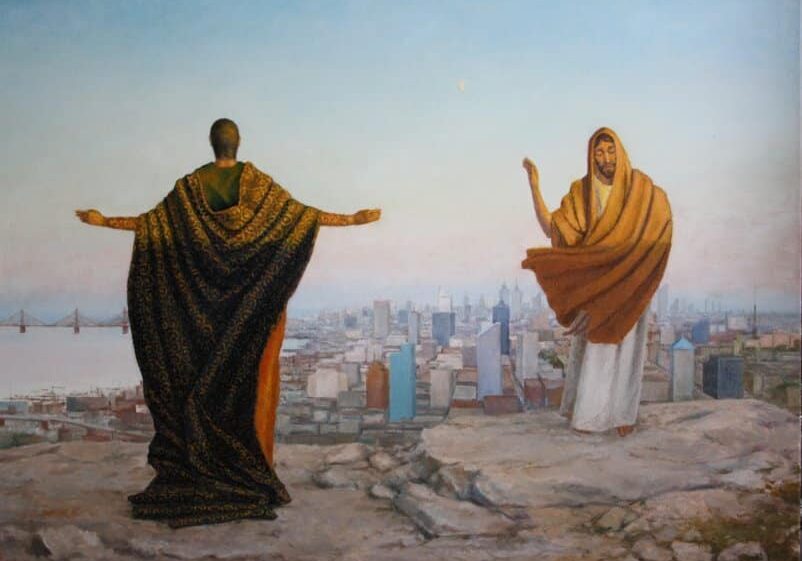
To evidence this truth, JESUS follows the Holy Spirit’s leading, by leaving the lush greenspaces of the Jordan, and the people that were so curious to know about Him and to speak with Him. Instead, He chooses to go into the uninhabited and barren wilderness. — It is obvious which is preferable but following the lead of His Father through the Holy Spirit, JESUS chose to live unto the LORD and not unto Himself. – In the Bible, the wilderness is a place, not only of physical hardships, but also of spiritual hardships, desolation, and testing. Yes, JESUS was led by GOD into the harshness of the wilderness to face testing through physical and spiritual temptations of the Devil. Both GOD and Satan desired to know what kind of pleasing Son JESUS would be, especially when driven to the point of physical, emotional, and spiritual breaking. – In such an environment as this, the question could be answered: Would JESUS live unto Himself, or would He live unto GOD the Father?
We should note a few things about JESUS’ circumstances, of which might be obvious. First, He was alone. – Now I have never lived in solitary confinement for any length of time, but a day without human interaction begins to wear on the endurance of my emotions, and the silence becomes overwhelming. Some people can go a very long time without connection to others, but forty days, for anyone, would cause the nerves to fray. – Second, JESUS was without food for forty days. – Study and science shows that the human body can go two to three days without water, but forty days without food. It is a long time, but the human body is an amazing creation of GOD, and it is not until forty days that the body becomes desperate for sustenance and energy. At that point, little else but food can occupy the mind. — Finally, JESUS was vulnerable. He had no community, no shelter from spiritual attack, he could not ask any of His friends to come to Him and encourage Him, or to pray for Him. JESUS was absolutely and undeniably separated and without help or comfort from others. – And that, is when the Devil came to Him.
The temptations of the Devil were threefold, and they served to challenge JESUS’ fidelity to GOD. Satan came at JESUS with the three base temptations that the Bible summarizes as the ‘love of the world’ – these three temptations are the foundation for all temptations the mankind experiences. – These three temptations of ‘the love of the world’ are the lust of the flesh, the lust of the eyes, and the pride of life. Satan knew that if he could get JESUS the Man to fall to any one of these tempting allures, the love of Himself, and not the love of the Father could be proved absent in Him who, ‘though he existed in the form of GOD, did not regard equality with GOD as something to be grasped.’ – For Satan longed to undue the Humanity of Christ, showing that, “If any man love the world, the love of the Father is not in him” (1 John 2,15). Thus, Satan systematically and mercilessly tempted JESUS to prove His love for the world, to deny GOD, and to live unto Himself.
To achieve his goal, Satan urged JESUS to turn rocks into bread to satisfy His hunger, to yield His fealty to the god of this world, that JESUS might have the wealth and power of the nations, and finally, to cast Himself from the Temple’s peak to force GOD’s hand to save Him. All these enticements, accentuated by JESUS’ loneliness and bodily longings, fed into the goal of persuading Him to deny what He knew – that He was the Son of the Father, in whom the Father was well pleased. – Paul’s illustration at this point seems childish compared to what JESUS was facing, but the spiritual reality of the test is the same. — Whether it is our food or drink, the way we drive, the language we choose to use, the media we allow to infiltrate our eyes and ears, the books and periodicals we read, the relationships we keep or shun, or the attitude of our hearts and minds when we hear in our conscience, ‘choose ye this day who you will serve’ – all of it is about dying to ourselves, and living unto the LORD. Living according to GOD’s commands or ours. – All of it, says St. Paul, whether in life or in death, is unto the LORD. For, “whether we live or die, we are the LORD’s” (Romans 14,8). That is, if we are true sons and daughters of GOD, who have put their whole faith and trust in the LORD JESUS Christ, we are the LORD’s, and so is our choice of life, IF we desire outwardly in our bodies and inwardly in our souls in righteousness and true holiness.
One last thing dear brothers and sisters. Please note that JESUS was successful in warding off Satan’s efforts to foil His Sonship and to persuade the LORD to live in a way that would please Himself and not GOD, through the Word. — JESUS defeats Satan’s dark efforts, not by power, nor by might, but by strictly and obediently following the Word of GOD’s commands, written in the Bible. – If the Bible’s Words were untrue or even half true, Satan would be unhampered in his schemes. Yet, as JESUS came face to face with the Devil, (whose power was there to undo the LORD in His humanity), JESUS quotes GOD’s commandments from the Book of Deuteronomy – “Man shall not live on bread alone, but by every word of GOD”; “You shall not tempt the LORD your GOD”; “You shall worship the LORD GOD, and Him only shalt you serve”. The Word of GOD is not magic, it is truth. The Word of GOD is not a tool to simply swat away Satan, it is a life source from which man must live and light his path if he is to live eternally – that is, if he/she is to live unto the LORD.
During the season of Lent, Christians willfully, and longingly, follow the Spirit’s leading into the wilderness. We go there, obediently, so that we might learn once again how and why we are to die unto ourselves and live unto the LORD. Undoubtedly, Satan is there waiting for us, for the wilderness is a place of testing. Yet, we are to be brave and fear not, if we walk by the Spirit – just as JESUS walked. The promise of Holy Scripture as evidenced by JESUS’ temptation in the wilderness, is that, even if we are alone, powerless, and hungered, if we die unto ourselves and live unto GOD, trusting in His Word and Commandment, the wilderness will become revelatory to us. You see, the wilderness is not only where GOD’s people are tested, but also where GOD reveals Himself to His people – His sons and daughters in whom He is well pleased. – Dear church, this Lent, if we are to follow in the godly motions of the righteousness and true holiness of JESUS to the Cross, and ultimately, to the Empty Tomb, we must submit ourselves fully to the leading and direction of the Holy Spirit. We do this by seeking His will and His direction over our own. For, my dear brothers and sisters, “the Kingdom of GOD is not eating and drinking, but righteousness and peace and joy in the Holy Ghost … Therefore, do not destroy the work of GOD for food, [for ego, or for lust]” (Romans 8,17-18, & 20). “For all that is in the world—the lust of the flesh, the lust of the eyes, and the pride of life is not of the Father but is of the world. And the world is passing away [my friends], and the lust of it thereto; but he who does the will of GOD, abides forever” (1 John 2,16-17). In the Name of GOD the Father, GOD the Son, and GOD the Holy Spirit. Amen.
1 BlueLetterBible.org. “Matthew Henry: Commentary on Romans 14.” Accessed 6 March 2024. https://www.blueletterbible.org/Comm/mhc/Rom/Rom_014.cfm?a=1060007

Join Us for Biblical Worship, Study, & Fellowship
Sundays:
Coffee and Fellowship 8:30 am
Catechesis for all ages 9:00 am
Holy Communion 10:30 am
Recent Sermons

Sixteenth Sunday after Trinity

Worship with Us
Join us for Biblical worship, study, and fellowship. We currently meet in the sanctuary of Christ the King Lutheran Church in Waxahachie.
Catechesis for Adults and Children 5+
Sundays at 9:00 am
The Order of Holy Communion
Sundays at 10:30 am
Fellowship Opportunities
See our calendar for other weekly and special events.