Passion Sunday
†
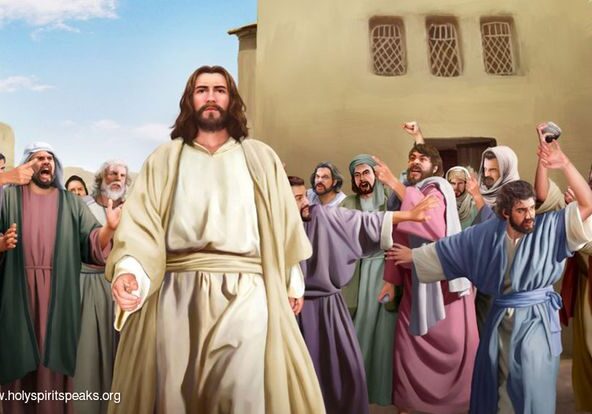
In the Gospel of Saint John, chapter eight, from which our Gospel Lesson comes today, we are witness to the last time our LORD JESUS engages with the religious leaders of Jerusalem, in a serious way. This conversation occurs before JESUS’ arrest, trial, abandonment, and crucifixion. There are many interesting things to note about this story, but what we must take note of first, is how JESUS and the Pharisees, in their conversation, as one commentator has said, were talking past each other like a slow waiter and a bad tipper – an engagement destined to end, for both parties, in frustration and disgruntlement. If we were to take the whole conversation in its complete context, we would start back in verse twelve of chapter eight, immediately following the redemption of the adulteress, who symbolized Israel, and whom none could condemn nor forgive, except JESUS. And after the LORD pronounces His absolution of the woman, He says: “I am the Light of the world: he that followeth me shall not walk in darkness but shall have the light of life” (8.12). These things JESUS did and said inside the Court of the Women in the Temple, a place where only Jews were allowed. By the end of their conversation, JESUS has moved out into the porches, just beyond the Court of the Gentiles, where all people could gather, no matter their ethnicity. There, in Solomon’s Porch, JESUS finished His commentary with the religious leaders by saying something very similar to what He said forty-seven verses earlier: “‘Verily, verily I say unto you, before Abraham was, I am.’ Then they took up stones to throw at Him; but JESUS hid himself and went out of the Temple complex…” (John 8.58-59a).
Interesting that the Jews did not pick up stones earlier to hurl at the LORD, when, in John 8.12 JESUS said: “I am the Light of the world: he that followeth me shall not walk in darkness, but shall have the light of life” (8.12). JESUS was intimating, as He would at the end of this narrative, to His glorious character and divine essence. — In the Midrash, a Jewish collection of commentaries on the Torah, compiled after 70 A.D., the architecture of the windows of the first Temple in Jerusalem is explained. “While commonly, windows were made wide within and narrow without, it was opposite in the Temple of Solomon. The light issuing from the Sanctuary (where the sacrifices were made) was to go through a narrow, internal frame, and then expand broadly to the exterior, so as to enlighten that which was without, viz., the Gentiles.”1 — The glory of GOD in His work of forgiveness and redemption occurring in the inner courts through the daily sacrifices and praises of His people, was to lighten, allegorically, the Gentiles, who were walking in darkness in the outer courts. This concept of broadcasting light from the inner courts to the outer courts was accentuated at night during the eight days of the Feast of Tabernacles, which is the context for John eight and JESUS’ conversation with the Pharisees. During that feast, the priests and Levites erected very large lamps in the Court of the Women, so that the light of the glory of GOD would beam out onto the Court of the Gentiles, just outside. The Court of the Women would also have been the place where Simeon and Ana encountered the Christ Child after His dedication on the fortieth day by Joseph and Mary. Thus, with this concept of the Light’s role in GOD’s theology, and Temple architecture, Simeon proclaimed: “Now mine eyes have seen Thy Salvation, [O YHWH], which Thou has prepared before the face of all people; to be a light to lighten the Gentiles, and to be the glory of Thy people Israel” (Luke 2.30-32). The whole affair was symbolic of the work and person of the Messiah, and Simeon had the divine foresight, to see Christ JESUS as the Messianic Redeemer and spiritual Light of the world. Thirty years later, JESUS stands up and says the same thing Simeon said, but this time, in the first person: ‘I am the Light of the world’ – translation, I am the Messiah of GOD.
Further, and perhaps even more provocatively, was the way JESUS personalized His claims. The Pharisees did not catch onto this until the end of the chapter when they grabbed stones to hurl at JESUS for blasphemey. The Jews not only understood that the Messiah, GOD’s Anointed One, would raise up the tribes of Jacob and restore the preserved of Israel, but that He would also be given as a light to the Gentiles; i.e., His Messiahship would be GOD’s salvation unto the end of the earth. (cf. Is. 49.6)
It was also understood that GOD Himself was the source of Divine Light, which is the essence of His absolute truth and life. In Daniel 2:22, in the story of Daniel’s interpretation of Nebuchadnezzar’s dream, we learn Who is the source of Daniel’s wisdom and Nebuchadnezzar’s enlightenment. Upon the gift of revelation of Nebuchadnezzar’s dream, Daniel exclaims his praise to YHWH GOD, saying: “Blessed be the name of YHWH forever and ever, to whom belong wisdom and might … He reveals deep and hidden things; He knows what is in the darkness, and the light dwells with him” (Daniel 2.20,22). Further, the Psalmist proclaims this truth about YHWH, saying: “For with Thee is the fountain of life: in Thy Light, we shall see light” (Psalm 36.9). — Thus, we understand, that JESUS was claiming, not only the Messianic glory, but also the personal essence of Israel’s revealed Deity with the very unmistakable, grammatical phrase, ‘I am.’ And like a slow waiter and a poor tipper, the LORD JESUS and the Pharisees talked right past one another: one signaling to the other where things were going, in no uncertain terms, if the service did not improve, immediately and drastically.
In His encounter with the Pharisees, JESUS tells them that He is the source of light and truth that the prophets and Moses had spoken about in the Old Testament. The Word made Flesh was tabernacling among the Jews, and JESUS wanted to release His chosen people from the bondage of spiritual sin they were in, as they lived according to the letter of the Law, but not its spirit. — The Jews would sing in the Temple and their synagogues, “Thy word is a lamp unto my feet, and a light unto my path,” (Psalm 119.105), and they would read from their scrolls, “Rejoice not against me, O mine enemy: when I fall, I shall arise; when I sit in darkness, the LORD shall be a light unto me” (Micah 7.8). And now, here was that Light to lighten their paths – a lamp unto their feet – JESUS was telling them that that which their prophets heard and wrote down only as ancient divine oracles, was now being revealed and standing brightly in front of them. Further, JESUS was inviting them onto the path that His light would enlighten when He said, “I speak to the world those things which I have heard of the Father” (8.26); “If ye continue in my word, then are ye my disciples indeed; And ye shall know the truth, and the truth shall make you free” (8.31-32); “Verily, verily, I say unto you, if a man keep my saying, he shall never see death”(8.51). Yet they would not hear Him because they did not believe. For, as JESUS said: “He that is of GOD heareth GOD’s words: ye therefore hear them not, because ye are not of GOD” (8.37).
For these sayings, the Pharisees accused JESUS of being several things. They did this, because they understood not the spiritual truths communicated by GOD’s symbols and words. As St. Paul says in 1 Corinthians 2 concerning the truth of the symbols and reality of the Gospel’s spiritual message: “We speak, not in the words which man’s [empirical and rational] wisdom teacheth, but which the Holy Ghost teacheth; comparing spiritual things with spiritual. The natural man, [looking for empiricism and natural logic], therefore, receiveth not the things of the Spirit of GOD – for they are foolishness unto him, neither can he know them, because such teachings are spiritually discerned” (2,14). — Thus, the Pharisees fell back on their standard indictment of JESUS, as they had done many times before. — “Say we not well that thou art a Samaritan, and hast a devil?” (John 6.48).
The Jews generally, and the Pharisees particularly, turned on JESUS, because He struck at their Achilles Heel – their most prized possession – their identity. And that is when they turned violent – verbally and physically. Since they would not, and therefore, could not, accept JESUS’ word and witness, the LORD told them that their identity was not in GOD. In fact, JESUS said unto them: “If you were Abraham’s children, you would do the works of Abraham. But now you seek to kill Me, a Man who has told you the truth which I heard from GOD. Abraham did not do this” (John 8.39-40). — There is not sufficient time or energy available in this individual homily (or any homily for that matter), to express the haughtiness many of the Jews of JESUS’ generation pridefully possessed in their assumed predestinated position and inheritance. Their belief was that they would participate in GOD’s Kingdom, simply because of their Jewish ethnicity. Yet, JESUS was not pointing out fault in their biological lineage, but in their spiritual and moral lineage. — JESUS said: “You are of your father the devil, and the desires of your father you want to do. He was a murderer from the beginning, and does not stand in the truth, because there is no truth in him. When he speaks a lie, he speaks from his own essence and character, for he is a liar and the father of it” (John 8.44).
JESUS enlightened the Pharisees to their spiritual bondage – a servitude of another kind and one which they knew not — it was that of bondage to sin. He told them: “Most assuredly, I say to you, whoever commits sin is a slave of sin” (John 8.34). And of this reality, they were in denial. — And if they continued in their denial, their national identity and heritage, like a slow waiter’s tip, was destined for destruction. “JESUS told them that their continuance in their servitude to sin (evidenced by their desire and hope to kill Him), would also lead to national, physical bondage – the result of rejection by YHWH … They were in a moral descent – and that alone was of a real, and not a symbolic value … JESUS made His meaning very clear, but they only misapplied it according to their Jewish prejudice.”2
To the Jew in JESUS’ day, “their racial purity was a sufficient guarantee of participation in the eternal Kingdom to be established by the Messiah. But our LORD – like John the Baptist before Him – rejected any such claim and insisted that salvation could only be attained by way of repentance, faith, and the keeping of GOD’s words and commandments.”3 The grace of this free gift was and is available to all, Jew and Gentile. Again, both a teaching of the LORD JESUS and His cousin John. (cf. Mk. 7.28-29; Lk. 3.8) And when our LORD defended His teaching, He did not mince His words. He said: “I know that you are Abraham’s descendants, but you seek to kill Me, because My word has no place in you. I speak what I have seen with My Father, and you do what you have seen with your father” (John 8.37-38). JESUS made it plain that He was obeying His Father, who is YHWH GOD, and they, their father, whom JESUS told them was the devil. — And this is a very important theological truth. There are only two fathers that people follow: GOD or Satan. You are either in Christ or in sin. You are either in the Light or in darkness. You cannot be in both, by any percentages, means, or ways. This is what JESUS was telling the Pharisees.
During Lent, we take the time and spiritual effort (body and soul), to identify and desist from those things, ideas, habits, or thought patterns that would seek to lure us into sin and away from being in Christ. JESUS gives us His formula for being in Him and staying in Him. He says, “If you abide in My word, you are My disciples indeed. And you shall know the truth, and the truth shall make you free” (John 8.31-32). — Did you hear that, friends? Free! Christ’s words, if we will hear them, mark them, inwardly digest them, and then do them, we will be made free – free spiritually, mentally, and physically. Free from spiritual fear and blindness – free from mental sadness and doubt – free from physical addictions and hang-ups. – ‘If you abide in My word, you are My disciples indeed. And you shall know the truth, and the truth shall make you free.’
But the Jews did not want to be free. They did not want to repent from their sin, and they did not want to trust JESUS as their LORD and Savior. They wanted to follow their dark father and cling to their obtuseness and pride with a murderous tenaciousness. This JESUS said, endangered their position in the House of GOD – His Kingdom of promise. JESUS said, “Most assuredly, I say to you, whoever commits sin, [and keeps on committing sin], is a slave of sin. And a slave does not abide in the house [of the Master] forever” (John 8.34-35a).
Liberty or bondage: JESUS’ light enlightens the truth about both and gives humanity a choice. Thus, after JESUS had given the Pharisees and all who were listening to their conversation in Solomon’s Porch the choice between liberty and bondage, JESUS appealed to His own authority and intimate relation with His Father to convince the Jews of His message’s veracity. — JESUS appeals to His eternality and greatness – a greatness, greater even than that of Abraham. — These words so infuriated the Pharisees that they accused Him of being demoniacally possessed. Then, as their tempers waxed hotter and hotter, they sought to stone Him for blasphemy because of His final challenge to lay claim to the Divine Name, which could not be mistaken: “Before Abraham was, I am” (John 8.58).
JESUS avoided the confrontation by slipping out of the very expansive and populated portico of the Temple, and from this moment forward, JESUS stopped making His Gospel plea to the Jews generally, and the religious leaders, particularly. He left them brooding upon His prophetic word: “When you have lifted up the Son of Man, then you will know that ‘I am’, and that I do nothing of Myself; but as My Father taught Me…” (John 8.28).
JESUS was veiled to the antagonistic Jews’ eyes and would remain that way until the Resurrection. And so, we too, veil the Cross as a sign of the silent suffering that our LORD JESUS entered into, weeping for Jerusalem and all who denied and abandoned Him for someone He was not. — The days preceding JESUS’ crucifixion were very burdensome for our LORD, for the contempt that came upon Him by His own, who received Him not, was great.
As Christians, we are to follow Christ JESUS by picking up our crosses and walking in His light, which is a lamp unto our feet. Yet, none of us can carry His Cross of judgment, shame, and rejection. Thus, He gives us the prescription for the freedom He has purchased through His suffering, which will truly set us free: abide in His words and commands and walk according to His will. In so doing, we will show ourselves His disciples and we will know the true truth of GOD, and it will set us free – spiritually, mentally, and physically. If we choose another path – a path of bondage over liberty – then we are the paradoxical slow waiter, that cannot sense the poor tip coming our way. — Thus, we pray on this Passion Sunday in remembrance of our LORD’s promise to be our Light and Life, which is the greatest gift we could receive because of His suffering to come: “Almighty GOD, mercifully look upon thy people; that by thy great goodness which you have showed us in your Son, govern and preserve us evermore in body, soul and mind, so that our hearts, being unveiled by thy Grace, might keep steadfast to Thy commandments and ever be set free indeed; through Jesus Christ our Lord. Amen.”4
—
1 Edersheim, Rev’d Fr. Alfred, The Life and Times of JESUS the Messiah, (Peabody: Hendrickson Publishers, 1993), 13490.
2 Edersheim, 13569-13570.
3 Shepherd Jr., Massey H., The American Prayer Book Commentary, (New York: Oxford University Press Inc., 1950), 133.
4 1928 Book of Common Prayer, 132.

Join Us for Biblical Worship, Study, & Fellowship
Sundays:
Morning Prayer 9:45 am
Coffee & Catechesis 10:30 am
Holy Communion 12:00 pm
Thursdays:
Holy Communion 6:00 pm
Recent Sermons
Fourth Sunday in Lent
Worship with Us
Join us for Biblical worship, study, and fellowship. We currently meet in the sanctuary of Christ the King Lutheran Church in Waxahachie.
Catechesis for Adults and Children 5+
Sundays at 9:00 am
The Order of Holy Communion
Sundays at 10:30 am
Fellowship Opportunities
See our calendar for other weekly and special events.