Sixteenth Sunday after Trinity
†
If a moral is to be learned from today’s Gospel Lesson from the narrative of the raising of the dead son of the widow of Nain, it must be found in the response of the people to the miracle. The people who witnessed this event included those in the train of mourning for the dead, as well as those who had followed JESUS from Capernaum, rejoicing at the healing of the sick servant of the Roman centurion. It was possibly on the day prior or only a few days before, when the Roman’s servant was stricken with a fatal illness, and if you recall, JESUS healed the man by His word alone. In that miracle narrative, the centurion, not wanting the Master to contract uncleanness for entering a Gentile’s home, said to the LORD: “Lord, trouble not thyself: for I am not worthy that thou shouldest enter under my roof: Wherefore neither thought I myself worthy to come unto thee: but say in a word, and my servant shall be healed…” (St. Luke 7.6-7). — To this emblem of faith, JESUS responded that He had not seen such beauty of trust in all of the collective hearts and attitudes of Israel. (cf. Matt. 8:13) — One group, in sadness, followed the inevitable in the dead man and his widowed mother; the other group, in gladness, followed the All Things are Possible, in the Person of JESUS Christ. It is to these people we will look to understand the moral of today’s Gospel Lesson.
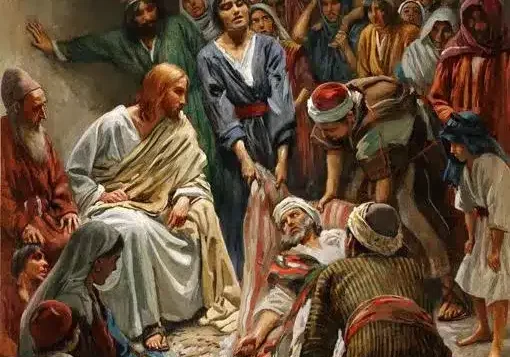
As it was to happen, these two groups of people met near the tombs outside of Nain, and there, JESUS performed one of His most remarkable miracles: He raised the widow’s dead son to life. The people, Saint Luke records, responded with fear, “and they glorified GOD, saying, ‘That great prophet is risen up among us [that Moses promised]’; and ‘GOD hath visited His people'” (7:16). In this scene, we can understand that the people were drawing the conclusion that JESUS intended: He was the Christ, the Anointed One of GOD to whom the prophets pointed. Their words of confidence in Him brought clarity and veracity to the claims that JESUS Himself was making. For He said unto those who were skeptical; even to John the Baptist: “Go your way and tell John what things you have seen and heard; how the blind see, the lame walk, the lepers are cleansed, the deaf hear, the dead are raised, and to the poor the Gospel is preached. And blessed is he, whosoever shall not be offended at me” (St. Luke 7:22-23).
The witness of the people (as they spread the rumor of what they had seen all throughout Judea), and their posture of fear and praise of GOD, is the strong witness for us in the modern Church of what this miracle means. Yet, before we understand their interpretation, let us consider the witness of the widow and her dead son. Theirs is a symbolic witness and one that is not explicitly communicated. — First, we must consider the illustrative meanings of each of these characters, especially since we never learn anything about them; not even their names. The only thing we know about these two people is their sad circumstance and the city to which they are attached, which, ironically enough, means Beauty. Yet, if we will allow for it, the widow and the once-dead man can become for us, the Church, spiritual representatives of a broader Gospel Truth; a truth even more powerful than the historical role they play in Luke’s Gospel narrative.
The widow of Nain represents all who are to be pitied in Israel. Not only because she has been forgotten by her husband through his death, but she is also to be considered lost through the death of her son. Based upon the description and deep concern Saint Luke has for her, we are just, by assuming she had no broader family ties – no other children; no grandchildren; no in-laws; no one to care for, or to have concern for her. Perhaps this is why the funeral party was populated with so many people: because the citizens of Nain had great pity upon the woman. — Rev’d. Dr. Edersheim+, our dear 19th-century Anglican priest and Messianic Jew, tells us that Jeremiah 22:10 was commonly recited by such a mourning party as we see in Nain. They would recite this passage while they processed from city to the tombs. They would say: “Weep sore for her that goeth away: for she shall return no more to her native country.”
With no husband and no living child, particularly a son to help provide for her in the male-dominant Jewish society, the widow of Nain was like Israel being led away captive to Babylon unto exile. With the passing of her child, she was never to enjoy or return to her inheritance again. For, in Israel, one’s inheritance was one’s tribe; particularly one’s immediate family. Thus, this widow from Nain, this husbandless and childless woman, was now seen to be dead too; socially for certain, but also relationally, with YHWH GOD. She would now depend upon the kindness and mercy of her neighbors for her cares and concerns, and thus she represented one of the most significant outcasts of society. Her tragic situation would not cause her to become unclean or impure, yet she would be stigmatized as something much worse: someone bitterly treated by GOD. In the book of Ruth, Naomi frames it best when she returned to her people in Bethelehemjudah, having spent many years in Moab, where she lost her husband and her two sons as well. When welcomed home by her kinsfolk, Naomi said: “Call me not Naomi; call me Mara (that is Bitter). For the LORD has dealt with me bitterly” (Ruth 1:20).
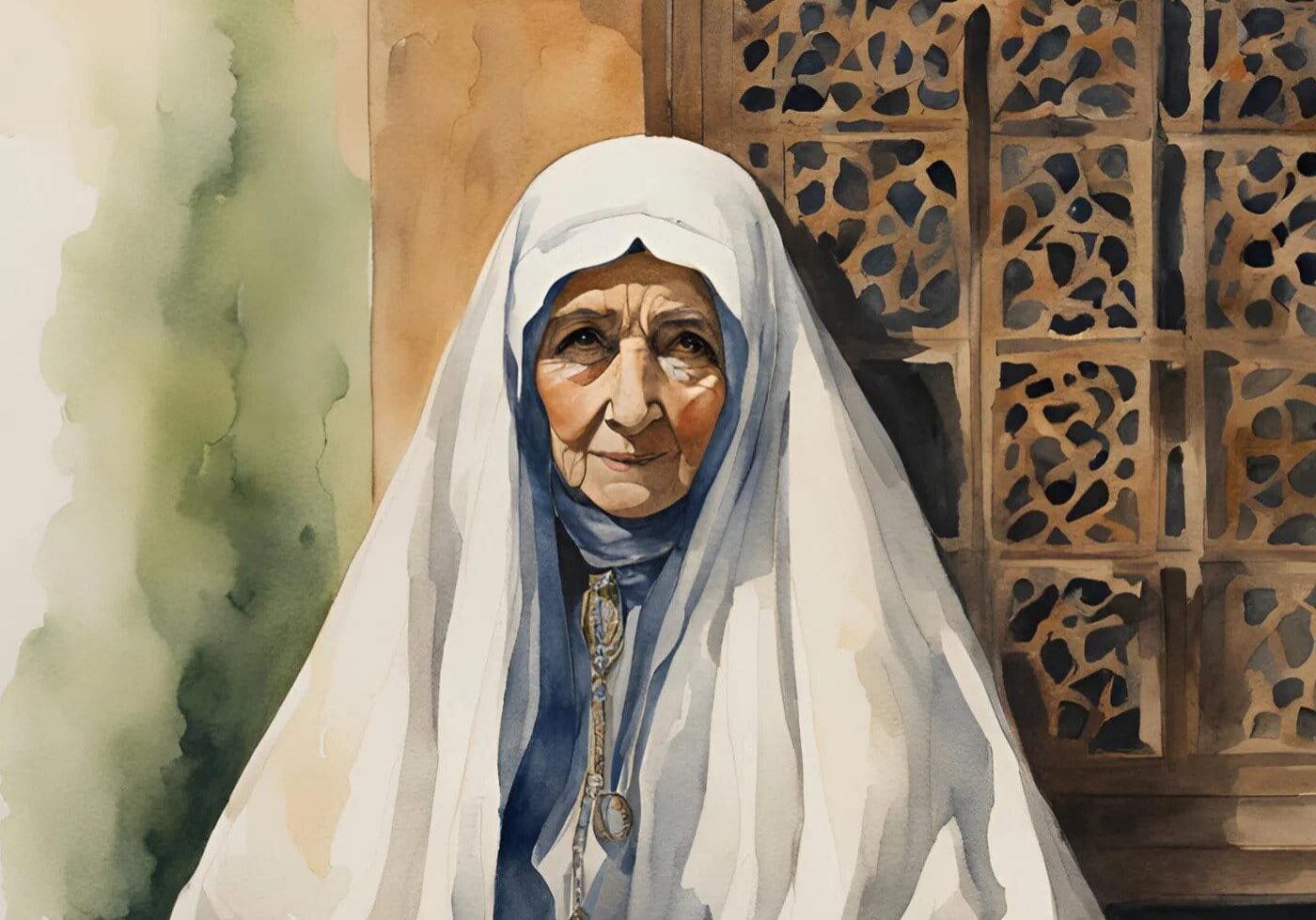
You see, in classic literature, “a widow is rarely just a character who has lost a spouse, or in this case, a spouse and a son. She is a powerful symbol. Historical societies, especially Judaism in Israel, defined a woman by her relationships to the men in her life as a daughter, wife, and mother. The widow of Nain is a profound social and spiritual anomaly; one in whom we cannot overlook because of the powerful symbol she represents. For the circumstances of her life had brought her to a lonely prison of spiritual bitterness and to the inflexible confinement of broken heartedness. — We are not told whether this was a just or an unjust circumstance, only that it was, and there was great sadness for her who must have once stood so joyfully proud to be a wife and a mother. A woman blessed of GOD with the hopes of a future like Ruth; the hope that she would become like Rachel and Leah: the two who built the house of Israel. — It is hard to deny this reality; her hopes and dreams were dashed by life’s cold inequities. Her sadness and the people’s pity for the widow reveal this, undoubtedly, to be true.
As for the dead man, the widow’s son, I think his symbolic meaning is easy to discern. All men, born of woman, who are of the seed of Adam, we are naturally dead men walking. Accentuated in this Gospel narrative, none of us are righteous; no not one, as Saint Paul says in Romans 3:10. Thus, in our own righteousness, while on this earth, if we are separated from GOD in Christ, we are like dead men being carried around on a bier: breathless and lifeless. Since all men and women come from the seed of Adam (that ‘old man’ who rebelled against GOD in the Garden of Eden), as his heirs, we are fallen, unregenerate, and natural enemies of GOD. This is the inheritance we have received from our first parents. — As the Thirty-Nine Articles point out: “It is the fault and corruption of the Nature of every man, that naturally is engendered of the offspring of Adam; whereby man is very far gone from original righteousness; [i.e., dead in his sins and trespasses] …”1 — I ask you, Saint Mark’s: Could the progeny of the ‘old man,’, dead in his own sins and unrighteousness, be any less a representative of the ‘old nature’ in Adam, than the dead son of the widow cloaked in the transient beauty of Nain. — He reflected the character of Israel – he reflected the nature of all mankind, and he reflected the condition of separation from GOD, being without hope in the world: motionless – powerless – dead – awaiting only his judgement as the enemy of GOD?
Strength, the fruit of man, but that day in Nain it was revealed for what it is apart from GOD: lifeless, still, and impotent. Beauty in the life-giving nurture of the fertile garden of womanhood, but that day in Nain, barren, bitter, and abysmal. The crown of glory of both man and woman – strength and beauty – from the beginning of Creation – left in ruins – in mourning due to sin and its sting. — In earthly Beauty – where people can only follow one another in sad procession to the hopeless tombs of memories lost, clutching and grasping hopelessly at the temporary transience of strength and beauty, life’s trajectory seems nothing but irredeemable; that is, until JESUS comes to town. — That is the Good News today, good people of GOD. JESUS did come to town; death approached Life and the way to Beauty, Life overcame death. When the blessed Presence of JESUS’ comes to visit you, grief and death cannot continue.
And here we come to the resolution of the symbolic meaning of the miracle that JESUS performed that day in Nain. Bitter Israel, separated from GOD by sin, was greeted by her Messiah and His host rejoicing in the life that fills the train of His robes. The prophets had told Israel that when her Messiah appeared, if she would rouse her mind, open her eyes, unstop her ears and turn and believe with her heart the good things GOD had in store for her, then He would heal her, and she would no longer be bitter in spirit and barren in her communion with GOD. If Israel would but hear and see what JESUS was teaching her, she would rise from the dead, and her present PROCESSION of death could be turned from mourning into gladness – grief into joy. – When JESUS arrives on the scene, the Life of GOD manifest in Him, can only be interpreted for what it is: transformative – redemptive – salvific.
It had been four hundred years, from the time of the prophet Malachi, since Israel had heard the word of GOD through His representative prophets. And that day in Nain, upon the somber scene of a funeral procession, JESUS, the Word of GOD spoke, saying unto her that was representative of Israel: ‘Weep not,’ for your GOD has come to your country to be with you. And to prove all is not a false dream, JESUS reaches out and touches the bier upon which the dead man lay, and says, “Arise” (St. Luke 7:14). In so doing, JESUS is saying to Israel’s dead past, ‘Arise,’ reclaim your life, and you shall dwell safely in the land, and you shall be my people, and I shall be your GOD. (cf. Jer. 32:37-38) Buy, sell, plant and harvest; the desolation that made you desolate, in me, will be turned to abundance; even unto everlasting life.
And upon seeing the miracle, the people of Israel in that city of Nain realized how beautiful a thing JESUS had done for them. They cried: “GOD hath visited His people, [as He promised!] (St. Luke 7:16). — “They did not say this in the sense of GOD paying them a social visit, but in the old biblical sense, where the phrase was used to refer to GOD ‘visiting’ Israel in the time of the Exodus from Egypt or at the time of the Annunciation to the Blessed Virgin. The people meant by this statement that ‘GOD has come near to us, to save and rescue us…personally. They meant: ‘this is the time we have been waiting for – the time we have been praying for.’2 The time when GOD would come and bear them in His hands; not permitting even their feet to be hurt against a stone” (Psalm 91:12).
In this scene with the widow and her dead son from Nain, we do not see any particularly grand acts of faith. No requirements of JESUS to do what they asked Him to do for them. In fact, no one even seems to notice that He is there, UNTIL He does the unthinkable. He encounters the people going about their daily human lives, in joy and in sadness, and He stops the human procession and speaks the words only GOD can speak: ‘Weep not’ and ‘Arise’. — Perhaps as you are sitting there right now, or maybe later this afternoon, or perhaps even next week or next month, while you are going about your normal human life, and and you realize your condition in life seems overwhelming and GOD underwhelming. Fear not, for if your are walking in the Way of the LORD, He will stop your procession too. While in the midst of a silent tribulation only known to you, or a public trial of change, disruption, or inconvenience of circumstance – sickness, accident, or abandonment – JESUS will arrive, seemingly accidentally, and stop you in your tracks. During your sorrow, bitterness, sadness, and despair, JESUS will come alongside of you, unbeknownst to you, and He will join you in the middle of your procession. — “JESUS may not do or say the thing that you expect or even want. But if His Presence comes to be with you there, at that moment, as He did that day in Nain, that will be all that you need. Once JESUS is in the middle of it all with you, the procession of your life, you will be able to come through.”3 The Life in the Person of JESUS Christ, permitted in, can only be and do what it is: transform, redeem, and save.
Friends, take the time and make the space, right now, to let JESUS in – let Him into your heart – into your procession – into your life. Allow Him to approach close enough to you that He might speak, touch, and command: ‘Weep not’ and ‘Arise.’ For whosoever dwelleth under the defense of the Most High, shall abide under the shadow of the ALMIGHTY GOD. With JESUS beside you, surely, He will deliver you from the snare of the fowler, and from the noisome pestilence. He shall cover thee with His feathers, and under His wings shalt thou dwell safely; His Word shall be thy shield and buckler. Trust in Him, for He shall be your refuge and fortress. (cf. Ps. 91:1-4)
And now unto Him who speaks peace and causes the dead areas of our spiritual lives to rise again, “unto Him that is able to exceedingly, abundantly, above all that we ask or think, according to the power that worketh in us [through Him]; unto Him be glory in the church by Christ JESUS throughout all ages, world without end. Amen.” (Ephesians 3:20-21). Amen.
—
1 1928 Book of Common Prayer, “Thirty-Nine Articles: IX. Of Original Sin,” 604.
2-3 +Wright, N.T., Luke for Everyone, (Westminster: John Knox Press, 2004), 84.

Join Us for Biblical Worship, Study, & Fellowship
Sundays:
Coffee and Fellowship 8:30 am
Catechesis for all ages 9:00 am
Holy Communion 10:30 am
Recent Sermons
Trinity Nineteen Sunday

Worship with Us
Join us for Biblical worship, study, and fellowship. We currently meet in the sanctuary of Christ the King Lutheran Church in Waxahachie.
Catechesis for Adults and Children 5+
Sundays at 9:00 am
The Order of Holy Communion
Sundays at 10:30 am
Fellowship Opportunities
See our calendar for other weekly and special events.