Trinity I Sunday
†
“For by whom a person is overcome, by him also he is brought into bondage…” (2 Peter 2.19). The spiritual question for us today, St. Mark’s, is this: Will we be overcome by what is most real, or will we succumb to non-realities? — St. Augustine observes in his City of GOD that in most cases of human consternation and unsettlement, or we might say ’bouts of fear and anxiety over what is real and what is not’, is typically more frequent and more intense in the hearts of richer men. For it is they, says the Bishop of Hippo, who are most often the least satisfied and fulfilled in this life. Augustine says: The rich are often “troubled by fears, pining with grief, burning with desire, never secure, always restless, and panting because of ceaseless struggles with foes. And though he does, to be sure, by dint of such sufferings accumulate great additions of value to his estate (even beyond measure), these additions add their quota of corrosive anxieties in the man’s heart and mind.”1 It is no wonder then, that JESUS says: “It is easier for a camel to go through the eye of a needle than for a rich man to enter the kingdom of GOD” (St. Mark 10.25).
Now, this critique is not meant to be an attack on those GOD has blessed with any degree of financial means and earthly resources, whom we might classify as ‘rich.’ For a man with such means, being a faithful servant of the Most-High GOD, can bring immeasurable benefits, along with great blessings to the Kingdom for GOD’s purposes. He can also be very content in his soul, heart, and mind, for there were many so-called ‘rich’, who followed JESUS faithfully, and were holy and blessed. I am thinking of Joseph of Arimathea, who was a prominent member of the Jewish council, and in whose tomb JESUS was laid after His crucifixion. — So, we should understand that St. Augustine is making the point that when it comes to peace of mind, body, and soul, because of the serious weight brought upon a man to husband a vast estate of treasures, such a person is often left anxious, for they never know how big a barn to build in which to store their abundance. — In Augustine’s pursuit to give an apologetic (defense) of his vision of the “City of GOD” (comprising of those who love GOD), and an “Earthly City” (comprising of those who love themselves), Augustine focuses on the devotion of men to either the real or the unreal. As the Bishop of Hippo points out, the members of each of these contrarian cities have very different foci.
Whether we are citizens in good standing in Augustine’s idyllic spiritual City of GOD, or of the less desirable Earthly City, we can easily discern by answering the following questions. Have we been overcome by what is most real or by non-realities? — For whom are we laying up spiritual treasures, for ourselves or for GOD? What legacy of spiritual things are we attempting to leave behind for our families, church, and friends; those that are lasting or those that are fleeting? In other words, upon what spiritual treasures are our hearts meditating day and night that steer our allegiances and inform our relationships – is it to the real or the unreal?
In the context of the theme of this First Sunday of Trinitytide, again, to be clear, we should not think of these questions in monetary terms, but in spiritual terms. — For, when we focus on, pursue, and embrace that which is most real over unreal things, the higher and more virtuous spiritual legacies of citizenship are built.2x St. Paul comments upon this in his epistle to the Romans when he says: “So then, each of us shall give account of himself to GOD [for the way in which we presented ourselves as citizens; either to what is spiritually real or unreal] … Therefore, do not let your good be spoken of as evil; for the kingdom of GOD is not [about] eating and drinking (unreal), but righteousness and peace and joy in the Holy Spirit (real). For he who serves Christ in these things is acceptable to GOD and approved by men” (Romans 14.12, 17-18). — St. Paul makes it clear that our spiritual relationships, not our monetary bank accounts, will come under scrutiny at the Day of Judgment. It is the commerce of our hearts that we transact with our fellow men that will leave us either spiritually rich or destitute in the City of GOD. For, when we love our brothers (freely giving to their spiritual, emotional, and physical needs), those who serve Christ in this way are acceptable to GOD and approved by men. Those who seek to serve themselves are not.
Dear church, let me ask you: What is the Coin of the Realm of Christ which is acceptable to GOD and approved by men? What essential ‘thing’ of being is so important to GOD and to our fellow human beings, that each time it is mixed with faith, it becomes an act glorifying unto the Father? What aspect of the Divine Nature can we participate in, that by it, “our transformation from it, replaces all cultural conformity, rendering life itself a continual act of praise and thanksgiving? What ethic, when pushed into our communities that know not the Light of GOD, causes horizontal credibility with our fellow men and vertical acceptance by the Most-High GOD?”2 – Again, I ask you, what is the thing that is acceptable to GOD and approved by men in GOD’s Kingdom?
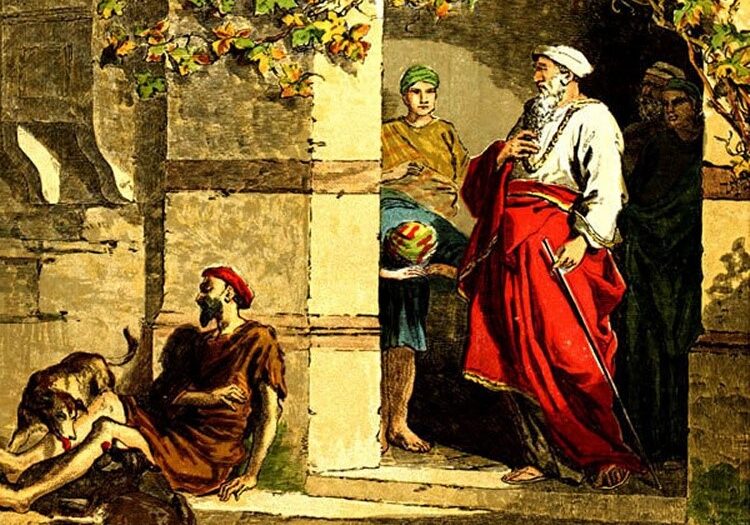
We can consider what the thing is not, by the parable that JESUS lays out for us in today’s Gospel Lesson. This parable is one of Holy Scripture’s most beloved moral lessons, and it offers great theological insight into the salvation that JESUS offers. — We know so, because “There was a rich man who was clothed in purple and fine linen, a species of Egyptian flax that is very soft and costly. This man feasted sumptuously (with a great host of company in joyful laughter), every day, detached from GOD and love of his neighbor. And at his gate was laid alone, a poor man seemingly without GOD, but certainly without a loving neighbor, whose name was Lazarus, which means, ‘one whom GOD helps’. He was covered with sores and unable to work; if able, he would have done so, because beggarliness was disgraceful to all in that culture. This poor man desired only to be fed with what fell from the rich man’s table and nothing else, for he was simple and humble. (cf. Luke 16.19-21a)
The story begins familiarly enough; a scene you might have witnessed many times yourself. One person with great resources and another with few. One person who sups sumptuously, and another who would only eat what the other would throw away. Such discrepancies in human interpersonal relationships happen daily between individuals, within families, amongst neighbors, within cities, and across nation-states. Yet, “The poor you will always have with you,” JESUS said (St. Matthew 11.26), but of them, the LORD commanded, “When you give a feast, invite the poor, the crippled, the lame, and the blind” (St. Luke 14.13). — And of this command, the rich man in JESUS’ parable failed to abide. His focus was on the Earthly City and the unreal things in it; on eating and drinking.
The rich man acted in such a way that was unacceptable to GOD and abhorrent to men. — The conscientious onlooker knows this for two reasons. First, poor Lazarus was left to be comforted by the dogs alone, and the rich man cared not for his sores nor his hunger, though he was left daily outside the rich man’s gate where he would have travelled in and out regularly. Second, after both men died, Abraham says to the rich man: “Child, remember that you in your lifetime received your good things, and Lazarus in like manner bad things; but now he is comforted here, and you are in anguish (St. Luke 16.25). — Thus, the rich man, focusing on non-realities, inherited the eternal reward of a citizen of the Earthly City, and not the City of GOD.
We know that the rich man would have been well aware of what St. Paul summarizes in Romans 14. For sure, based upon the condition of his life and the circumstances in which JESUS told the parable, the character of the rich man was, by allegorical association, a Pharisee in Jerusalem. He would have known through Moses how one serves GOD as a citizen in His City, and what makes him acceptable to GOD and approved by men.
It is important to note that in the parable of the rich man and Lazarus, nothing is said about righteous religious deeds or competence in the Law of Moses. What is stated, explicitly, is how each man transacted the spiritual commerce of his heart with his neighbor, and that seems to weigh most on the telos or final goal of the Salvation that Christ offers mankind. – It was not whether either man had a mind for proper theology, or an orthodox practice of Moses’ rituals; on the contrary, his salvation depended ultimately upon how he applied his spiritual transaction of love toward his neighbor that determined his eternal outcome. For the rich man, his coup fatal (knowing of Lazarus’ need), deemed it outside of his prerogative to help his fellow Jew. Thus, because of his impoverished spiritual transaction of love on behalf of his neighbor, the rich man inherited, as Abraham says, ‘evil things.’
In contrast, Lazarus, neither complaining against the rich man for his good things, nor against GOD for the bad things He permitted, executed a transaction of love in patience and contentment with the things he had. Thus, he, as Abraham says, inherited ‘good things. — Again, St. Augustine. “For what is money in comparison with all things which are contained in heaven and earth? It is nothing, even if we include all the things that are owned by men and counted as part of their wealth … For riches are one thing – money another. [In the City of GOD], we describe as ‘rich’ men, those who are wise, just and good, who may have little or no money. They are rich rather because of their Christian virtues, which enable them, even in times when material things are lacking, to be content with what is at hand. But the greedy, always grasping and needing more, are truly poor.”3 For they have laid up for themselves treasures upon earth, where moth and rust doth corrupt, and where thieves break through and steal … For where your treasure is (said JESUS in His Sermon on the Mount), there will your heart be also” (St. Matthew 6.19,21).
At the moment of greatest awareness of what was real, and what was unreal, the rich man hears Abraham say: “Between you and us there is a great gulf fixed, so that those who want to pass from here to you cannot, nor can those from there pass to us” (St. Luke 16.26). — And what makes up that insurmountable divide of reality between Lazarus’ eternal inheritance of ‘good things,’ and the rich man’s eternal inheritance of ‘evil things?’ — Is it nationality, gender, class, pedigree, economic status, political affiliation, knowledge, or worldly experience? — St. John names the insurmountable chasm clearly: “He that loveth not, knoweth not GOD; for GOD is love” (1 John 4.8). — John is saying that the ultimate human reality is love, for GOD is love, and GOD is the most real Person of whom man can know, experience, and participate. Thus, to choose a human existence apart from GOD and apart from His essence and being, which is love, is to choose the most ‘unreal’ condition of all human existence; a condition without meaning, identity, or purpose. Surely, if anyone loveth not GOD, how can he expect to enter into Abraham’s Bosom, alongside Lazarus, to inherit the ‘good things’ of human reality?
And for those of us who choose the ultimate human reality as a citizen of the City of GOD by faith through grace, John tells us we can not only experience GOD’s love, but that we can also know His love, distinctly and uniquely, apart from the love that the world might attempt to give us. The Apostle whom JESUS loved said: “In this was manifested the love of GOD towards us, because that GOD sent His only begotten Son into the world, that we might live through JESUS” (1 John 4.9). Our lives, if they are to be lived in reality versus unreality, must be lived as GOD’s Son lived His life. — And what does living the Son’s life look like? — It looks like a chasm crossing from the realm of torment unto Abraham’s bosom, wherein our tongues are cooled with the waters of mercy, as we lovingly and mercifully care for the needs of others the way that GOD loved and cared for us through His Son. — “For herein is love, not that we loved GOD, but that He loved us, and sent His Son to be the atoning propitiation for our sins” (1 John 4.10). — And like the rich man and Lazarus, each of us must choose which reality we would be overcome with; the real or the unreal. Which city we would become a citizen of; the City of GOD or the Earthly City.
In the Law of Moses, GOD said: “If there is among you a poor man of your brethren, within any of the gates in your land which the LORD your GOD is giving you, you shall not harden your heart nor shut your hand from your poor brother; but you shall open your hand wide to him and willingly lend him sufficient for his need, whatever he needs … You shall surely give to him, and your heart should not be grieved when you give to him, because for this thing the LORD your GOD will bless you in all your works and in all to which you put your hand. For the poor will never cease from the land; therefore, I command you, saying, ‘You shall open your hand wide to your brother, to your poor and your needy, in your land’” (Deuteronomy 15.7-8,10-11). — This is the rule of conformity, should anyone want to be a citizen of the City of GOD – a partaker of the real over and above the unreal. For if you desire to be a citizen of the Kingdom of GOD, then know that it is not about eating and drinking, but about righteousness, peace and joy in the Holy Ghost; for he who serves Christ in these things, in GOD’s City, is acceptable to GOD and approved by men.
It is thus appropriate, dear brothers and sisters of St. Mark the Evangelist, that on the first Sunday after Trinity, after we have confessed the fullness of GOD as He has always been and will always be (Father, Son, and Holy Spirit), that we confess Him as He is revealed in the Holy Scriptures: as love. — This is a love that does for others to their benefit, even if giving that love costs us everything. It is a love that goes out of one’s way, so as to bring the other in. It is a love that binds up, mends, and forgives, until the other is well, no matter the burden or pain of the cross that will heal their wounds. This is a love that opens wide its hands and gives sufficient to another’s need, even if it means the death of the giver. This is a love that is and defines human reality, for this love is, from, and through GOD.
Dear church, what are you anxious about today? Do you feel you have a good grasp on what is real and what is unreal? Who are you laying up spiritual treasures for while you are here on earth; yourself or for GOD? What spiritual treasure is your heart meditating upon, even now; of the lasting or the fleeting? — I pray it is upon the reality of GOD’s love – love not received but love freely and zealously given away. — This is the ‘real’ Christian project we are about here at St. Mark’s, and I hope that you will continue in this project with us. — This is our project, and this our motto: ‘That the love which the Father loved the Son may be in us by the Spirit; that we might make GOD the Trinity, who revealed Himself as love in the Holy Scriptures, known in the world; and by participating in His love through the Son, we, real human beings, not overcome by the unrealities of the world, but overcoming the world through what is real, may reveal GOD, one person at a time, by love’. Amen.
—
1 St. Augustine of Hippo, The City of GOD Against the Pagans, Vol.2, (London: Harvard University Press, 1963), 13.
2 BibleHub.org. “Lexical exposition of euarestos: well-pleasing.” Accessed 2 June 2026. https://biblehub.com/greek/2101.htm.
3 Augustine, 419.

Join Us for Biblical Worship, Study, & Fellowship
Sundays:
Coffee and Fellowship 8:30 am
Catechesis for all ages 9:00 am
Holy Communion 10:30 am
Recent Sermons

Sixteenth Sunday after Trinity

Worship with Us
Join us for Biblical worship, study, and fellowship. We currently meet in the sanctuary of Christ the King Lutheran Church in Waxahachie.
Catechesis for Adults and Children 5+
Sundays at 9:00 am
The Order of Holy Communion
Sundays at 10:30 am
Fellowship Opportunities
See our calendar for other weekly and special events.