Trinity Sunday
†
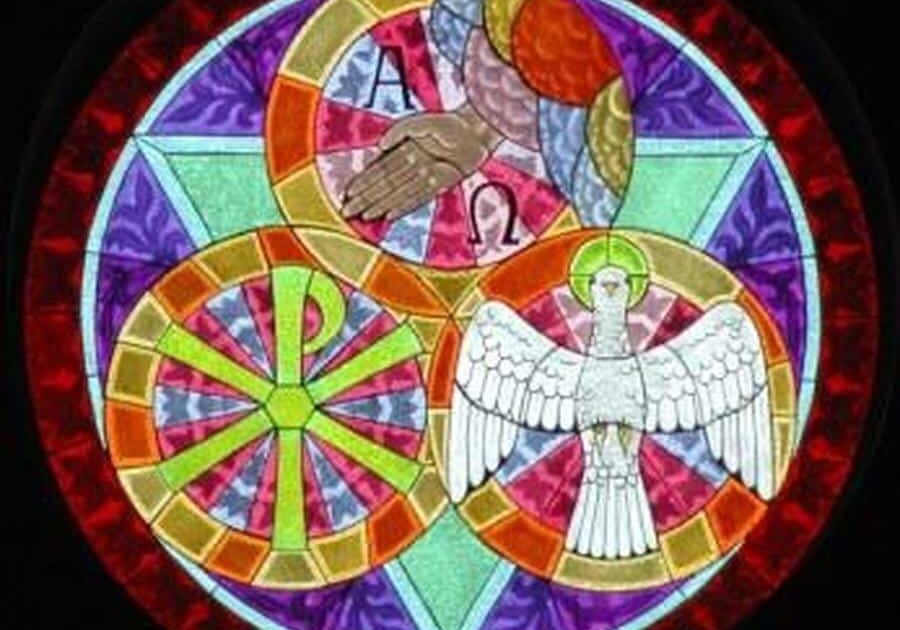
Might we be so bold to make an attempt to contemplate, with some sense of real understanding, the Eternal GOD who Isaiah witnesses the heavenly host calling the Thrice Holy One? — In our Old Testament lesson, Isaiah is given a vision of the ALMIGHTY GOD, sitting on His Throne in the heavenly Temple, as the seraphim cried out: “Holy, holy, holy, is the LORD of Hosts; the whole earth is full of His glory” (Isaiah 6.3) Why thrice holy and not twice holy? Why thrice and not once holy? — Cecil Frances Alexander in his monumental hymn entitled, Saint Patrick’s Breastplate, binds himself, while exhorting us to the same, to the strong name of this Thrice Holy GOD. Of the Thrice Holy One, Alexander says that He has a strong name worthy for all of creation to bind/cohere/align ourselves with, even “The Strong Name of the Trinity.”1
The Trinity — the Divine GOD of the Bible – He is a paradox against human logic, reason, philosophy, and even to a degree, theology. For what is Three in One and One in Three; how can one explain the One in Many and the Many in One? How can this be? To the grammarian, we might say the Holy Trinity, if He were diagrammed, would be the subject, object and verb of a sentence, but this reduces His Majesty to simple linear rationality. Is there, then, a natural or creaturely equivalent that is illustrative of the Unity in Trinity and the Trinity in Unity? — No, there is no such equivalent! — Yet, through human language and symbolism, we do try to describe Him who is holy, holy, holy – the LORD GOD of hosts. Nonetheless, our efforts, though admirable and reasonable, still do not encompass the fullness of Him whom we should ascribe our honor, praise, and blessing, now and forever; the LORD GOD ALMIGHTY, One in Three Persons.”2
As we confessed earlier in one of the Church’s certified credos (the Athanasian Creed), elucidating the Catholic Faith by stating: “We worship one GOD in Trinity, and Trinity in Unity, neither confounding the Persons, nor dividing the Substance.”3 The immutable Persons of the Godhead of our Universal Faith, JESUS clarifies by naming them “the Father, and the Son, and the Holy Ghost” (St. Matthew 28.19). Gregory of Nazianzus who died in 391 A.D., (himself a member of a dynamic trio of the Church’s early Eastern doctors of Cappadocia), echoes JESUS and elaborates, saying, we are to worship “the Father as GOD, the Son as GOD, and the Holy Spirit as GOD; three Individualities, one Divinity, undivided in Honor, Glory, Essence and Kingdom.”4 — Again, the Creed of Saint Athanasius agrees with both JESUS and the Church’s witness in the person of Gregory: “There is one Person of the Father, another of the Son, and another of the Holy Ghost .. the Glory equal, and the Majesty co-eternal.”
Through the ages, the Church has been, and continues to be, extremely careful, but concise, in her hermeneutic of the Trinity and His work of salvation. As the Litany of the 1928 Prayer Book describes the Thrice Holy One: “GOD the Father, Creator of Heaven and Earth … GOD the Son, Redeemer of the world … and GOD the Holy Ghost, Sanctifier of the faithful.” And in the Anglican Church’s 1549 Prayer Book, we confess the Trinity in the Creed of Nicaea by saying: “The Father Almighty, maker of Heaven and Earth … the one LORD JESUS Christ … being of one substance with the Father, by whom all things were made … and the Holy Ghost, the LORD and Giver of Life.” “For as there are three several and sundry persons in the Deity; so, have they three and sundry offices proper to each of them. The Father to create, the Son to redeem, and the Holy Ghost to sanctify and regenerate.”5 — The trouble always comes when the Church and her children try to find a natural or creaturely illustration in which to describe the nature and being of the Trinity. This effort always leads to what is called modalism; viz., GOD finding His expression sometimes as the Father, sometimes as the Son, and sometimes as the Holy Spirit. — Some interesting but dangerously heretical expressions of trinitarian modalism are the descriptions of water and the sun: liquid, vapor, ice, as well heavenly body, light, and heat. The prior is one substance yet expressed in three particular natures that are neither co-equal, nor co-existing. The latter is three substances having a similar nature, but again, neither co-equal, nor co-existing. The Creed of Saint Athanasius is careful to dispel such notions, guarding us jealously from heresy by stating, clarifyingly, that we worship the Trinity in Unity and the Unity in Trinity; co-equal and co-eternal. — Unlike anything else in nature or reasonable thought, nothing is One in Three and Three in One. “As the Father is, such is the Son, and such is the Holy Ghost … The Father incomprehensible, the Son incomprehensible, and the Holy Ghost incomprehensible … the Father eternal, the Son eternal, and the Holy Ghost eternal.”
In spite of the Thrice Holy One’s uniqueness, the Bible makes every effort to articulate an expression of the ALMIGHTY, so that we might grasp Him, characteristically speaking. — In the Beginning, the Thrice Holy One is seen in the opening words of Holy Writ: GOD the Father, whose creative efficacy is through the Son, the Word, effects His creative intent with order through the hovering Holy Spirit upon the face of the formless void of darkness. From their co-equal and co-eternal glory and majesty, the One ALMIGHTY, not three almighties, created all that was good before the Fall of Adam and Eve. And being co-equal in His love for mankind, the One ALMIGHTY can be seen operating in the narrative scene concerning the revelation of the Seed of Promise – the Redeemer of mankind. — In the narrative of the Annunciation, Gabriel says to the Virgin Mary, “Thou shalt conceive in thy womb and bring forth a son, and shalt call His Name JESUS. He shall be great, and shall be called the Son of the Highest … the Holy Ghost shall come upon thee, and the power of the Highest shall overshadow thee: therefore, also that Holy Thing which shall be born in thee shall be called the Son of GOD” (Saint Luke 1.31-31a, 35).
The Thrice Holy GOD is seen again on the Mount of Transfiguration. There, JESUS was “transfigured before [Peter, James, and John]. And his raiment became shining, exceeding white as snow; so, as no fuller on earth could whiten them … And there was a cloud, [the Shekinah presence of the Holy Ghost]: and the Voice [of the Father] came out of the Cloud, saying: ‘This is my beloved Son; hear him!'” (St. Mark 9.2b-3, 7). And of this scene, the disciple whom JESUS loved, said: “That which was from the beginning (which is the Thrice Holy One), which we have heard, which we have seen with our eyes, which we have looked upon, and our hands have handled, of the Word of Life … was manifested unto us” (1 John 1.1,2b). And again, Saint John from today’s recording of his vision of the Heavenly Throne Room in the Book of Revelation, describes a scene very nearly the same in its thematic architecture that we heard in Isaiah six about the Thrice Holy One: “A Throne was set in Heaven, and one sat on the Throne … who to look upon was like a jasper and sardine stone, [red with purifying judgment]; yet the rainbow of covenantal grace was round about the Throne in sight like an emerald … And in the midst of the Throne … a Lamb stood as it had been slain, having seven horns of omnipotence and seven eyes of omniscience, which are the seven Spirits of GOD, who is the Holy Spirit, sent forth in [the number of His fulness] to the earth as a sign of His omnipresence. (cf. Rev. 4.2-3; 5.6b) — These are just some of the Biblical images of the Thrice Holy One that have been deposited into the memory and understanding of the Church; not three gods, but One GOD.
The Scriptures are plain and the Church’s understanding concise: we live in a Trinitarian Universe wherein the revealed and trusted Essence and Personhood of the Godhead allow us to experience an ultimate reality of human being and identity; neither empowered by mythology nor hyper humanism. Instead, the Christian ‘ultima veritas’ is defined by the Unity of the Three Persons of the Godhead, bound together in Love, and expressive and accessible unto the Christian in singleness, marriage, and or ecclesial community. To claim any other universal construct, is to endanger identity – to endanger reality – to endanger humanness as GOD intended. Thus, as Christ’s Church, “We are compelled by the Christian verity to acknowledge every Person of the Trinity by Himself to be both GOD and LORD; so are we forbidden by the Catholic Religion (the Faith once delivered), to say, ‘There be three gods, or three lords … And in this Trinity, none is afore, or after other; none is greater, or less than another; but the whole three Persons are co-eternal together and co-equal. So that in all things, as is aforesaid, the Unity in Trinity, and the Trinity in Unity is to be worshipped. He therefore that will be saved must think thus of the Trinity.” — This that we believe, though a mysterious Faith, we find virtuous comforts for our souls in the Godhead that surpasses all understanding; both for our day of temptation and trial, as well for our day of rest and contemplation. For, “The grace of the LORD JESUS Christ, and the Love of GOD [the Father], and the communion of the Holy Ghost is with you all” (2 Corinthians 13.14), if ye be in Christ by the Catholic Faith committed and confirmed to us in the Creed of Saint Athanasius.
But why here, why now on this Sunday is the Feast of the Thrice Holy One celebrated? Again, the Cappadocian theology of Gregory of Nyssa who died in the East in 394 A.D: “In the case of the Divine Nature, we do not similarly learn that the Father does anything by Himself in which the Son does not work conjointly, or again that the Son has any special operation apart from the Holy Spirit; but every operation which extends from GOD to the Creation … [viz.; Every good gift and every perfect gift is from above], and it has its origin from the Father, and proceeds through the Son, and is perfected in the Holy Spirit.”6 — Thus, at this point in the Holy Mother Church’s calendar, we have the fullness of the New Covenant Oracles of GOD revealed fully to us. We have the Divine Annunciation, the Incarnation, the Epiphany, the Circumcision, the Presentation in the Temple, the Departure of the prophet class in the persons of Simeon and Anna and the arrival of the Prophetic Light of glory to Israel and the Gentiles, the Baptism, the Temptation, the fulfillment of the Law and the Prophets in the Transfiguration, the Miracles, Parables, the Triumphal Entry, the Betrayal and Denial, the Suffering in the Garden, the Passion, the Crucifixion, Death, Resurrection, Ascension, and the coming of the Holy Ghost. — And now, dear brothers and sisters, the long expanse of the ‘evergreen season’ of Trinity is before us, for there is nothing else needing general revelation. Thus, the Godhead working co-jointly, being of one Substance but three distinct Persons, has “inaugurated New Grace [in Christ’s Blood], which supersedes the old covenant of the Law … [And as a sign of its divine prescription for those who seek the Kingdom of GOD and eternal life], it was given in a marvelous aura of wind and fire … The Western Church, therefore, concludes this Trinity Sunday, the sequence of observances of GOD’s self-disclosure of Himself and of His redemptive purposes (mentioned above) in historical time with a celebration on this Trinity Feast Day with what He is, was, and ever shall be through all eternity: Three Persons in One GOD … And now, those Sundays after Pentecost until next Calendar’s Advent, the long period of the historic Church’s life under the guidance of the Holy Spirit begins; a dynamic act of the Father proceeding through the Son, until the final Advent, when time shall be no more.”7
Thus, the Church prays that GOD would keep us steadfast in faithfulness to Him, evermore defending us from all adversities by His grace, and protecting us from any wayward thought or belief about the true confession of the Catholic Faith. Our prayer is that the Trinity, in His distinct Persons and Offices, will help us to rightly acknowledge the glory of the Eternal Triad and the power of the Divine Majesty, which we worship in the essence of Unity. — “Whosoever will be saved, before all things it is necessary that he hold to this, the Catholic Faith of the Triune GOD of the Bible: Father, Son, and Holy Ghost. — Which Faith, except everyone do keep whole and undefiled without doubt, he shall perish everlastingly. — And again, as the Creed of Athanasius hath said, the Catholic Faith is this: That we worship One GOD in Trinity, and Trinity in Unity…” — In the Name of Him whose Persons we make every effort not to confound, and whose Substance we dare not divide. Amen.
—
1 Book of Common Praise, “I Bind unto Myself Today,” (Newport Beach: Anglican House Media Ministry, 2017), 333.
2 Book of Common Praise, “Father Most Holy; Merciful and Loving,” (Newport Beach: Anglican House Media Ministry, 2017), 328.
3 The Creed of Saint Athanasius
4 Reasons.org. Samples, Kenneth. “Three Fathers Defended the Trinity.” 30 May 2023. Accessed 30 May 2026. https://reasons.org/explore/blogs/reflection/three-church-fathers-defended-the-trinity.
5 Various Anglican Divines, The Anglican Book of Homilies, (London: The Prayer Book and Homily
Society, 1852), 428.
6 Reasons.org. Samples.
7 Sheppard Jr., Massey H., The American Prayer Book Commentary, (New York: Oxford University Press, 1950) 255 & 261.
Join Us for Biblical Worship, Study, & Fellowship
Sundays:
Coffee and Fellowship 8:30 am
Catechesis for all ages 9:00 am
Holy Communion 10:30 am
Recent Sermons
Sixteenth Sunday after Trinity
Worship with Us
Join us for Biblical worship, study, and fellowship. We currently meet in the sanctuary of Christ the King Lutheran Church in Waxahachie.
Catechesis for Adults and Children 5+
Sundays at 9:00 am
The Order of Holy Communion
Sundays at 10:30 am
Fellowship Opportunities
See our calendar for other weekly and special events.