Twelfth Sunday after Trinity
†
There is a very interesting worldview that we might consider today, especially when we think about how we have just prayed in our Collect Prayer: “ALMIGHTY and everlasting God, who art always more ready to hear than we to pray, and art wont to give more than either we desire or deserve.” (1928 BCP 206) — It is easy to imagine how GOD might be willing to hear more than we are willing to pray, but how could He give us more than we desire or deserve? — The simple answer is by His Grace. — As you might imagine, this word has a bounty of rich meaning. Many times, in Holy Scripture, GOD’s grace is seen in how the ALMIGHTY approaches and interacts with His people. For example in Isaiah 65.24, we read: “And it shall come to pass, that before they call, I [the LORD] will answer; and while they are yet speaking, I will hear.” A reflection of this blessed characteristic of GOD’s grace is seen in the father of the younger prodigal son; yet while he was still a long way off, the father was yearning for his son’s return, and to hear his son’s petition to rejoin the family; the father was resolved to receive his son, even before the son intended and fashioned his plan of reconciliation. In Ephesians 3.20, we read: “God pledges Himself to promptitude in hearing His suppliants;” readier to hear than we are to pray, and eagerly resolved, as the Holy Scriptures say, “to do exceeding abundantly above all that we ask or think.”
When contemplating the divine grace of GOD, some Christians see their lives in this world like a story; it helps them to better understand and explain the Gospel gift of GOD’s grace to them, which Saint Paul describes in Ephesians 2.7 as: “The exceeding riches of His grace in His kindness towards us through Christ JESUS.” — In one camp, there are those who think GOD has written their story from time immemorial (that is, their life’s events from beginning to end), and there is no changing it. It is what GOD had always predestinated it to be, and there will be no editing going on; not by them – not by anyone. Then there is another camp that indeed believes that GOD is the Grand Author of stories, yet they believe His providence and mercy will allow them to contribute to the content of that story through their own free, independent, and willful contributions. Through their choices (with GOD’s leading, they pray), they can help mold and shape the texture of their stories. For again, the Great Author, the Writer of every life story, balances that person’s life with His mercy, grace, and truth, such that any independent, human decisions can be used by GOD to accomplish His ultimate pursuits and purposes. — Proverbs 19.21 says, “Many are the plans in the mind of a man, but it is the purpose of the LORD that will stand.” — Proverbs 16.9 says, “The heart of man plans his way, but the LORD establishes his steps;” IF we give our pens over to Him and abide by His stylistic instructions. — Did the father know that the younger prodigal son would come home after he left? That is a good question. I cannot answer it, but I do know that when he did, the father had prepared all things perfectly, giving a richness and gracious form to the son’s life-story through adaptation and edits the younger prodigal could not have imagined, asked for, earned, or deserved. The father was able to do so because the young prodigal (“came to his senses”, the New English Translation tells us – Lk. 15.17); the father was able to establish his original plans for his son’s story and its conclusion. From this we learn that GOD can and will author redemptive stories for any man, woman, or child, full of joy, grace, and truth – readier is He to hear than we to pray; more wont and accustomed to give than we desire or deserve.
Unfortunately, some people’s stories do go awry; this we cannot deny. They miss the grace of GOD because they will not hand over their pens to the LORD, not willing to receive His grammatical and stylistic discipline. As a result, their lives, and the lives of their loved ones, are fraught with heartache, pain, and disfigurement. You see, even though the Great Writer begins a person’s story well, by giving it a good and beautiful tone, character, and a hopeful plot, if a person keeps hold of their pen (that is their lives’ plans and steps), insisting upon writing an unwise and confused storyline that conflicts the Master Author’s vision, their whole world becomes twisted and corrupted in some manner, and they lose vision of the good, true, and beautiful. — Yet, that does not mean if the lost person should come to their senses, that the Great Writer cannot insert a new chapter of restoration that will renew the storyline and the corrupted plot of the rambling and confused story. As it was with the younger prodigal son, when he said within himself: “‘How many of my father’s hired workers have food enough to spare, but here I am dying from hunger! I will get up and go to my father’ … So, he got up and went to his father. And while he was still a long way from home, his father saw him and his heart went out to him; he ran and hugged his son and kissed him [and welcomed him home], commanding his servants, ‘Bring forth the best robe, and put it on him; and put a ring on his hand, and shoes on his feet. And bring the fatted calf hither and kill it; and let us eat and be merry. For this my son was dead and is alive again’” (St. Luke 15. 17-18, 20, 22-24). — And if a person will persist in the Grand Author’s tutoring, He will, as our Collect Prayer indicates, edit their story with more life-transforming content than they could ask for; He will rewrite much more of their poor grammar and syntax than they deserve.
All our stories would be lost in twisted ramblings and babblings if GOD, by His nature, were not always more ready to hear than we to pray; and wont to give more than either we desire or deserve. — And to receive His good grace so that our plans will match His steps and glorify His purposes, we need only one thing, which the Collect tells us in its final phrase: to be willing and active in our reception of the mercy He pours out upon us through the merits and mediation of Christ JESUS. — If our worldview is that we have no say in the matter of our stories, their content, and conclusion, then it will be a challenge to actively receive what GOD pours down upon us – we will not have a say in it. Yet, if our worldview is that we can play an active and willful role in the purposes and plans that GOD has for our lives, then we must recognize and respond to His bountiful grace that He has given us through the merits and mediation of JESUS Christ.
Consider what we heard in our Old Testament Lesson. GOD had determined to bring a famine onto the land, and there was nothing that the Pharaoh could do to stop it. This circumstance was predestined in his life and the lives of all the peoples of the world, because it was an unshakeable purpose of GOD. — Yet, GOD presented Pharaoh with a choice to receive more than he could ask for, and more than he desired or deserved, by giving him two dreams. Through an elaborate course of events, GOD sent Joseph into Egypt by what seemed the ill intent of others to be able to offer a better outcome to Pharaoh, for his story, if he would receive it. — What seemed like evil for everyone (Joseph, Pharaoh, and the people of the world), GOD meant it for good. — And when presented with the interpretation of his dreams and the counsel of GOD through Joseph, Pharaoh had a choice on which steps he would take. Wisely, he chose what he was not ready to pray for, nor was he worthy to receive – the divine path that would keep starvation from man and beast. — In other words, GOD poured down upon all the people of the land the abundance of His mercy, giving good things which the people were not worthy to ask for, and hearing their cries for rescue, even before they made them. Again, Isaiah’s description of GOD’s divine grace: “And it shall come to pass, that before they call, I will answer; and while they are yet speaking, I will hear” (Is. 65.24).
The miracle in Egypt required Joseph’s faithfulness to GOD’s leading of his story, and Pharaoh’s willingness to trust GOD to write the balance of his story as He promised through Joseph. Both men said yes to GOD; both men, in the conditions and circumstances that took them to the moment of their decisions, were being pulled along by GOD. — It was not a mechanical, predetermined pushing by GOD; rather, He led these men with divine inferences and designs to freely choose His restorative and merciful purposes. — Thereby, the one said: “GOD shall give Pharaoh an answer of peace;” the other said, “For as much as GOD has showed you all this … according unto thy word, all my people shall be ruled” (Genesis 41.25, 39-40).
GOD’s pulling and leading (instead of a mechanistic pushing and forcing), reveals His desire for wooing and leading His people through a relationship; a relationship of trust and interdependence, through Love by Grace. Relationally, GOD draws His people along according to His Divine Will, by making inferences to His desired ends using truth, goodness, and beauty. He does not force Himself upon our wills; instead, He lovingly modulates and leads our steps to achieve His plans, all with our consent, at some level. — GOD has an ideal form of circumstances for you, me, and all human history. His intent has (and will always be), to pull us along from in front by a willful, personal, symbiotic, and consensual relationship. — GOD does not act mechanistically, pushing from behind to achieve His will in forms by an impersonal, soulless, and automated inevitability. Such an idea ratifies what we said earlier about the worldviews: GOD is either an Author of stories that are balanced by an aspect of His design and preferences, allowing the characters of that story to contribute to the plot’s content and fulfillment. Or He is an Author of stories predestinated with an inevitable conclusion and no possibility of outside influence or redirection.
As you think about this character of GOD and how you might respond to our Collect prayer’s request to have GOD pour down upon us the abundance of His mercy to forgive and to give, think of a dance and how the artistic leader of the dance partners, leads in a direction, but at the same time, is open to a beautiful expression of creation in movement in space and time, by inferences of creativity from the other partner. Such a dance would be characterized by a relationship between the dancers, in willful, symbiotic, intermutual dependence. Now, consider in your mind the beautiful, true, and good thing that could be created in compact with GOD’s purposes; GOD being the lead in the relationship of both partners every time. — Imagine! The result might be a perfectly executed merengue or waltz, Michelangelo’s Pietà or the Cystine Chapel, the salvation of the nations from Egypt’s famine, a lifelong marriage of intimacy and connectivity, a soul lost in the darkness of doubt and despair brought into the hope of a new creation through Baptismal regeneration, and the sanctification of a people in a small mission church in Ellis County who have the prophetic word of the Gospel of Christ confirmed in their souls “as a lamp shining in a dark place, waiting until the day dawns and the morning star rises in their hearts” (2 Peter 1.19).
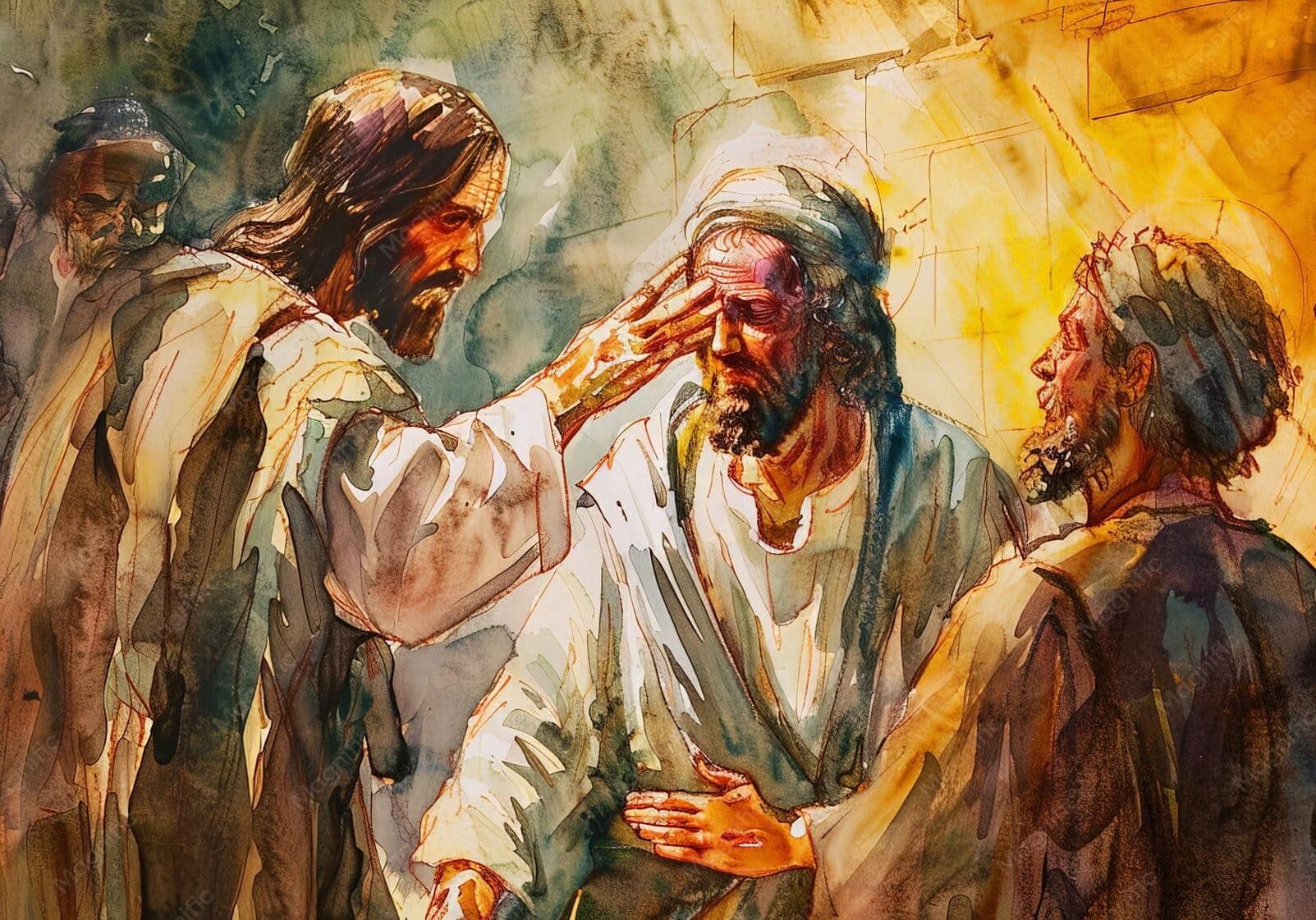
As He comes into the Decapolis on the east side of the Sea of Galilee, JESUS is presented with a man whose story has not gone well; he can neither hear nor speak. Obviously not the ideal form of a human story that the Master Author would compose. Yet the man gives himself to the Master, and the LORD reimagines his story for him. — The image that JESUS infers to us by His actions and words is that this poor man’s story had been without illumination; illumination of what the true form of hearing and speaking was and what it is for. Such creaturely joys of hearing GOD’s words spoken and sung had been closed off to this man. Yet, I believe, the point for the Church in this miraculous working of Christ, is not to discern whether JESUS pushed the man’s healing from behind or pulled it from the front. Rather, I believe, we are witnessing our Collect prayer lived out in true form right in front of us. To the spiritually mute, the LORD is willing to listen more than we are willing to speak; He is more wont and accustomed to giving the spiritually deaf more capacity to hear His Word than we desire or deserve. — Our responsibility, as was the deaf/mute in the Decapolis, is to enjoin the healing miracle of the true form of spiritual grace that grows in us to Christ alone. For our sufficiency is of GOD. It is He who illumines our stories, our souls, and our lives by His grace – causing us to see and to hear Him and His truth. That grace comes to us through the Sacraments of Holy Baptism and Eucharist, as well as by our fellowship and service to one another in love within this fellowship of the Body of Christ; this local visible church here at St. Mark’s
Today, brothers and sisters, let our prayer be that of our Collect; that GOD will pour down upon us the abundance of His mercy; forgiving us those things whereof our conscience is afraid, and giving us those good things which we are not worthy to ask. May He pull, lead, woo, and guide by the beautiful, good, and true inferences of His Holy Word, our souls into His new and everlasting life. — May we see the vision of GOD as He is revealed in Holy Scripture, as desirous and wont to hear us before we pray, and to provide us gracious and transformed adaptations to our stories which were once bedraggled in the mire, twisted, and deformed. For by “practical application, it is pretty obvious: we come as outsiders, foreign born, and without rights or resources in our hands to purchase our salvation; we can but only trust in GOD’s mercy to heal the maladies of our sinful souls; we come, putting aside all pride of independence, and all preoccupation and preconception as to how GOD is to heal us, trusting only in his all-seeing wisdom. And we are truly healed when we live our lives always to the glory and thanksgiving of GOD ALMIGHTY, Father, Son, and Holy Ghost.”1 — “LORD, if you would have us hear, open wide our shuttered ears … LORD, if you would have us pure, grant our leprous heart your cure … LORD, if you would have our song, loose the taught strings of our tongues … LORD, if you would have us whole, write your story in our hearts and souls.”2 — Ephphatha, be opened – be loosed. — A newborn people, may we rise; more pure, more true, more nobly wise. All of which we ask, O Father, and precious Holy Ghost, through the merits and mediation of JESUS Christ; He who hath done all things well, such that He maketh even the deaf to hear, and the dumb to speak. Amen.
—
1 LectionaryCentral.org. Crouse, The Rev’d Canon Dr. Robert. “The Twelfth Sunday after Trinity.” Accessed 22 August 2026. https://www.lectionarycentral.com/trinity12/Crouse.html.
2 Book of Common Praise, “LORD, if you would have me stand,” (Newport Beach: Anglican House Media Ministry, Inc., 2017), 396.

Join Us for Biblical Worship, Study, & Fellowship
Sundays:
Coffee and Fellowship 8:30 am
Catechesis for all ages 9:00 am
Holy Communion 10:30 am
Recent Sermons

Trinity Twenty-One Sunday

Worship with Us
Join us for Biblical worship, study, and fellowship. We currently meet in the sanctuary of Christ the King Lutheran Church in Waxahachie.
Catechesis for Adults and Children 5+
Sundays at 9:00 am
The Order of Holy Communion
Sundays at 10:30 am
Fellowship Opportunities
See our calendar for other weekly and special events.