Trinity Nineteen Sunday
†
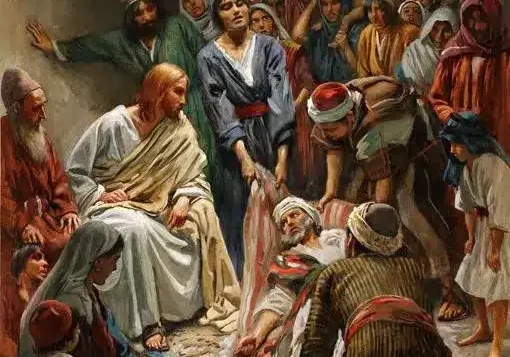
If we were to research the meaning of the word dependance, we would find it to mean, ‘the state of deriving existence, support, or direction from another.’ — The oldest known meaning of dependence, (tracing it back through its Medieval French roots, dépendance), means ‘to hang from something, deriving existence, support, or direction from another.’ The image of the paralytic, an immobile man, completely dependent upon others for his existence and support, lowered, haphazardly, but gently to the ground on his mat before JESUS, this is an incomparable image expressing ‘dependance.’
I know this will come as a surprise, especially since so many grants have gone to pay for the research to affirm this truth that I am about to reveal to you: ‘uncertainty’ in a person’s life, the data tells us, is psychologically taxing. Again, ‘uncertainty’ in a person’s life leads to psychological stress, trauma, and emotional hurt. — And as Bible believing Christians, we know that you cannot separate mind from body, nor mind from soul. Thus, we could conclude the following, trusting the academy’s research and data, ‘uncertainty’ is taxing on the whole human being. — Here is how Psychology Today summarizes the empirical problem: “For everyone, whether already diagnosed with a mental health condition or blessed with a well-adjusted, neurotypical mind, almost no one is immune to the mental and emotional effects of the instability of life … And as each person notices unsettling change in their personal environments, they join the growing ranks of those individuals worrying about the future and wondering what to do — if anything. Such anxiety over the unknown can lead to feelings of powerlessness and alienation, which are profound human stressors. For lack of existing vocabulary to describe our present moment of cultural unease, (the scientist of Psychology Today, write,) we have coined the term koinostalgia. From the Greek words for community (koinonia) and pain (algos). Koinostalgia refers to the discomfort we experience as cultural landscapes change in ways we find unsettling. Whether it’s shifting societal norms, fractured relationships, or escalating rhetoric [purporting that every new societal crisis will bring about the ‘end of the world’], the stress from these unsettling changes can create a deep sense of loss, fear, and disenfranchisement.”1 And since the whole human exists in little or much community, the unsettling stressors of life, we can conclude, affect the whole human community, and need to be addressed by such.
One modern theological clinician, attributes much, if not all, of our cultural distress back to the source where people seek their reality – their meaning – their identity. This modern-day spiritual guidance counselor is Fr. Martin Bernhard, a monastic in the revitalized Monastery of St. Benedict in the town of Saint Benedict, in Nursia, Italy; today called, Norcia. Fr. Martin, the monastery’s business manager, needing to leave the community from time to time to take care of affairs, interacts frequently with the local residents of the town. In his interactions, Fr. Martin says that he notices something consistent among the people he encounters; something sad – something sterile in their souls. “They seem anxious, so unsettled, and so uncertain. I believe it is the result of loneliness, isolation and the lack of life-giving communal bonds. When the light in most people’s faces”, [Fr. Martin points out]”, comes from the glow of the laptop, the smartphone, or from the television screen, then we know that we are living in the Dark Age. These people are missing the fundamental light meant to shine forth in a human person through intimate interactions [with a tangible, real-time, incarnational] community. Love can only come through [such a community] as that, [and that is where we should be finding our realities, meanings, and identities – not through the glowing lights of a screen]. — [And these people that I see, (remarks Fr. Martin), instead of walking in the Light of GOD where all people must find meaning], they are walking in darkness. And, Fr. Martin says, ‘we have never seen a Dark Age like [the one we are living in now, glowing with the bright light of an untold number of screens.]”2
Considering this, now remember what Thomas Merton, our American Trappist monk said: ‘He who walks in darkness is not a son of GOD; “he has lost his likeness to GOD by becoming centered on himself. In losing his divine likeness, man has plunged into unreality, for he is no longer united to the source of his reality. He still exists. He is still in the ‘image’ of his Maker. But he does not have in him Love, which is the likeness of GOD Himself, for GOD is pure Love.”3 Thus, to be fully human, and to bear the image and likeness of GOD, as our Collect prayers have been encouraging us since Trinity Thirteen week to do, we must, completely trust in GOD, in whom we live, move, and have our being, for “We are not sufficient of ourselves to think of anything as being from ourselves, but our sufficiency is from GOD alone” (2 Corinthians 3:5). — And today, Trinity Nineteen, the Prayer Book’s exhortation continues: “O GOD, forasmuch as without thee we are not able to please thee; Mercifully grant that thy Holy Spirit may in all things direct and rule our hearts” (1928 BCP, 215).
If you are a Christian and you are not dependent upon the LORD GOD of the Bible for your sufficiency, aiding you in all things to avoid spiritual hurt, and helping you to continue safely in this world with a pure mind and heart, in spite of the temptations of the flesh and the devil, then I must ask you, who or what are you dependent upon? What are you hanging from to derive your meaning, identity, and security? What is your strength and salvation against koinostalgia? For the true Christian knows, without the Holy Spirit directing us and ruling over our hearts, there is no hope of salvation for us – in this world, or the next.
Now, the Bible does not use the word ‘dependent’ or ‘dependency,’ but it does use the word ‘need.’ — To have a ‘need’ proves the prior point: you are dependent upon someone else if you have a need. Again, this is the definition of dependency: ‘the state of deriving existence, support, or direction from another.’ And as mentioned before, the Christian implicitly knows he must trust GOD for all his needs; for without GOD, left to our own devices and power, we can only fail.
Now, the only reason we can approach GOD, trusting Him for aid in our need, is because of what the Second Person of the Holy Trinity assumed, and what He did. The Logos of GOD, the Word, He became flesh, dwelt among us, took our nature upon Himself, and became our High Priest, offering His own Human Blood before GOD for our forgiveness. Thus, as the author of Hebrews writes: “Seeing then that we have a great high priest, that is passed into the heavens, JESUS the Son of GOD, let us hold fast our profession [of the Christian Faith]. For we have not a high priest which cannot be touched with the feeling of our infirmities; but [JESUS] was in all points tempted like as we are, yet without sin. Let us therefore come boldly unto the Throne of [the Father’s] Grace, that we may obtain mercy, and find grace to help in time of need” (Hebrews 4:12-14).
Trusting GOD in time of our needs – this is the second most important theme of Holy Scripture. For if we do not unconditionally trust GOD when we realize our great need for Him, how will we ever answer His call to us to be saved and receive His justification, procured for our sin? If someone preaches the Gospel, and we hear it, and we do not trust GOD enough to believe what we have heard in that Gospel, how can we expect the fruits of His glorious promises of everlasting life to bud in our lives, and in the Age to come? — The writer of Hebrews again says: “But without faith it is impossible to please GOD: for he that cometh to GOD must believe that He is, and that He is the rewarder of them that diligently seek [and trust] Him” (Hebrews 11:6). — We must trust GOD – we must place ourselves in dependency upon Him – we must understand that there are no vanities or idols in America ‘that can cause the heavens to give their showers. For it is only He, the LORD our GOD who can cause it to rain upon our dry land. Therefore, let us wait upon Him: for the LORD GOD hast made all these things.’ (cf. Jer. 14:22)
Make no mistake, my friends, this is not a skin-deep, transactional trust, but a deep soul-trust with hope; hope for our very spiritual existence – hope for endearing, eternal relationship with the Most-High GOD. — To help us, the Psalmist gives us an illustration of what this trust, with all one’s being, in GOD looks like. He says: “I stretch forth my hands unto thee; * my soul gaspeth unto thee as a thirsty land. Hear me, O LORD, and that soon; for my spirit waxeth faint: * hide not Thy face from me, lest I be like unto them that go down into the pit. O let me hear Thy loving-kindness betimes in the morning; for in Thee is my trust: * show thou me the way that I should walk in; for I lift up my soul unto Thee. Deliver me, O LORD, from mine enemies; * for I flee unto Thee to hide me. Teach me to do the thing that pleaseth Thee; for Thou art my GOD: * let Thy loving Spirit lead me forth into the land of righteousness” (Psalm 143:6-10).
One of the most idyllic reflections of deep, heartfelt trust in GOD is seen in today’s Gospel Lesson. First, GOD in Christ shows that He can be trusted with our souls, and to prove as much, He shows that He cares for our bodily existence as well. — The miracle that JESUS accomplishes for the paralytic man who is lowered through (what is believed to be the roof of Saint Peter’s home in Capernaum), is a sign of two things: first, JESUS is GOD, the Second Person of the Holy Trinity, and secondly, He, as the representative of the Holy Trinity on earth, can be trusted with our deep spiritual and bodily needs. “The healing of the paralytic is the one instance in the Gospels where our LORD unequivocally claimed what every Jew considered the prerogative of GOD alone: namely, the power to forgive sins. To substantiate this claim, He pointed to His power of healing. Now the ancient Jew superstitiously thought illness was a punishment for sin, and its cure a sign of the breaking of that sin’s power. Only a priest could pronounce a man ‘whole,’ even though he had no power to make him so. Our LORD here set a challenge before His adversaries and the crowds with respect to His person and authority, for He not only declared the paralytic spiritually ‘whole,’ but exercised His power to make him physically, such.”4
On the matter of JESUS’ divine power and working, and its relevant eternal meaning, the biblical commentator Matthew Henry has summarized in the following: “In this chapter (St. Matthew 9), we have a remarkable instance of the power and pity of the LORD JESUS. It is sufficient to convince us that He is both able to save to the uttermost, all that come to GOD by Him, and He is as willing as He is able. His power and pity appear here in the good offices He did to the bodies of the people, especially in curing the man with palsy … Thus, did JESUS prove Himself to be, as undoubtedly, He is, the skillful and faithful Physician, both of soul and body. It is only JESUS who has sufficient heavenly remedies for the maladies of all mankind; (especially for those suffering from koinostolgia). Therefore, we must apply ourselves to Him and glorify Him with our bodies and spirits in return for His kindness to both.”5 In other words, ‘cast all your cares upon GOD in Christ; for He careth for you!’ (cf. 1 Ptr. 5:7).
Now, dear church, there is one thing more. Today’s Gospel Lesson also challenges a very contemporary Christian notion, and that is this: that depending upon GOD and trusting Him with our needs, is an individual affair. That is, I can sharpen my own iron outside of community with others, or at least, I can be dependent upon GOD in transparency with one or two others that are like-minded with me. This is not true – this is not community – this is not koinonia, at least not in the biblical and Christian context! — Look again with me at the text from Matthew 9, and note this: “And behold, they brought to JESUS a man sick with the palsy, lying on a bed…” (9:2). — Imagine, if you will, that only one of the paralyzed man’s friends came to him and said, ‘JESUS is in town, let’s go see Him; perhaps He will have mercy on you and heal you!’ One of his friends could not be so persuasive. — Two of his friends might have been, for it would have required at least that many to carry him to Peter’s home. Yet there were at least four friends, and probably many more, that came around this man in community and brought him to JESUS. – If we look carefully at the scene, it was the faith of the man’s friends, and his dependency upon them that provoked JESUS to have mercy and meet the man’s needs; spiritual and physical.
This narrative is oozing with dependency. The paralytic depends upon his friends to take him to see JESUS; he then must trust his friends to creatively acquire audience with the Master through an unorthodox means; and besides this, all of the people at the house that day were depending upon JESUS for His attention, words, mercy, and power; and ultimately, everyone reading or hearing this narrative today, is depending upon the presence of GOD in Christ for the salvation of our souls and bodies. — Whether they understood it or not, all of the people that had come to Peter’s house that day in Capernaum were part of a community – a community of hope-filled faith. Their faith was in GOD, and their hope was that JESUS was the expression of GOD’s promise to bring ‘healing to the nations.’ — And the point I would like to underscore is this: they did not come to JESUS as individuals, but as a community; with the same faith and the same hope.
On the micro level, it is the paralytic and his cohorts who represent what the finer meaning of Christian Community is. It is the whole community putting the needs of others before their individual needs, that they might serve one another in truth and righteousness. Christians in community look like those who “anticipate one another in honor (Rom. 12:10), most patiently enduring one another’s infirmities (weaknesses), whether of body or of character.”6 A true Christian Community prefers nothing whatsoever over Christ and His call to follow Him and to imitate Him, preferring sincere charity over strife, envy, or jealousy. For in Christian Community, “a friend loveth at all times, and a brother is born for adversity (Proverb 17:17). In Christian Community, brothers and sisters “bear one another’s burdens, and so fulfill the [Summary of the] Law of Christ” (Galatians 6:2).
And this is exactly what happened at Peter’s house in Capernaum that day. “Inmost in the hearts of those that bore the paralyzed man, as well as the paralyzed man himself, was the belief that JESUS could, and that He would, heal. They could have heard it from others; they might have even witnessed it themselves in other instances.”7 – Thus, JESUS had an eye on their faith – the faith of the paralytic and his friends; the faith of the Christian Community. — And what the LORD witnessed in them was not a grasping for koinostalgia, due to the disruption that their friend’s paralysis was causing upon the landscape of their common relationship, but rather, they seized upon koinotherepeuo, or community healing, because they believed what the writer of Hebrews said: ‘We have a great high priest, JESUS the Son of GOD, therefore, let us hold fast our profession [of the Christian Faith]; therefore, let us come boldly unto the Throne of [the Father’s] Grace, that we may obtain mercy, and find grace to help in time of our need.’ — Again, I present unto you for your judgment, dear people of GOD – the Christian Community is vital to the dependency of the individuals in that community upon GOD. — For what would the paralyzed man have done, even if he had the faith to move mountains, unless his friends brought him to JESUS. You see, dear friends, “Little children cannot go to Christ themselves, but He will have an eye to the faith of those that bring them, and it shall not be in vain.”8
“A Christian needs another Christian to speak GOD’s Word to him. He needs him, especially when he becomes uncertain and discouraged, for by himself, the believer cannot help himself without falsifying the truth; without falsifying his need of the Christian Community. He needs his brother Christian as a bearer and proclaimer of the divine word of salvation”9, lest wholeness pass him by.
It must have been a marvelous sight that day in Capernaum, when the Son of GOD walked the earth; when the marvelous might of the Divine could have been said to have become an everyday occurrence. The energy, creativity and determination of that small community of faith surrounding the paralytic, exceeded all that had been witnessed before. JESUS saw their dependency and need, and He spoke before the blanched lips of the invalid, and his friends could part to utter their petition. Their faith-filled, communal act of lowering the man to the LORD’s feet, bespoke their belief in the power of JESUS to heal, and willingness to do the same. — That moment indeed needed faith to overcome all the hindrances encapsulated in the awkward scene; the overcrowding of Peter’s home, the antagonism of the Scribes and Pharisees, and the brash disruption of a concaving roof presenting before all an immobile man on a mat. — And the open outburst of faith in the hearts of the community of believers surrounding the paralytic, shone more brightly, in contrast, to the total of the faith of all others in, on, and around the house.”10
Dear brothers and sisters, the strength of reformed Anglicanism, or better, reclaimed Anglicanism, is our prayer book spirituality. This “spirituality teaches us to bear with the world in love and to transform it as the Holy Spirit transforms us,”11 in Christian Community. And though “‘Life in community together is not a dreamy ideal, it is the ideal initiation into the “divine reality,” that is the Church. The Church is a divine brotherhood instituted by Christ, even if it does not feel like it at every moment. What’s more, struggles within the community can be a work of GOD’s grace, because they force the members of that community to reckon with the reality of their kinship in Christ, despite their individual human brokenness and weaknesses. A community that cannot face its faults and address its members’ needs, loving each other through to healing (like the friends of the paralytic did in Capernaum), well, they are probably not really a Christian Community after all. Instead, we would label them a community of koinostolgia; not a community of koinotherepeuo. — I am curious – how would you label our community? How would the LORD JESUS label it?
And JESUS looked, ‘and seeing their faith, He said unto the sick of the palsy: Son, be of good cheer; thy sins be forgiven thee … and to prove that the Son of Man hath power on earth to forgive sins, JESUS said to the sick of the palsy, ‘Arise, and take up thy bed, and go unto thy house.’ — May the Community of Saint Mark the Evangelist Anglican Church be so blessed GOD, too — in the Name of GOD the Father, GOD the Son, and GOD the Holy Ghost. Amen.
—
1 PsychologyToday.com. Anxiety and Depression in an Unstable World: How political and economic uncertainty are impacting our mental health in 2025. Levine Ed.D., Eric, Nelson M.A., Kim, and Shipkosky, Becky. Accessed 6 October 2026. https://www.psychologytoday.com/us/blog/a-healing-community/202502/anxiety-and-depression-in-an-unstable-world
2 Dreher, Rod, The Benedict Option, (New York, Penguin Publishing House, 2017), 71.
3 Merton, Thomas, The Silent Life, (New York: Noonday Press, 1957), 12.
4 Massey, Hamilton Shephard Jr., American Prayer Book Commentary, (New York: Oxford University Press, 1950), 291.
5 BlueLetterBible.org; Henry, Matthew. “Commentary on Saint Matthew 9.” Accessed 8 October 2026. https://www.blueletterbible.org/Comm/mhc/Mat/Mat_009.cfm?a=938001.
6 Dreher, 69.
7 Edersheim, Rev. Dr. Alfred, The Life and Times of Jesus the Messiah, (Peabody: Hendrickson, 2016), 347.
8 Henry, “Commentary on Saint Matthew
9. Bonhoeffer, Dietrich, Life Together: The Classic Exploration of Christian Community, (New York: Harper One, 2009), 8.
10 Edersheim, 348.
11 Dreher, 77.

Join Us for Biblical Worship, Study, & Fellowship
Sundays:
Coffee and Fellowship 8:30 am
Catechesis for all ages 9:00 am
Holy Communion 10:30 am
Recent Sermons
Eighteenth Sunday after Trininty


Worship with Us
Join us for Biblical worship, study, and fellowship. We currently meet in the sanctuary of Christ the King Lutheran Church in Waxahachie.
Catechesis for Adults and Children 5+
Sundays at 9:00 am
The Order of Holy Communion
Sundays at 10:30 am
Fellowship Opportunities
See our calendar for other weekly and special events.