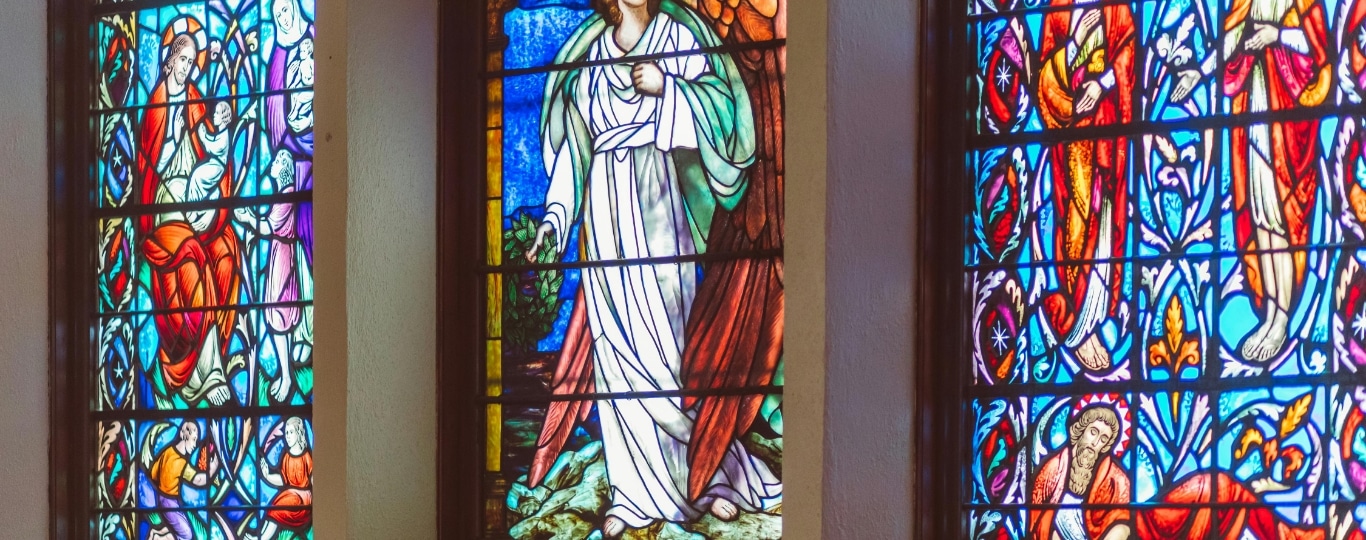
Trinity Twenty-Four Sunday
†
Paul opens his letter to the Colossians with a salutation of bright and encouraging commendation and praise. He writes: “We give thanks to the GOD and the Father of our LORD JESUS Christ, praying always for you, since we heard of your faith in JESUS Christ … [your knowledge] of the grace of GOD in truth … and for the hope that is laid up for you in heaven” (Colossians 1:3-6). Saint Paul continues his exhortation of the Colossian church by commending their Christianity, which is affirmed and upheld by what they had heard ‘in the word of the truth of the Gospel.’ Thus, let us be sharpened in our Christian faith, knowledge, and hope by looking deeper upon ‘the word of the truth’ of our Gospel Lesson for today.
Before we take on the narrative itself, we should approach it in its proper context. In Saint Matthew chapter nine, JESUS has a conversation with the disciples of John the Baptist, and the concern is fasting; viz., doing religious things for religiousness’ sake. Even though religious discipline is permissible, not all religious disciplines are beneficial. In JESUS’ day, some of these things did not, and still do not, as Paul noted in today’s Epistle, ‘Bring forth fruit in every good work, with an increase in the knowledge of GOD.’ — Therefore, in their conversation, JESUS responds by telling John’s disciples: ‘Listen to me, you all wear old clothes with old patches, and you drink old wine from old wineskins. I am doing a new thing; if kept under the categories of those old things, it would tear apart and burst those old things asunder. Thus, how can the children of the bridechamber fast, as long as the Bridegroom is with them?” (cf. St. Matt. 9:15)
Through His ministry, JESUS inaugurated a ‘new Way’ for people to live and think and believe – to have faith, knowledge, and hope. Religious practices of self-discipline were not part of that Way. JESUS’ Way of life is built out and beyond the old way that the Pharisees and John’s disciples were living, but it could not (and it still cannot), be held down or held in by that old way. It is a Way beyond duty unto faith, ultimately expressing itself in Love. In JESUS’ Way is a new life of feasting; not fasting; of singing and dancing; not mourning and wailing; of living, not dying.
To make His point, JESUS uses the classic Hebrew image of a wedding – of the groom, of the attendants of the bride’s chamber – and all the festivities and preparations being joyfully made for the couple’s blessed union and life together. And from this image, we understand JESUS’ meaning about His new Way to be festive, fruitful, bountiful, and abundant, because the Groom, JESUS, had come for His Bride, the Remnant of Israel and those Gentiles with the faith of Abraham. He had come to make a new Way for a new life with GOD; a new Way for GOD’s people to know and relate to Him in communion and relationship. — The prophet Isaiah described the Messianic and epithalamic (nuptial) Way of JESUS like this: “And in this mountain shall the LORD of hosts make unto all people a feast of fat things, a feast of wines on the lees, of fat things full of marrow, of wines on the lees well refined … He will swallow up death in victory; and the LORD GOD shall wipe away tears from off all faces; and the rebuke of his people shall He take away from off all the earth: for the LORD hath spoken it.” (25:6,8). “This Way revealed the Divine Nature of JESUS’ Mission, and the all-powerfulness of faith which it called forth [for those who choose to Walk in this Way, feasting, not fasting; rejoicing and not mourning.”1
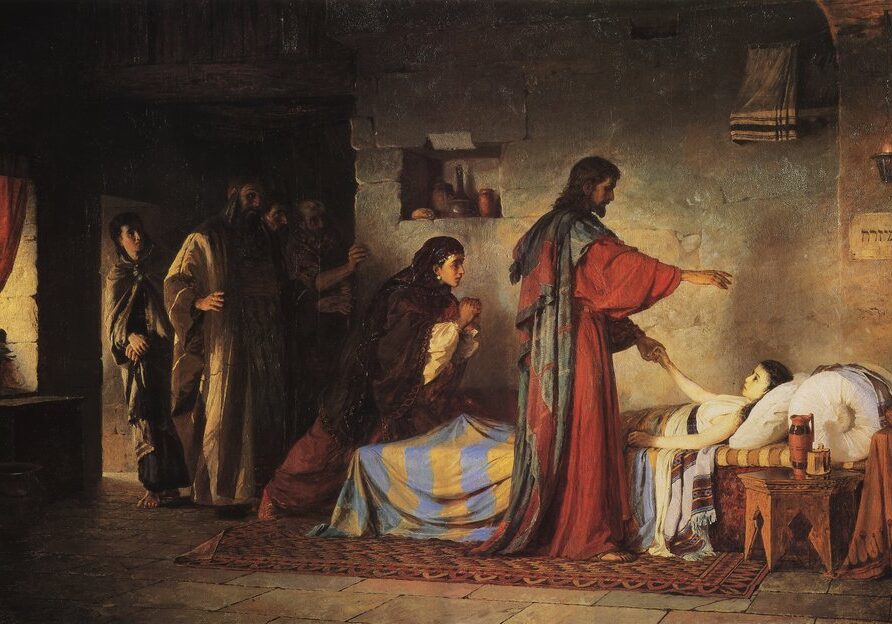
And then our Gospel Lesson for today kicks in! — “While he spake these things unto them, behold, there came a certain ruler, and worshipped him, saying, ‘My daughter is even now dying, but come and lay thy hand upon her, and she shall live'” (St. Matthew 9.18). The man, Jairus, was most likely a synagogue ruler and a representative of the people in Capernaum. Familiar with decorum in every other setting, Jairus throws himself on the ground before the Master for the sake of saving the life of his daughter – a twelve-year-old girl on the threshold of womanhood. — The urgency of life or death brought the man to the realization that the rumors of JESUS’ power and authority and the hope of their veracity were all he could believe in now; all else having failed to save his little girl. — “For a figure of this rank to prostrate himself before Jesus in public shows striking humility and signals the growing recognition of JESUS’ Messianic authority within the Jewish religious structures in Galilee.”2 Yet, something was lacking in Jairus’ faith which JESUS identified. — His faith was weak “due to a defect, which threatened to end in despair. [The corrective could only be obtained through the power of Christ and the peculiar] discipline the all-wise Master could apply to Jairus’ faith…”3 So, the Bridegroom “Arose, and followed [Jairus], and so did his disciples” (9:19).
On the way to Jairus’ home, with all the crowds following around, JESUS was delayed by another person; equally desperate – equally needy of participation in JESUS’ feast of fat things, with new garments, new wine, and a new life. It was a woman who had been stricken with an issue of bleeding for twelve years. Like Jairus, this woman believed that a ‘touch’ would bring her into JESUS’ new Way. Yet, her faith also was challenged; not by any sense of perseverance or assurance, but unto the dangerous point of excess. Her issue with blood was second only in its intense measure of impurity to that of death in the community. In fact, to have an issue with blood was to be an outcast in Hebrew society, by law, such that a bleeding or seeping person might as well be dead. No one could associate with this person, ever; no family, no friends, no clergy. This outcast woman could only apply to the medical community for their recommended remedies, ointments, and potions. And the more she appealed to the apothecaries, the sicker she became. — This poor woman’s case became so extreme that her deliverance, she believed, needed to be equally extreme. – Certainly, if JESUS could heal a leper by laying His hands upon him, then certainly He could heal her. – Yet, because of her religious and social stigma, she feared to approach JESUS and appeal to Him for His touch. Instead, she sought to ‘steal’ a touch from the hem of His garment, unbeknownst, and then go her way. For, she thought to herself, “If I may but touch His garment, I shall be made whole” (St. Matthew 9:21).
These two desperate people came to JESUS with everything to gain by the new Way of Life in Christ, if only they would lose what was lacking in their faith. — In our initial reading, it appears that Jairus and the woman had the ‘stuff’ of true faith – they come to JESUS honestly and truthfully, believing GOD is with Him; that GOD is working through Him. Yet, as we will see, “Christ’s Miracles were intended to aid, not to supersede faith; to direct us to the Person and Teaching of Christ … not to excite and satisfy the carnal and personal expectancies of the Jewish people, among whom JESUS performed His Miracles. The Gospel Miracles were to lead the people (as they are to lead us) to the Feet of JESUS, the Christ.”4 — Both Jairus and the woman had learned through their respective and challenging life journeys that they could bring nothing to GOD, except faith. With death lying at each of their doorsteps, they had learned that GOD is, and that He is the rewarder of them that diligently seek Him. (cf. Heb. 11:6) — Yet, dear friends, to participate in the new Way of GOD in Christ, more than faith in GOD’s Divine Power is required. First, the Way requires faith in the Divine Personhood of JESUS as the Christ; then faith in the Divine Power at work in and through Him is next.
Do you see it? — Each of these people applied to JESUS only when all else failed. Their hope was JESUS’ Divine Omnipotence, not His Divine Person. — “I am the Way, the Truth, and the Life; no one comes to the Father but by me. If ye had known me, ye should have known my Father also,” JESUS said. (St. John 14:6-7). — The issue here is control and trust. — Jairus waited until his daughter was breathing her last before He sought the Savior, even though he would have seen JESUS regularly in the Capernaum synagogue. Jairus would have also been part of the synagogue leadership in Saint Matthew 8, who solicited JESUS on behalf of the Roman centurion’s sick servant. And Jairus’ peer was the nobleman of Saint John 4, whose son was dying. In both cases, Jairus knew that JESUS had healed with His spoken word. Yet, Jairus waits; He does not request a word; he requires a physical, ever-assuring touch. He wants JESUS in His house in the flesh, assuring through his control that nothing will go wrong, and that his daughter will be made well again. — This is not the all-powerfulness of faith in Christ’s Personhood that GOD requires. It is a ‘foxhole’ entreaty, with a heart clinging to a fistful of control, and keeping open an expectation of disappointment and despair.
Similarly, the woman’s issue was not only with blood; she also struggled in her faith with trust. She had put her faith in her community, but no one came to her aid. She was abandoned, forsaken, and only getting sicker. Her disease and social humiliation were more than anyone could possibly bear; yet she did. Who could she trust but herself alone? — To sneak up behind JESUS, touch His garment, and then steal away with her wholeness intact does not sound like the all-engrossing faith in JESUS the Christ that GOD requires. Instead, it smells of control, and the fear of exposure of the true ‘self’ to GOD. — The woman desired none to know her in her errand, not even JESUS. She expected by some form of excessive faith, tilting toward superstition, that the fabric that touched JESUS was enough to heal her, yet the Person of JESUS, she selfishly thought, she could avoid.
Dear people of GOD, trust is intertwined with faith, and trust is the first rung on the ladder of faith. Trust in JESUS and an intimate relationship with Him requires the loosening of our grip on disguises – on shame – on performance – on control. “Trust sounds beautiful until GOD asks you to trust Him with the thing(s) you would like most to keep in your own hands.”5 Yet this is what He asks. — “This is my beloved Son, in whom I am well pleased; hear ye Him!” (St. Matthew 17:5).
Responding to our faith, GOD’s grace works for us freely, and GOD’s grace works in us freely. — Yet, with trembling hands, we must place into His hands those things we so want to protect from Him: brokenness, shame, disappointment, sin. — If we resist, we will only keep ourselves from reaching the second rung on the ladder of faith after trust, which is confidence, then obedience, then love, then sanctification, and ultimately glory. Again, Christ’s Miracles were intended to aid, not to supersede, faith; to direct us to the Person and Teaching of Christ … not to excite our carnal and personal wills.
Both Jairus and the woman were seeking clean, but self-designed transactions with JESUS, but the LORD had other thoughts. — Though we bring even damaged faith to the LORD, Isaiah promises of Him: “A bruised reed He shall not break; the smoking flax He shall not extinguish” (42.3). — Thus, JESUS turns to face the woman whose faith caused power to leave Him. Yet, to accommodate, but to prevent excessive, superstitious, and impersonal faith, the LORD calls the woman out to meet Him: the loving and pitying Savior. JESUS does not “disdain her nor turn away from the weakness and what is lacking in the manifestation of her faith.”6 Though she believes that Divine Power resides in JESUS, the LORD engages her personally, such that she might know the One “Who hath abolished death, and hath brought life and immortality to light through the Gospel” (2 Timothy 1:10). — She responds with trust and explains her illness and exposes her personal weakness to the LORD. As Saint Mark tells us: “But the woman fearing and trembling, knowing what was done in her, came and fell down before Him, and told Him the truth. And JESUS said to her, ‘Daughter, thy faith hath made thee whole; go in peace and be whole of thy plague'” (5:33-34). — Christ’s Miracles bring true seekers to His feet; and coming to His feet, JESUS does not snuff them out but leads them into His new Way of life; unto trust, love, and glory; unto healing beyond the body; unto healing of the soul.
Now, we cannot downplay the delay that Jairus was forced to endure as he waited for JESUS to attend to his prayer. Though not according to plan, Jairus knew that none, save JESUS, could help him and save his daughter. For no one; not doctor, nor Pharisee, nor Sadducee, nor scribe, nor even Moses could bring aid and comfort to his family now. And due to the delay, a messenger came to meet Jairus and the accompanying party to say: “Thy daughter is dead: trouble not the Master” (9:49). — Jairus had placed his faith in the Divine Power of GOD at work in JESUS, but now that his daughter was dead, that faith risked failing. — All that the man had dreaded, and all that he had extended himself to prevent, was spoken into reality. — This is the exact opportunity that the all-wise Master providentially prepared. He did so to apply the corrective needed to uphold Jairus’ faith with assurance and perseverance. For Christ’s Miracles aid, not supersede faith. — Thus, JESUS says to the man: “Fear not: believe only, and she shall be made whole” (St. Matthew 9:50).
JESUS’ “emphatic admonition, not to fear, only to believe, gives us an insight into the threatening failure of the synagogue ruler’s faith … The utmost need of JESUS, which would henceforth require the utmost faith on the part of Jairus, had now come.”7 — Jairus, from this point on in the narrative, grows silent, which shows his original plan had met a dead end, and with words and directions only coming from JESUS. It was apparent that Jairus had relinquished control and was put into a position of trusting the Person of Christ. This is the ‘truth’ of the power of GOD’s grace. When GOD rewards those who truly seek Him by faith, believing that He is GOD, and that in Him all life moves and has its being, the LORD brings wholeness. Yet, as we said, glory and wholeness follow trust in JESUS as LORD.
Jairus now follows JESUS into his home, and “he took no part in what happened next; he witnessed the pageantry of the ensuing obsequies of the funeral preparations in his own home; he heard the scorn which Christ’s majestic declaration of over death provoked, and he did this all, without checking anyone for it – especially JESUS.”8 – In this moment, the weakness of Jairus’ faith was upheld by the Person of JESUS Christ more than he could have ever asked or imagined. For when the herald of death came, instead of hoisting his white flag of despondence, he stepped forward and followed JESUS to the den of the supposed dead. — By simply opening the door to JESUS, the LORD comes in and dines with the master of the house and his whole household, sharing His new Way and His new Life. (cf. Rev. 3:20) — The moment his daughter was pronounced dead, Jairus began to trust the Personhood of JESUS, well before the miracle was ever performed. He invited JESUS into his home and to take the place of honor in all that proceeded from that moment. And with particular care and concern, with Jairus’ trusting permission, the Master of the nuptial Feast “took little girl by the hand, and the maid arose” (St. Matthew 9:25).
What JESUS was doing with the woman with the issue of blood and with Jairus’ daughter was the beginning of His work of rescuing the world; saving us from everything that pollutes, defaces, and destroys through sin. JESUS is the Bridegroom of GOD; His Kingdom has come, and His will is being done by the power of the Father’s grace in those who have faith in Him, the Divine Savior of the world.
Dear friends, the invitation to the Son’s wedding feast is now – I am the Way – I am the Truth – I am the Life, JESUS said. — We need no longer fast, trying to control GOD and His visitation to our dwellings. We must need let go and believe, for the Day of Christ has already come – He is risen indeed, Alleluia! — We need now only to trust by putting on the new garments of salvation and believe by drinking the new wine of life, for the new Way of Christ is offered to us now; today. — We need only come when called, diligently seeking the Divine Personhood of Christ by faith, which He offers to us in the intimacy of Himself and His Life in the Bread and the Cup. For the Divine mystery of Christ’s Miracles supports but never supersedes our faith. — Come, beloved; all has been made ready by the Bridegroom. Amen.
—
1 Edersheim, Rev. Dr. Alfred, The Life and Times of JESUS the Messiah, (Peabody: Hendrickson Publishers, 1993), 424.
2 BibleHub.org. “Lexicon review of the word Ἰάϊρος.” Accessed 12 November 2026. https://biblehub.com/greek/2383.htm.
3 Edersheim, 424-425.
4 Edersheim, 426.
5 Luginbyhl, James A., Hymns for the Unfinished: A memoir of Grief, Grace, and Becoming, (Made in Coppell, Texas, 2026), 120.
6 Edersheim, 431.
7-8 Edersheim, 432-434.

Join Us for Biblical Worship, Study, & Fellowship
Sundays:
Coffee and Fellowship 8:30 am
Catechesis for all ages 9:00 am
Holy Communion 10:30 am
Recent Sermons
Feast of All Saints Sunday

Worship with Us
Join us for Biblical worship, study, and fellowship. We currently meet in the sanctuary of Christ the King Lutheran Church in Waxahachie.
Catechesis for Adults and Children 5+
Sundays at 9:00 am
The Order of Holy Communion
Sundays at 10:30 am
Fellowship Opportunities
See our calendar for other weekly and special events.