First Sunday in Lent
†
Following his chapter entitled “Necessary Qualifications for a Master,” in his book, A Treatise on the Theory and Practice of the Art of Fencing, Roland George has a chapter entitled: “A few short maxims which the Young Fencer will do well to keep in his Reflection.” There, Mr. George offers multiple pieces of advice for novices concerning the art and activity of fencing. Several of those are as follows: ‘Always place yourself on guard, out of the possible reach of your opponent’s lunge’; ‘Never appear to exult at giving thrusts, nor show ill temper at receiving them’; ‘Endeavor to discover your adversary’s designs, and to conceal your own’; and ‘To know what you may risk, you must know what you are worth.’1
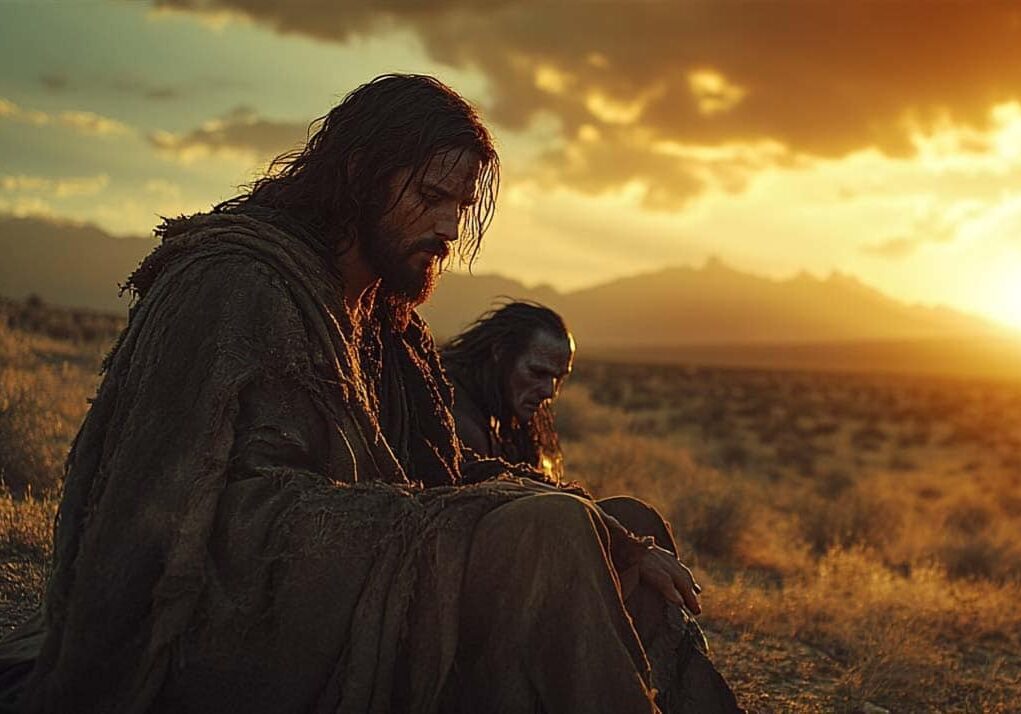
– The narrative of JESUS’ temptation in the wilderness launches us into our Lenten Journey, and we find it presented to us in St. Matthew four, as well as in the fourth chapter of St. Luke’s Gospel. The narrative is especially cogent for Lent, because Christ JESUS, the Kingdom’s Commander-in-Chief, blazes a trail for us, showing us how we are to walk in this life. We follow our Master, mimicking Him, as the Prayer Book says, by “confessing the faith of Christ crucified, and manfully fighting under his banner, against sin, the world, and the devil; [in this, we will] continue Christ’s faithful soldier and servant unto our life’s end.”2 Let us now, consider the context of today’s Gospel Lesson more closely.
JESUS had just been baptized in the Jordan by John the Baptist, and as the Holy Spirit descended upon JESUS in the form of a dove, a Voice spoke from Heaven saying, “This is my beloved Son, in whom I am well pleased” (St. Matthew 3.17). — The Divine Sonship was publicly professed so that all that heard that Voice, including JESUS, would know the Divine Anointing was pronounced upon JESUS of Nazareth. Again, Roland George’s primary maxim for young fencers: To know what you may risk, you must know what you are worth – what your mettle is capable of enduring. JESUS’ worth, His capability (mettle, courage, fortitude), was that of the Son of GOD, but He had taken to no risks yet; He was untested. So, the Spirit of GOD leads JESUS into the wilderness.
Oh, how many times have we approached the Lenten Season, wanting to show GOD our dedication to Him by ‘giving up’ something to reveal our devotion. Knowing that devotion is no devotion until it is tested, we journey with Christ for forty days to learn the ways of the Son, that we too might tell Satan to ‘get hence’, finding ourselves victorious with Christ, fighting under His banner until our lives’ end. — Yet, on the front end of your spiritual Lenten journey, I beseech thee brothers and sisters, keep in mind that He who was perfect, after emptying Himself of all that made Him equal to GOD, “did nothing of Himself, but only what He saw the Father do. For whatever the Father did, so did His Son do also, [daily]” (St. John 5.19). — Let us then consider Christ JESUS’ life-long commitment to abide in the Father’s word, so that we might calibrate our devotion to be Christ-like, too, following in His Godly motions in righteousness, especially in the testing of His capability as the Son in the wilderness by Satan.
There, JESUS went forty days without eating any food. — Now we ask, why? Why did the LORD JESUS need to be tested in such a way as this? — It was because JESUS was the true archetype or fulfilled reflection of Israel. The redemptive drama that Israel experienced for two thousand years, was continued until its final, redemptive fulfillment in the archetype – JESUS the Christ. — And like the nation of Israel that marched forty years in the wilderness and was tested without food, JESUS was forced to trust GOD for His goodness and mercy. And like Israel, when she was hungry and nearly starving, Satan, the tester and tempter, came to solicit JESUS to grumble and to turn away from His calling as the Son and Savior of the world.
Bluntly put, but theologically accurate, Satan is a tool. He is a creature of the Creator that can do nothing of his own accord, lest with GOD’s permission he is released. GOD uses Satan to accomplish the means and desired outcomes of the Divine Will. We read as much, implicitly in the fifth book of Moses, called Deuteronomy, when GOD tested ethnic Israel in the wilderness. GOD did so, that He might “humble [Israel], and to test [her], to know what was in [her] heart, whether [she] would keep His commandments or not. So, GOD humbled [her], allowing [her] to hunger” (Deuteronomy 8.2-3). — GOD did this, Moses says, “that He might make Israel know that man shall not live by bread alone; but man lives by every word that proceeds from the mouth the of the LORD” (Deuteronomy 8.3). Thus, if Christ, the Incarnate Servant of GOD, the true Israel was to fulfill His role of Sonship professed at His baptism in the Jordan, JESUS must also endure a hungering in His flesh to the point of starvation, that He might be tested, like Israel, to show what was in His heart. — To know what you may risk in combat, especially the combat of the spiritual kind, you must know what you are worth – what you are capable. — “This is my Son in whom I am well pleased.” — So, JESUS fasted and craved ardently for food, and He was hungry.
Fasting for forty days is to go to the brink of starvation. — In the first week of a food fast (for Jesus did not fast from water, which could only be sustained for 3-4 days), one hungers and longs for food, mostly psychologically, for the body has plenty of calories to draw from if needed. Yet in the second week and beyond, there are no longer any pangs of hunger. The body, crying out, no longer for the provision of fresh sustenance, begins to consume all the calories trapped in the belly and colon for energy. And in these weeks, instead of hunger, a person feels rather energetic and fresh. And then, as if hitting a wall, about forty days into a food fast, when all the reserved calories in the body are expended, the body and the mind begin to hunger ardently – to be on the brink of physical death – to starve. — In St. Matthew four, this was the LORD JESUS’s condition, and this is when Satan, waiting for the ideal moment, came to test JESUS thrice, saying: ‘If you are the Son of GOD…then.’
Again, Mr. George’s advice: ‘Always place yourself on guard, out of the possible reach of your opponent’s lunge.’ Satan’s first lunge at Christ was a swift strike to test JESUS’ footing. If He were anyone but the Christ, a slash at His flesh would strike home and render Him defenseless. — “If you are the Son of GOD, command that these stones become bread” (St. Matthew 4.3). This was Satan’s first temptation of our LORD, and it was elementary – pedestrian in fact. — And in this way, the Tempter defeatsd many of us, regularly. — Many a Christian has fallen prey to this tactic of the Tempter, sinning with what their flesh craves the most and the most often. We fall for Satan’s trap in our flesh, typically, because we are already falling forward with an unbalanced spiritual stance. Those things we succumb to in our flesh, are often those things that we keep closely at hand, well within our access, and the enemy lunges at us with them with ease, being within his reach, we are struck down.
When we lean toward our flesh’s natural, but prohibited desire, in extremis, we are bound to fall prey to the enemy’s design. As St. James says, “But each one is tempted when he is drawn away by his own desires and enticed. Then, when desire has conceived, it gives birth to sin; and sin, when it is full-grown, brings forth death” (James 1.14-15). — JESUS, expecting the over-aggression of His nemesis, parries the blow and renders Satan’s first attack neutral. He parries the strike easily, because JESUS must have surely considered, long before the Tempter’s arrival, that He could turn any stone to bread and satiate His hunger. But JESUS had concluded to resign His devotion in faithfulness to GOD, articulated His resignation to His unholy opponent: “It is written, ‘Man shall not live by bread alone, but by every word that proceeds from the mouth of GOD” (Matthew 4.4).
Satan, not to be undone, recalibrates his attack by taking JESUS up to Jerusalem, the holy city, and setting Him upon a pinnacle of the Temple. One must presume that this would have been during a part of the day when great crowds were gathering in the Temple, and engaging in commerce, education, civics, and religious activities. The Tempter then says to the LORD: “If you are the Son of GOD, [and you know what you are worth], throw yourself down. For it is written: ‘He shall give His angels charge over you; and in their hands they shall bear you up. Lest you dash your foot against a stone” (Matthew 4.5-6). “Christ answered and baffled all the temptations of Satan with, ‘It is written.’ He is Himself the Eternal Word, and He could have produced the mind of GOD in expert debate without having recourse to the writings of Moses; instead, the LORD put honor upon the Scripture. And, to set us an example, JESUS appealed to what was written in the law. He quotes Holy Scripture to Satan, taking it for granted that the Tempter knew well enough what was written too.”3 – To counter the LORD’s strategy, the Tempter also quotes Scripture, knowing that JESUS would also know it well. — Now, brothers and sisters, it is one thing to know Scripture with the intellect, and to believe it is true. For even “the devils also believe, and tremble,” says St. James (2.19). Yet it is another thing to know the Scriptures and to have the skill to use them in spiritual combat. — Roland George, in his fencing reminders coaches the novice, to never appear to exult at giving thrusts, nor showing ill temper at receiving them. — Satan rallies and exults at his tactic of using “It is written”, but JESUS is the dueling master’s Master. — Satan quotes Scripture, but only in hyphenation. He had purposefully left out the phrase ‘He shall give His angels charge over you to keep you in all your ways; and in their hands they shall bear you up. Lest you dash your foot against a stone” (Psalm 91.11-12). All of JESUS’ ways were commanded by His Father through the Holy Spirit, and those ways were to go into the wilderness and fast until the appropriate time. To do otherwise, would not to be walking in GOD’s ways. Thus, when we walk in our own ways, we are walking selfishly and not like sons and daughters of The Most Highest. If JESUS were to have cast Himself from the pinnacle of the Temple with the expectation of Heaven’s support, it would be to tempt GOD into doing what He would command from His Father. Such are not the ways of a true child with his father. — The true Son of GOD, JESUS, thus responds to the Tempter, calmly and without ill temper because of his well-calculated thrust: “It is written, AGAIN, ‘Though shalt not tempt the LORD thy GOD” (St. Matthew 4.7).
Lastly, “Satan took JESUS to an exceedingly high mountain, and showed Him all the kingdoms of this world and their glory. And he said to JESUS, ‘All these things I will give You, if You will fall down and worship me” (Matthew 4.8-9). — Apparently, Satan had not read Roland George’s chapter on those things “Necessary for the Fencing Master.” For here, Satan shows his cards in full view. His aim is not only to tempt JESUS from His mission, or to challenge the knowledge of who He was, but rather, his ultimate desire was the worship of the Son of GOD. Oh, the ways of the satanic are always to throw their pearls before swine, shamelessly participating in the most horrid of idolatries. Satan could help it no longer: he revealed his ultimate design as the father of lies. In fact, he was believing his own lies and forgot his original purpose, which was to connive JESUS out of His identity. Instead, he no longer endeavored to discover his adversary’s designs, but instead, revealed his own.
Not receiving any proofs from JESUS that He was GOD’s Son, Satan tested JESUS as he has so many before. Those, knowing not who they are easily persuaded by the evil one to seek their identity in wealth, power, and influence. The Tempter does the same to the LORD. Since He was not showing Satan what he wanted to see in the “Son of GOD”, he was offering JESUS all the kingdoms of the world with their pomp, glory and all the laud and acclaim that would come with their ownership. This Messiah of GOD, JESUS, had no material kingdom as of yet, and if He were to acquire it, it would take Him a lifetime to achieve what Satan could offer Him in an instant. The temptation was that Satan could deliver all that was in JESUS’ eye, so Satan perches JESUS a false height to view the kingdoms of this world and their glory. But friends, all of Satan’s dainties are pablum and counterfeits – he can never deliver what he promises, except lies, ugliness, and evil. JESUS expected to receive a Kingdom from His Father, but the trek to that inheritance would be long and require great suffering. Perhaps Satan knew this, and perhaps not. But his device was to tempt JESUS with the shortcut to temporal sonship, if JESUS would only bow down and claim Satan as His master – His god – His father. The pornographic promises of instant gratification are more fulfilling than the fulfillment that comes through digging deep foundations of godly, covenantal communion with the Good, True, and Beautiful is a satanic originality – the Tempter’s Magnum Opus. But don’t be fooled dear church – his originality is unoriginal – an apparition – a vapor.
It was to GOD alone that JESUS owed His fealty and worship, for He knew who His true Father was, in spite of weakness, hunger, solitude, and desire for His time to come. — The lesson for the Christian in this temptation is in its utter disgustingness and abhorrence: “All of Satan’s baits are shams, counterfeits, and false images; [they should be immediately shunned].”4 Worship anything other than the Creator and His commands? Feel ourselves so important as to turn within ourselves and challenge the Creator’s honesty: “Did he really say? Did he really promise? Did he really command? “Some temptations have their wickedness written in their foreheads and are open on the palm of the hand. These are not to be given the credibility of a dispute.”5 — And with the Tempter’s nefarious intent in plain sight, JESUS counterstrikes a final time and brings down His adversary by saying: “Get thee hence, Satan! For it is written, ‘Thou shalt worship the LORD thy GOD, and Him only shalt thou serve’” (Matthew 4.10).
How should we then summarize all that has been said here today? — The narrative about our LORD’s fasting and temptation in the wilderness “represents the extraordinary experience of JESUS’ inward struggle to confirm His Messianic vocation and intimate relation to the Father as the ‘Beloved Son.’ And what we learn from this narrative is that JESUS was forced to make a decision. A decision about how he would choose to follow His call as the Son of GOD. Under great duress from Satan, the world, and His flesh, would JESUS heed: “It is written,” OR “Did He really say?” — I believe this is the question we are to wrestle with this Lent, also. If we are sons and daughters born by adoption into the Family of GOD, will we heed GOD’s word, or be enticed by another’s counterfeits? — Remember brothers and sisters, “the Kingdom of GOD is not of this world; it does not come with observation (cf. Lk. 17.20) … The Kingdom is eternal and spiritual, not temporal and material. There is no more diabolical and satanic denial of GOD’s way of redeeming human nature, than the attempt to soothe men’s consciousness of their sin and to lure them into the delusional state of the fruits of righteousness by means of material prosperity, fleshly gratifications, or idolatrous infatuations. Such are the tactics of antichrists.”6 Before we know what we can risk, we must know what we are worth – what we are capable – how strong is our mettle, our fortitude. It is one thing to know the word of GOD – it is another to know how to use it in spiritual battle for your soul against the Tempter. Let us remember then, dear church, Christ’s wilderness temptation being our Lenten forerunner: ‘It is written!’ ‘Again, it is written!’ ‘It is written.’ Amen.
—
1 Roland, George, A treatise on the theory and practice of the art of fencing, (Edinburgh: Printed for Archd. Constable and Company; London: Hurst, Robinson, and Company, 1823), 152-153.
2 1928 Book of Common Prayer, 280.
3 Henry, Matthew. BlueLetterBible.org. “Commentary on Matthew 4.” Accessed 20-November 2026. https://www.blueletterbible.org/Comm/mhc/Mat/Mat_004.cfm?a=933004
4 1928 BCP, 26.
5 Henry, “Commentary on Matthew 4”.
6 Sheppard Jr., Massey H., The Oxford American Prayer Book Commentary, (New York: Oxford University Press, 1950), 203.

Join Us for Biblical Worship, Study, & Fellowship
Sundays:
Morning Prayer 9:45 am
Coffee & Catechesis 10:30 am
Holy Communion 12:00 pm
Thursdays:
Holy Communion 6:00 pm
Recent Sermons

Quinquagesima Sunday


Worship with Us
Join us for Biblical worship, study, and fellowship. We currently meet in the sanctuary of Christ the King Lutheran Church in Waxahachie.
The Order of Morning Prayer
Sundays at 9:45 am
Coffee and Catechesis
Sundays at 10:30 am
Holy Communion
Sundays at 12:00 pm and Thursdays at 6:00 pm