Third Sunday after Easter

†
A dear brother at our recent Men’s Retreat at Camp Crucis in Granbury, asked a very insightful question: ‘Why do we seek a blessing that passes all understanding, which the priest says at the end of the Eucharistic Service? If it is beyond understanding, why are we seeking to receive it, if we cannot understand it?’ — It is a wonderful question, and the theme of the Third Sunday after Easter helps us understand the answer to this excellent question.
The blessing of ‘the peace which passes all understanding,’ is informed by Philippians 4.6-7. It is St. Paul’s benediction to the church in Philippi, wherein, he says: “Be careful about nothing; but in everything by prayer and supplication with thanksgiving let your requests be made known unto God. And the peace of God, which passes all understanding, shall keep your hearts and minds through Christ JESUS.” — Paul’s benediction is for all Christians everywhere, because in this world, we are to be careful about nothing, that is, to take nothing for granted, for we are not of this world, because we are a people of a different generation – a different nation – a different desitantion. — In another place, St. Paul says, “For our conversation is in heaven; from whence also we look for the Saviour, the Lord JESUS Christ” (Philippians 3.20). — What is this conversation that St. Paul speaks about? — In Paul’s meaning, ‘conversation’ is translated as commonwealth, which is the wholeness of a common people – people with the same mission, purpose, and Ruler or King. — St. Paul is speaking about the ‘commonwealth’ of the Church, and our commonwealth’s conversation is in heaven, from whence we look for the Savior JESUS Christ to lead, guide, and direct us. — And He leads us far above the world’s understanding in peace.
‘That which passes all understanding’ is Christ’s peace. And this divine peace is the working of His grace to create out of many nations, tribes, and tongues, a unity – a wholeness – a wholeness in unified commonwealth, wherein the citizens of that commonwealth are in the same ‘conversation’ with GOD, His Christ, and with each other. — And this incomprehensible peace is ours to enjoy and partake in, while we yet dwell in the world. — This peace, this wholeness passes every worldly concept of reality. Thus, it passes all understanding!
It passes understanding, because the world is so chaotic and antagonistic to our commonwealth. — Even though JESUS promises us tribulation in this world, He also tells us the following: “These things I have spoken unto you, that in me ye might have peace … be of good cheer; I have overcome the world” (St. John 16.33). The peace of Christ, given to us in this world, amidst tribulation, is what is beyond understanding. More by the world, mind you, than by us. For we believe in the Empty Tomb, the principal symbol of divine truth from which our peace arises – sealed in the Everlasting Covenant in His Blood. Yet, the world cannot accept this miracle – it is beyond their understanding and acceptance.
To testify to our hope in this peace that passes all understanding – that we are living into it and experiencing it – in today’s Epistle Lesson, St. Peter calls us to live as ‘citizens of Christ’s commonwealth, in His peace’ – for this is where our conversation belongs. And to be sure, to be a part of this citizenship and this conversation, a different sort of lifestyle is required of us. A lifestyle of peace with GOD that passes all understanding, if you will. Peter says, “Beloved, I beg you as sojourners and pilgrims, abstain from fleshly lusts which war against the soul, having your conduct honorable among the Gentiles” (1 Peter 2.11).
We’ve all heard it said: ‘Christians are to live in the world but not be of the world.’ Yes! This is exactly what St. Peter is getting at. The peace that comes to us from GOD is beyond all understanding, and so must our behavior be, too. — To do this, we first must understand that our conversation and commonwealth is of a far distant country, and that we are only passing through this world. Yet, as sojourners passing through this world, though not of this world, we are to understand that our King is with us. – He is in our hearts and in our minds, beyond all understanding, in the Person of His Holy Spirit. This is why our life’s conversation is about His commonwealth – not a conversation about a temporal or intermediate communion with the world and its perks. — We are to live as JESUS’ people, and not as the people that accommodate the world’s behaviors – the world’s oaths – the world’s culture – the world’s vanity fair.
This reminds me of a wonderful allegory by John Bunyan concerning a certain pilgrim of the conversation of Heaven, whose name was Christian, and his good friend, Faithful. Traveling to the Celestial City, Christian and Faithful met a man named Evangelist, who encouraged them in the progress on their pilgrimage, to walk in the same Way as the Prince of princes walked. — And on their journey, Evangelist warned Christian and Faithful that they would encounter a city erected many years ago by Beelzebub, Apollyon, and Legion. The name of the city is Vanity Fair. It is so named, because every day of the year, every sort of vanity can be seen and bought at the fair, in this city. Anyone at Vanity Fair could purchase, “houses, lands, trades, places, honors, preferments, titles, countries, kingdoms, lusts, pleasures; as well as delights of all sorts, especially harlots, wives, husbands, children, masters, servants, lives, blood, bodies, souls, silver, gold, pearls, precious stones, and the like … And moreover, at this fair there is at all times to be seen juggling, cheats, games, plays, fools, apes, knaves, and rogues. And if that were not enough, there are also to be seen thefts, murders, adulteries, false swearers, and all of these, for no cost.”1
The Evangelist further warned the pilgrims that, because of the Way mapped out by the Blessed One, the Prince of the Celestial City, “they should not cheapen themselves [on their holy mission], but rather, to have no mind to the merchandise of the city, and therefore leave the town without laying out so much as one farthing upon any of these vanities, [just as the Prince did not].”2 — This is the same advice that we have from the evangelist, St. Peter: ‘Beloved, I beg you,’ he says, ‘as sojourners and pilgrims, abstain from fleshly lusts which war against the soul, having your conduct honorable among the Gentiles.’ We, citizens of the commonwealth of the conversation of Heaven, we are to pass through this world, this vanity fair, without so much laying out a farthing upon the world’s vanities, all free, mind you, that war against the desires of our human souls, hearts, and minds.
St. Peter tells us we are to do this for two primary reasons. The first reason, St. Peter expands upon even more elaborately when he says: “Since Christ suffered for us in the flesh, [we should] arm ourselves also with the same mind, for he who has suffered in the flesh has ceased from sin, that he no longer should live the rest of his time in the flesh for the lusts of men, but, for the will of God. For we have spent enough of our past lifetime in [vanity fair], doing the will of the Gentiles—when we walked in lewdness, lusts, drunkenness, revelries, drinking parties, and abominable idolatries” (1 Peter 4.1-4). As Evangelist said, if we are to walk to the Celestial City, then we need to walk in the Way of the Blessed One; the Prince of princes; Him who first charted out the Way for us, even at the price of His life.
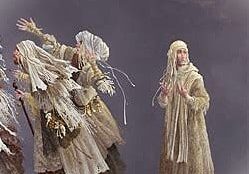
Further, we are to pass by the frivolities, lewdness, and passions of the vain wares of the world, because St. Peter says, when the Gentiles “speak against you as evildoers, they may, by your good works which they observe, glorify GOD in the visitation” (1 Peter 2.12). — When Christian and Faithful came to Vanity Fair, they did as the Evangelist said – they partook not of the culture of that vain place. Yet, while they walked through those pretentious fairgrounds, (which one must do to get from one side of the place to the other), several things struck the locals odd, about them. The people of that place, “gazing upon them, said that Christian and Faithful were fools, bedlams, and outlandish men. [This was because,] the pilgrims were clothed with such a kind of raiment as was diverse from the raiment of any that traded in that fair. [That is their comportment, demeanor, carriage, and attitude was strikingly different than that of anyone at Vanity Fair. Thus,] … the people wondered at their apparel, as they also did at their speech; for few could understand what they said. For even though they naturally spoke the language of Canaan, [they “let no corrupt word proceed out of their mouth, but only what was good for necessary edification…speaking to one another in psalms, and hymns, and spiritual songs.’ (cf. Eph. 4.29 & 5.19).] And as a result, from one end of the fair to the other, they seemed barbarians to the local citizens … And finally, that which did not amuse the merchandizers one bit, was that the pilgrims set very light by all the vain wares. They cared not so much as to look upon them; and if the merchandizers called upon them to buy, they would put their fingers in their ears, and cry, ‘Turn away mine eyes from beholding vanity,’ and looking instead upwards, signifying that their trade, traffic, and conversation [was not in Vanity Fair], but was in heaven?”3
The Way that Christian and Faithful walked, and how they walked in that Way, gained much attention and observation from the citizens of Vanity Fair, because it was beyond their understanding. Whether they did or did not, Peter the evangelist’s commendation is that by our walk in the Way through this world, done for the glory of GOD, every person will give glory to GOD for that ‘Way’ – one way or the other. — Yes, St. Peter is encouraging his readers that by their conversation and wholeness in commonwealth, living into the peace which passes all understanding, being focused upon Heaven and Heaven’s King, the Gentiles in the fair of the world, will see our good works and glorify GOD. — Thus, our conversation is not to be quiet or discreet. Our conversation in the Way should be apparent and ‘loud’, so that those Gentiles that reject GOD and His Christ, cannot be ignorant of the reality of the judgment to come. — Certainly, we hope that the citizens of Vanity Fair will abandon the fairgrounds as we did, but if they refuse, they must see us glorifying GOD and walking steadfastly in the Way. — These things we do, so that on the day of visitation, be that when a minister or a member of the Church calls the world to account for its ways, or whether it be the Day of the return of the LORD JESUS, all the unrepentant Gentiles “will glorify God, and applaud us, for our excellent conversation.”4 “This is the will of GOD, that by doing good, we may put to silence the ignorance of foolish men – as free, [unrestrained citizens of the heavenly conversation], not using this freedom as a cloak for vice and depravity, but rather as slaves of GOD.’ (cf. 1 Peter 2.15-17)
Brothers and sisters, the ‘peace which passes all understanding’ is not only for us to receive and enjoy – it is also ours to reveal and express to all of those in Vanity Fair by our conversation that looks to Heaven – not only in our speech, but also in our deeds. Thus, in today’s Epistle Lesson, St. Peter encourages us to mimic Christian and Faithful as we sojourn through this world – this vain fair – on our way to the Celestial City. We must abstain from the fleshly lusts that call upon us naturally, for in our fallen nature, we are prone to overindulge in that which GOD has made for us to naturally and rightly desire, i.e., food, drink, sleep, sex, ambition, gain, etc. If these things call out to us vainly, we are to abstain from them, and ‘hold them away from our person’,5 even to putting our fingers in our ears and hands over our eyes and saying: ‘Turn away mine eyes, O Lord, from beholding vanity!’
Now, St. Marks, may the GOD of Heaven, and His Prince of princes, grant unto all those who are admitted into the fellowship of Christ’s Religion, travelling from this world unto the Celestial City, the grace and peace that passes all understanding, that we may avoid those things that are contrary to our conversation, and follow all such things as are agreeable to the same. Just like Christian and Faithful at Vanity Fair. Amen!
1 Bunyan, John, Pilgrim’s Progress, (Oxford: Clarendon Press, 1855), 134.
2 Bunyan, 136.
3 Bunyan, 137.
4 Henry, Matthew. BlueLetterBible.org. “Commentary on 1 Peter 2.12”. Accessed 7 May 2025. https://www.blueletterbible.org/Comm/mhc/1Pe/1Pe_002.cfm?a=1153012.
5 Nelson NKJV Study Bible, “fn. 1 Peter 2.11,” (Peabody: Harper Collins Publishing Co., 2018), 1844.

Join Us for Biblical Worship, Study, & Fellowship
Sundays:
Coffee and Fellowship 8:30 am
Catechesis for all ages 9:00 am
Holy Communion 10:30 am
Recent Sermons

Sixteenth Sunday after Trinity

Worship with Us
Join us for Biblical worship, study, and fellowship. We currently meet in the sanctuary of Christ the King Lutheran Church in Waxahachie.
Catechesis for Adults and Children 5+
Sundays at 9:00 am
The Order of Holy Communion
Sundays at 10:30 am
Fellowship Opportunities
See our calendar for other weekly and special events.