Thirteenth Sunday after Trinity
†
Some classical, literary idealists prefer to stay away from allegories and types, favoring the plain moral or historical content of a chronicle as sufficient; at least that is what I am told. They want their works, or the works they read, to be read for what they are, without anyone trying to decode some deeper philosophical, political, or theological message from their narratives. Mark Twain was one of those purists, but did provide a most excellent allegory in his book entitled Roughing It. As he himself describes it, “It is a record of several years a vagabondizing … in the history of the Far West, about which no books have been written by persons who were on the ground, and saw the happenings of the time with their own eyes. [In this work], I allude to the rise, growth, and culmination of the silver-mining fever in Nevada in the 1800’s.”1 And in this book, which he says not to read allegorically, Twain, nonetheless, gives us a vision of what a beautifully simple, literary emblematic type can be: he writes, ‘a starving, miserable coyote is a living, breathing allegory of Want.’
Unlike Mr. Samual Clemens, I do enjoy a good allegory, particularly when it is a historical event pointing to a greater reality over and above that event’s own importance. For example, in modern Western Civilization, Rome is the allegorical benchmark for empire collapse. Since she was such a paragon of civilization for one thousand years, Rome’s fall (due to her own moral degradation and civic laziness) acts as a model, warning other empires on similar trajectories of what they can expect, lest they reform their ways. Societal corruption and moral failures provide the stuff of civilization-collapse; Rome is the principal allegorical model for such an occurrence. – As another example, in the American Revolution against the British Empire, we can see represented for us the struggle for freedom and self-determination against tyranny. In her pursuit of the ideals realized in our American Republic, we see an allegory of what a person or a people can achieve for life, liberty, and the pursuit of their destiny, if they are willing to make the sacrifices to achieve their goals, pledging their lives, their fortunes, and their sacred honor to that end.
Now, let us consider a biblical allegory, for I love such an allegory as much as the next Church Father. If we might, because it is relevant to our Lectionary readings for today, one can find significant emblematic and allegorical meaning in the historical places of Mt. Sinai and Mt. Zion. — Each of these places is of great biblical importance! Mt. Sinai is the place that YHWH GOD revealed Himself to Moses in the Burning Bush, and it is also the place where GOD audibly spoke to Israel from smoke, fire, and thunder, giving Jeshurun the stones upon which were written GOD’s Ten Commandments. These Tablets, plus the oral Torah that Moses recorded from the Mouth of GOD, are the Law upon which Israel was established as a people; religiously, culturally, and morally. — Of equal importance, Mt. Zion was the mount upon which the city of Jerusalem and the Temple were constructed for the glory of GOD. Upon this important mount, and in the holy structures that rested upon it, the people of Israel believed that the Anointed Servant of GOD, the Messiah, would one day come to rule and reign as the heir of King David – being the promised Seed of Abraham, bringing the realized fulfillment of the Mt. Sinai Torah in His wings. — As evidence of this hope in Israel, we read in Malachi 3:1 the prophetic word: “I will send my messenger, and he shall prepare the way before me: and the LORD, who ye seek, shall suddenly come to His Temple, even the Messenger of the Covenant, who ye delight in. Behold, He shall come, saith the LORD of Hosts.”
Mt. Sinai had a very different historical and theological significance than Mt. Zion, but that is the point. Each place casts its own emblematic vision of GOD’s relationship with Israel – a theological allegory and type, if you will. Mt. Zion, envisioned by the prophets as a place of communion (by grace) with GOD ALMIGHTY, was a place of deliverance and peace; renewal and righteousness; strength and redemption; the spiritual footstool of GOD in Heaven. In Obadiah 1:17 we read: “But upon Zion shall be deliverance, and there shall be holiness; and the house of Jacob shall possess her possessions.” In Isaiah 2:3, the prophet says of Zion: “Come ye, and let us go up to the mountain of the LORD, to the house of the GOD of Jacob, and He will teach us of His ways, and we will walk in His paths. For out of Zion shall go forth the Torah [the instruction in the Messianic Age], and the word of the LORD from Jerusalem.” This brief passage is pregnant with images of very specific and intimate spiritual interactions with the LORD ALMIGHTY and His faithful and desirous people. — Isaiah’s call is for the people to come to Zion with a hunger for revealed truth from GOD, and not about regulations, rites, and rituals written on cold, impersonal stones. Rather, in Zion, the prophet confesses, one could receive from the LORD what one could not find anywhere else; and it was not ‘law!’ — In Isaiah’s divine vision of Zion in the Messianic Age, GOD would walk with and teach His people directly, helping them take hold of “real knowledge; of spiritual Torah. In other words, YHWH GOD would reveal an incarnate truth, issuing forth to the changing of the lives of those who had ears to hear and hearts to embrace it and believe; for the just shall live by faith, Habakkuk reminds us. — In Isaiah’s vision, the Messianic Torah would cause “the head to warm the heart and redirect the feet [back to GOD his Creator] (cf. Lk. 24.32-33).”2
The emblematic theology that Mt. Sinai communicated was drastically different. In Psalm 68, David reimagines what Sinai looked like when the LORD came down, and the Just One met fallen humanity in Creation. It was awe-inspiring, daunting, and fear-provoking because, from before the LORD GOD ALMIGHTY, mountains and men fled. Fire, hail, storm, and wind went out from before Him, and if any man or beast approached the Holy Mount upon which GOD descended, they would die. – It was an awesome and fearsome scene, of which David describes in this way: “The earth shook, the heavens also dropped at the presence of GOD: even Sinai itself was moved at the presence of GOD, the GOD of Israel” (v. 8) – And when the people heard the LORD their GOD speak to them from atop this mount in such a dreadful way, His voice fantastically amplified as it came out to them from a dark cloud surrounded by fire, they said: “Now therefore why should we die? For this great fire will consume us. If we hear the voice of the LORD our GOD anymore, we shall die. For whom is there of all flesh, that has heard the voice of the living GOD speaking out of the midst of fire as we have, and has still lived?” (Deuteronomy 5.25-26).
These were the historical and allegorical realities of Mount Sinai and Zion: the one reality given to the people of Israel to prevent life’s transgressions through the fear of the law, disobedience punishable by death. The other, given by GOD to bring life to the people of Israel through gracious words of holy communion with the Most-High; the one, an emblem for all time of the divine, immoveable standard of virtue, “added,” as Saint Paul writes, “because of transgressions and sin” (Galatians 3:19) – given by the Father to prick the conscience of men and stop their feet from falling; the other, redirecting the feet of the righteous who live by faith, not only to keep them from falling, but to transform them through holy communion with Messianic Torah – Truth that sets one free – heart, mind, soul, and strength.
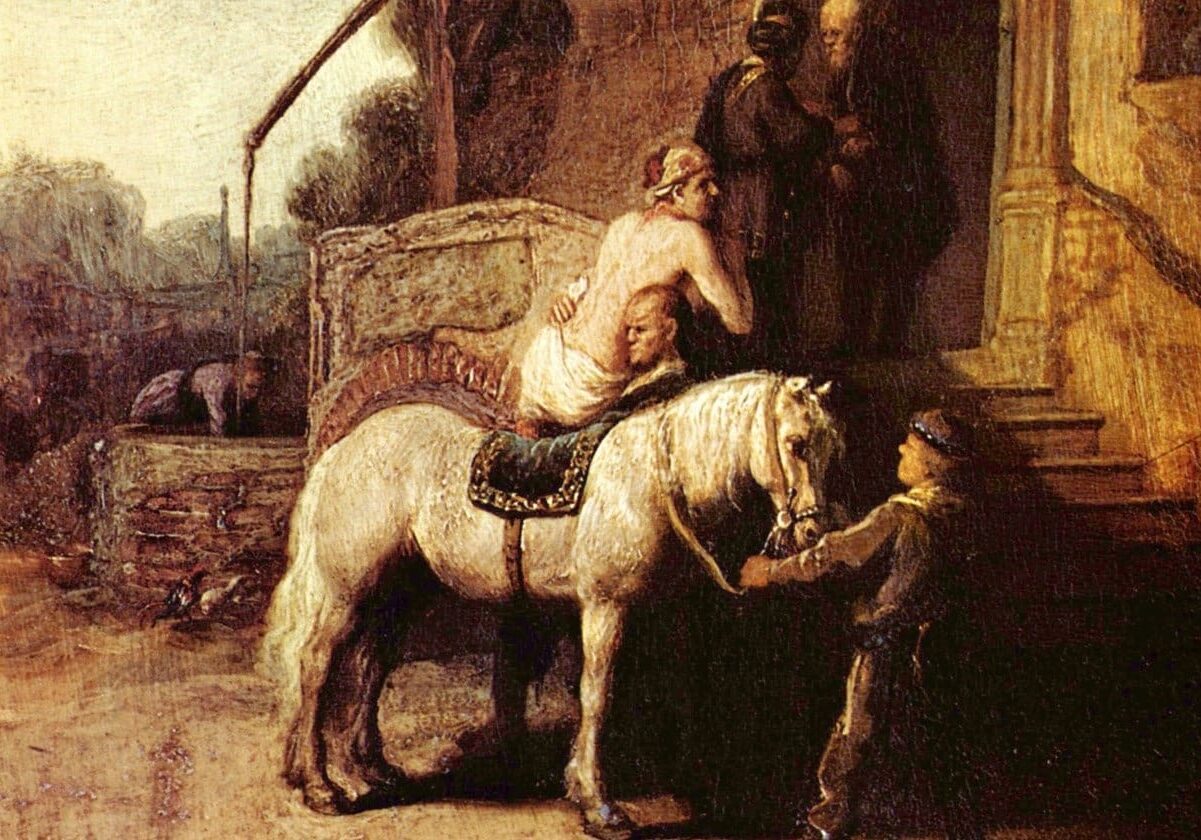
If such meaningful allegories, emblems, and symbols exist in the Old Testament, might we expect equally meaningful ones in the New Testament; say, from today’s Gospel Lesson from Saint Luke ten? Undoubtedly! – “A certain man went down from Jerusalem to Jericho and fell among thieves…” (10:30). – The LORD JESUS tells this transformative parable in response to a question from one of the experts in the Torah of Mt. Sinai. Yet, to his dismay, he was unaware that his interlocutor was the one Isaiah told Israel to go up to the mountain of the LORD to see; to the house of the GOD of Jacob to hear; for He had come to teach Israel His ways, that they might walk in His paths. (cf. Is. 2:3)
The lawyer assumed Torah was life; he narrowly believed that anyone who did not follow it would be disqualified from GOD’s inheritance. JESUS ate, drank, walked, touched, and spoke of the Messianic Torah of Grace with sinners. In combat against such graciousness, the expert in Sinai’s Torah stood and tempted JESUS; that is to say, tested Him and His skill in answering questions out of Sinai’s Law, which then was the rule and guide of daily life in Israel. It is not unlikely that the lawyer hoped to convict the broad and generous Rabbi of some unorthodox statement which would injure his reputation as the Teacher.”3 This legalist, no doubt in conspiracy with others, meant to disqualify JESUS as a respectable voice in Israel, but instead, they found JESUS without deceit. “The self-righteous, but probably rigidly conscientious, Jewish scholar, who had been taught to hate as the enemy, any who opposed his own narrow, vapid creed, now looking into the clear, truthful eyes of the Galilean Master, must have been struck, perhaps for the first time, the moral beauty of the words of Sinai’s Law, spoken by JESUS in Love … As such, this clever, unfriendly critic of JESUS of Nazareth, must have forgotten the hostile purpose with which he stood up to question the Master, and now, really conscience-stricken, tried to wriggle free by justifying himself, thereby putting forth the query which called out the famous parable we read today.”4
Surely, the lawyer knew not the counterthrust levied by JESUS in His summary parable colored by the Messianic Torah. He was a purist and zealot for the superiority of Israel, which in all her history, she believed was deserved, being the recipient of the Oracles of GOD from Mt. Sinai. Such elitism revealed itself in JESUS’ day as pompous religious and ritual devotion that prostrated itself to the letter of Torah, while dismissing the spirit of it. For example, the Torah says in Leviticus 19:33: “And if a stranger sojourn with thee in your land, ye shall not vex him. But the stranger that dwelleth with you shall be unto you as one born among you, and thou shalt love him as thyself; for ye were strangers in the land of Egypt: [hear this, for] I am the LORD your GOD.”
Cultural and religious elitism are not allowed in the Torah concerning human rights. Gentile or fallen Jew, the people of Israel were to welcome all as their neighbors; loving the stranger as themselves, saith the LORD GOD. — No greater witness to this truth was evident, of which every prophet, scholar, and chaste layman understood in Jerusalem than the witness of Boaz, the father of Jesse and the grandfather of King David. — When Naomi returned to Bethlehem, a widow with her Moabitess daughter-in-law Ruth, also a widow, Boaz befriended this Moabite stranger who sought to gather grain for herself and Naomi for their livelihood. As such, being a true Mt. Zion Jew, Boaz permitted Ruth to gather in his fields, thereby abiding truthfully by the spirit of the Torah. He said to her: “Go not to glean in another field, neither go hence, but abide here fast by my handmaids. Let thine eyes be on the field that they do reap, and go thou after them: have I not charged the young men that they shall not touch thee? And when thou art athirst, go unto the vessels, and drink of that which the young men have drawn … The LORD recompense thy [kindness to Naomi], and a full reward be given thee of the LORD GOD of Israel, under whose wings thou art come to trust” (Ruth 2:8-9, 12). — Under the wings of the LORD, the GOD of Israel, whom thou art come to trust. This is the Messianic Torah given flesh in the Incarnation of the Second Person of the Holy Trinity, JESUS of Nazareth. It is He who takes us, wounded and without hope in this world, to be sheltered under the wings of the LORD in whom we must come to trust.
Do you see it? Do you see the allegorical truth of it all? — A brother Jew comes down from Jerusalem, followed by a Levite and a Priest, meaning, just hours prior, all these men were in solidarity together in Jerusalem, either at a feast of special order, or some convocation. Yet, when their brother Jew falls prey to robbers and is left for dead, the esteemed men of the Sinai Torah neglect their neighbor – their brother who they can see and touch. The priest passes by on the other side to prevent any ceremonial uncleanliness, and the Levite stops to look upon his bedraggled neighbor, only to selfishly strangled the noble impulse of compassion at its conception, without so much as throwing a cloth over the poor maimed man to shelter him from the scorching sun, or the cold night dew, as he passed by. The Priest and Levite would not even stop for a brother Jew, much less a stranger likened unto themselves when they were in Egypt. So much for their dedication to the Sinai Torah, which commanded those of true Israel, to welcome all under the wings of the LORD, the GOD of Israel, so that they might come to trust Him. — Though elitists and purists, they were dismantling the spirit of Torah, stone by stone, after claiming to devoutly follow its commands by their rites, rituals, vestments, and demeanor in Jerusalem just hours prior.
To emphatically emphasize true Torah, Torah of deliverance and peace, of renewal and righteousness, of strength and redemption, of mercy and kindness, the Torah of Mt. Zion, in comes the despised Samaritan – a half-breed Jew, worse than a dog or a Gentile. Yet he, a ‘true’ stranger in Israel, unwanted and undesired, abides by the Torah, in letter and in spirit. This character in JESUS’ parable becomes the advocate general arguing against the lawyer’s own position, founded on obtuseness, and we, the jurists, sitting in court this morning, must decide upon whose position is truly just and honors GOD’s Word. — The argument implicit in JESUS’ parable? — It was just as Saint Paul argues in his letter to the Romans: “For not the hearers of the Torah are just before GOD, but the doers of the Torah shall be justified. For when the Gentiles, which have not the Torah [of Mt. Sinai], do by nature the things contained in the Torah [of Mt. Sinai], these are a Torah of Mt. Zion unto themselves” (Romans 2:14).
The tense encounter in Luke ten resolves itself with the lawyer going away, his phylacteries between his tail, confessing through his silence his perjury against the Torah of Mt. Zion, and admitting that JESUS, the Incarnate Torah of Grace, has said all things well, revealing the Word of the LORD from Jerusalem, just as Isaiah promised. — Thus, we are left to understand one more thing. — The moral lesson is clear and easy to grasp, though perhaps difficult to put into practice. That lesson is this. Some think that their neighbor is their brother, family relative, or their kinsman. Yet, the LORD models in the parable of the Good Samaritan that … Everyone is our neighbor, and we should not harm anyone, but aid them, especially in their times of need … We are neighbors all, for we have one Father and Creator (Jerome).”5
Yet, if we long to be children of the hope and truth of the spiritual Torah of Mt. Zion, we should understand the allegorical application of this parable, and not only its moral lesson. — So, please note, “Most of the Church Fathers treat the parable of the Good Samaritan allegorically with a Christological interpretation (Origen). They identify the Good Samaritan with JESUS, and by binding up the wounds of the man accosted and left for dead, JESUS the Samaritan shows that He has the remedies of heavenly grace to heal mankind’s sin and brokenness with His oil (Baptism) and wine (Communion). The inn is the Church, showing that GOD’s mercy may be found only in the ministry of His Body. (Augustine) … The two pence he gives the innkeeper, the Apostolic stewards of the Church, are the two Testaments of the Scriptures for preaching the Gospel of salvation to the least, the last, the lost, and the lonely. (Ambrose) … The fact that the Samaritan promises he will return represents the Savior’s promise of His Second Coming, [when He will pay every man his due] … This Samaritan, who took pity on the man who had fallen among thieves, saving his life, is truly a guardian and a closer neighbor than the Law and the Prophets. His Torah was shown to his neighbor more by deed than by word. [He comes not to call them who think they are righteous, but to minister repentance to the sick] (Origen).”6
Legalists who cross-examine JESUS make no progress until they recognize that they are the man who is half dead, and JESUS is the one who wishes to be called their neighbor (Augustine).”7 The allegorical truth of this parable is to let us know that it is not what we can do for Him, but by what the Good Samaritan is willing to do for us. –We all, like the man gone down from Jerusalem to Jericho pursuing after the Law of Mt. Sinai, have fallen among the thievery of the world, the flesh, and the devil. And we all, like the man beaten by thieves, were once left for dead. Yet, JESUS the Christ, the Good and Just and Beautiful Samaritan, while we were wallowing in our depravity and brokenness, redeemed us from the certain death of trying to approach too closely to the expectations of the Torah of Mt. Sinai. Instead, He became the Torah of Mt. Zion and walked among us, pouring His oil and wine upon us and taking us to His Holy Church for convalescence and recuperation, paying the cost for all our spiritual needs for wholeness and holiness, until He returns again. — This our Neighbor did for us, that we shall live through Him and the Good Samaritan in us. Amen.
—
1 Twain, Mark, Roughing It, (Hartford: American Publishing Co., 1872), Kindle pg. 84
2 Motyer, J. Alec, Tyndale Old Testament Commentary: Isaiah, (Downers Grove: Intervarsity Press, 1999), 59.
3-4 BibleHub.org. “Pulpit Sermon Commentary Series: St. Luke 10.” Accessed 29 August 2026. https://biblehub.com/commentaries/pulpit/luke/10.htm.
5 Ancient Christian Commentary on Scripture, ed. Just Jr., Arthur A., Oden, Thomas C. (Downers Grove: Intervarsity Press, 2003), 179.
6 ACC, 178, 180.
7 ACC, 178.

Join Us for Biblical Worship, Study, & Fellowship
Sundays:
Coffee and Fellowship 8:30 am
Catechesis for all ages 9:00 am
Holy Communion 10:30 am
Recent Sermons

Trinity Twenty Sunday
Worship with Us
Join us for Biblical worship, study, and fellowship. We currently meet in the sanctuary of Christ the King Lutheran Church in Waxahachie.
Catechesis for Adults and Children 5+
Sundays at 9:00 am
The Order of Holy Communion
Sundays at 10:30 am
Fellowship Opportunities
See our calendar for other weekly and special events.